Zottman Curl
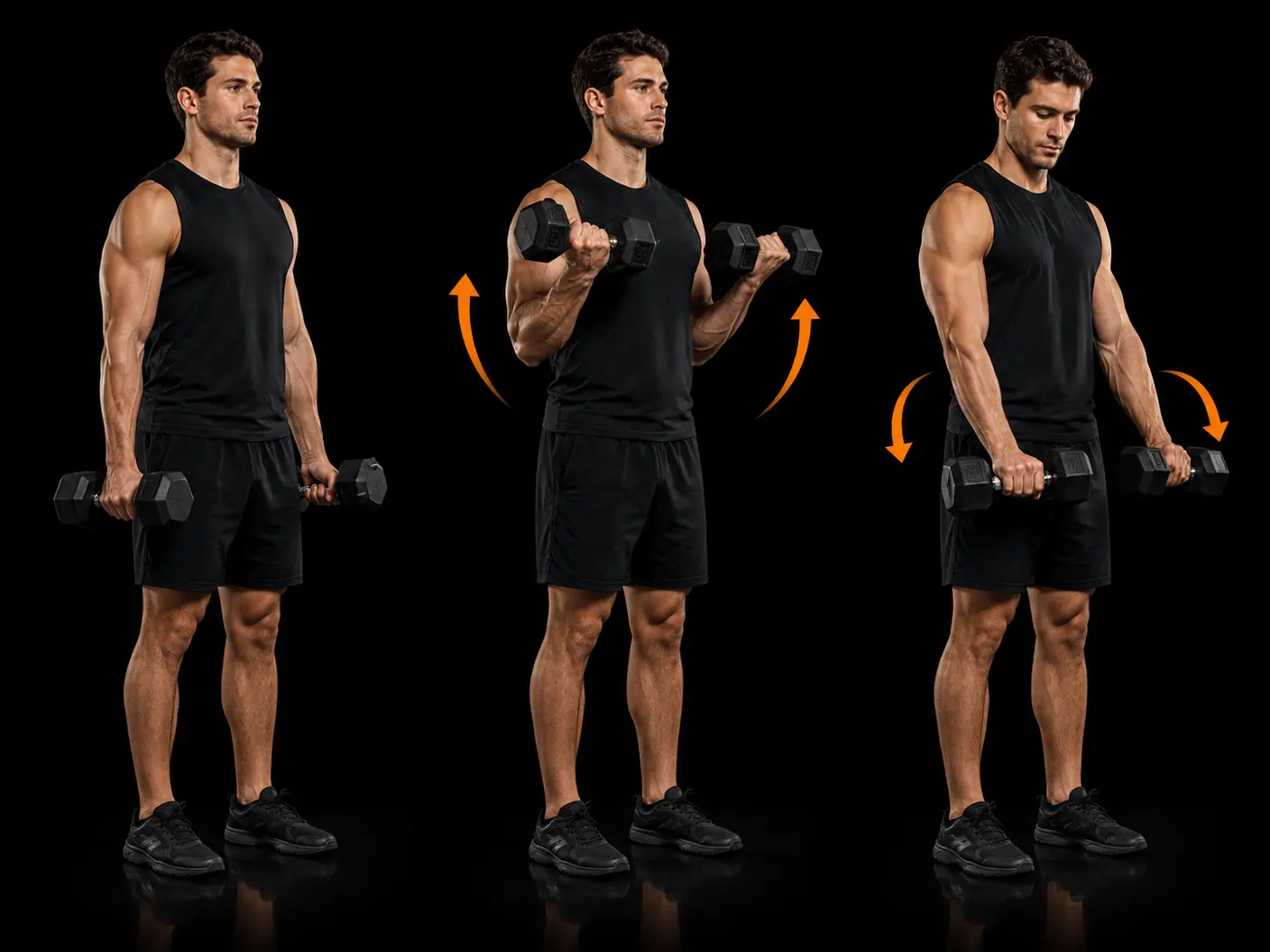
The Zottman curl is a dumbbell isolation exercise that trains both the supinated and pronated phases of elbow flexion within a single repetition. By curling up with palms facing up and lowering with palms facing down, it places meaningful load on the biceps brachii and brachioradialis across two distinct grip positions. It suits anyone looking to develop upper arm and forearm thickness with a single, time-efficient movement.
How to do it
Stand tall, dumbbells at the sides, palms forward. Curl up with supinated grip. At the top, rotate the palms to face down. Lower with this pronated grip under control. At the bottom, rotate back to supinated. Repeat.
Coaching cues
- Curl up palms up
- Rotate at the top
- Lower palms down
- Slow rotation
Why train it
- Training the eccentric lowering phase with a pronated grip directly loads the brachioradialis and forearm flexors, which are underworked in a standard dumbbell curl.
- The supinated curl upward ensures the biceps brachii remains the primary mover through the concentric phase, preserving direct bicep stimulus.
- Using one exercise to target multiple elbow flexors reduces the need for several isolation movements in a programme, making it efficient for hypertrophy-focused sessions.
- The controlled rotation at the top and bottom of each repetition reinforces wrist and forearm coordination, supporting grip strength as a secondary adaptation.
Common mistakes
- Rushing the rotation at the top — pause briefly with the dumbbells at shoulder height before rotating the palms fully to face down, ensuring the grip change is deliberate rather than sloppy.
- Using momentum to swing the dumbbells up — keep the upper arms pinned to the sides throughout so the elbow flexors, not the shoulders, drive the movement.
- Allowing the eccentric phase to become uncontrolled — the pronated lowering is where much of the forearm stimulus occurs, so take two to three seconds to return to the bottom.
- Failing to complete the full rotation at the bottom — return completely to a supinated grip before beginning the next repetition, otherwise the movement loses its defining benefit.
Primary: Biceps Brachii, Brachioradialis.
Secondary: Brachialis, Forearm Flexors.
Equipment
Good for
Easier variation
Alternating curl — supinated only; simpler pattern.
Similar movements
Frequently asked
- What muscles does the Zottman curl work?
- The primary muscles are the biceps brachii and brachioradialis. The brachialis and forearm flexors act as secondary contributors, particularly during the pronated lowering phase.
- How many sets and reps should I do for the Zottman curl?
- For hypertrophy, three to four sets of eight to twelve repetitions works well. Select a weight that allows full, controlled rotation at both ends of the movement — if the rotation becomes rushed, the load is too heavy.
- How does the Zottman curl differ from a standard dumbbell curl?
- A standard curl typically uses a supinated grip throughout, loading the biceps brachii as the dominant muscle. The Zottman curl adds a pronated eccentric phase, which shifts emphasis to the brachioradialis and forearm flexors on the way down.
- Where should I place the Zottman curl in a session?
- Programme it as an accessory movement after compound pulling exercises such as rows or pull-ups. Its isolation nature makes it best suited to the latter portion of an upper body or arm-focused session.
- Is the Zottman curl suitable for beginners?
- It is classified as a foundational movement, so it is appropriate for those early in their training. However, beginners should practise the rotation slowly with a light weight before progressing load, as grip coordination takes a few sessions to feel natural.
Want this movement in a plan built for you?
Adaptiv programmes the right exercises for your goal, equipment and experience — then adapts them as you train.
Build my programme