Cable Hammer Curl (Rope)
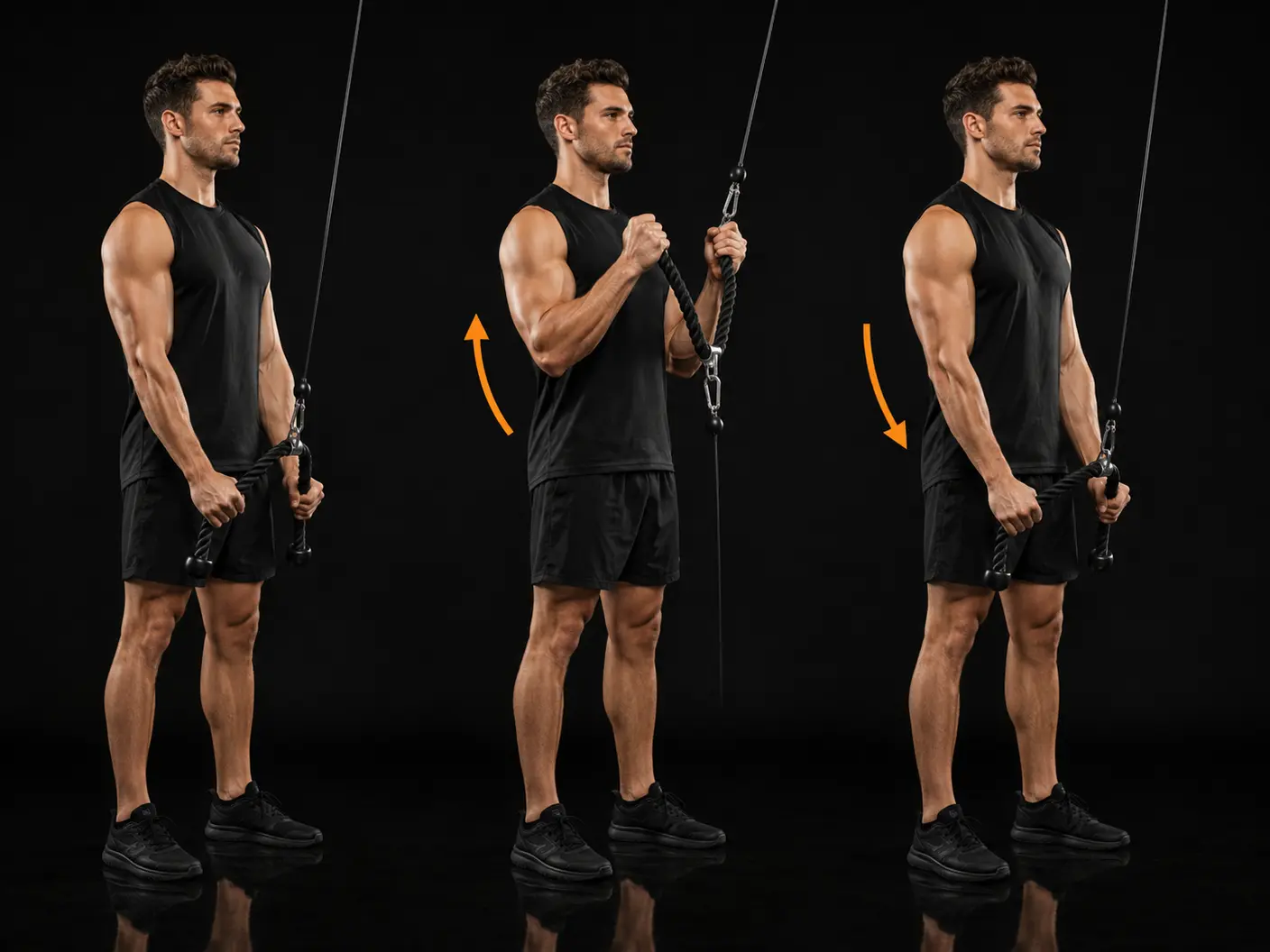
The cable hammer curl (rope) is an isolation exercise for the elbow flexors, performed at a low cable pulley with a rope attachment and a neutral, palms-facing grip throughout the full range of motion. Unlike a supinated barbell curl, the neutral grip shifts emphasis onto the brachialis and brachioradialis — the muscles that sit beneath and alongside the biceps brachii — making it a reliable choice for building arm thickness and forearm development. It suits lifters at any experience level and fits naturally into upper-body accessory work or dedicated arm training.
How to do it
Face a low cable with a rope attachment. Grip the rope with palms facing each other. Elbows tucked. Curl the rope up; pull the ends apart at the top. Pause. Lower under control.
Coaching cues
- Neutral grip
- Pull ends apart at the top
- Elbows locked
- Slow eccentric
Why train it
- The neutral grip places the brachialis under direct load throughout the curl, promoting hypertrophy in a muscle that sits beneath the biceps and contributes meaningfully to overall upper-arm size.
- The rope attachment allows you to pull the ends apart at the top of the movement, increasing tension through the brachioradialis at peak contraction.
- The cable provides continuous, consistent resistance across the entire range of motion — unlike a dumbbell, the load does not diminish at the bottom of the rep.
- A slow, controlled eccentric phase, as the form demands, maximises time under tension, which is a well-established driver of hypertrophy in isolation work.
Common mistakes
- Allowing the elbows to drift forward or flare outward — keep them fixed at the sides throughout the curl so the target muscles, not the front deltoid, do the work.
- Rushing through the lowering phase — resist the cable on the way down with a deliberate, slow eccentric rather than letting the weight drop back freely.
- Gripping the rope without pulling the ends apart at the top — actively splitting the rope at peak contraction increases tension through the brachioradialis and improves the quality of the contraction.
- Using momentum by swinging the torso — brace the core, stand tall, and initiate the movement from the elbow flexors rather than rocking the body to move the load.
Primary: Brachialis, Brachioradialis.
Secondary: Biceps Brachii.
Equipment
Good for
Easier variation
DB hammer curl — simpler setup.
Similar movements
Frequently asked
- What muscles does the cable hammer curl (rope) work?
- The primary muscles are the brachialis and brachioradialis. The biceps brachii contributes as a secondary mover but is placed at a mechanical disadvantage by the neutral grip, which is what distinguishes this exercise from a standard supinated curl.
- How many sets and reps should I do for the cable hammer curl?
- For hypertrophy — the primary goal of this exercise — three to four sets of eight to fifteen repetitions works well. Prioritise controlled technique and a slow eccentric over loading the cable heavily.
- What is the difference between a cable hammer curl and a dumbbell hammer curl?
- Both use a neutral grip and train the same muscles, but the cable maintains constant tension through the bottom of the range of motion, where a dumbbell offers very little load. This makes the cable variation particularly effective for accumulating high-quality time under tension.
- Can beginners use this exercise?
- Yes — it is rated foundational in difficulty. The rope attachment and cable stack make it straightforward to select an appropriate load, and the movement pattern is relatively simple to learn with a few practice sets at light weight.
- What exercises can I use as an alternative to the cable hammer curl (rope)?
- Dumbbell hammer curls and cross-body hammer curls are the closest alternatives, as they share the neutral grip and the same primary muscles. If a cable machine is unavailable, either dumbbell variation is a practical substitute.
Want this movement in a plan built for you?
Adaptiv programmes the right exercises for your goal, equipment and experience — then adapts them as you train.
Build my programme