Barbell Curl
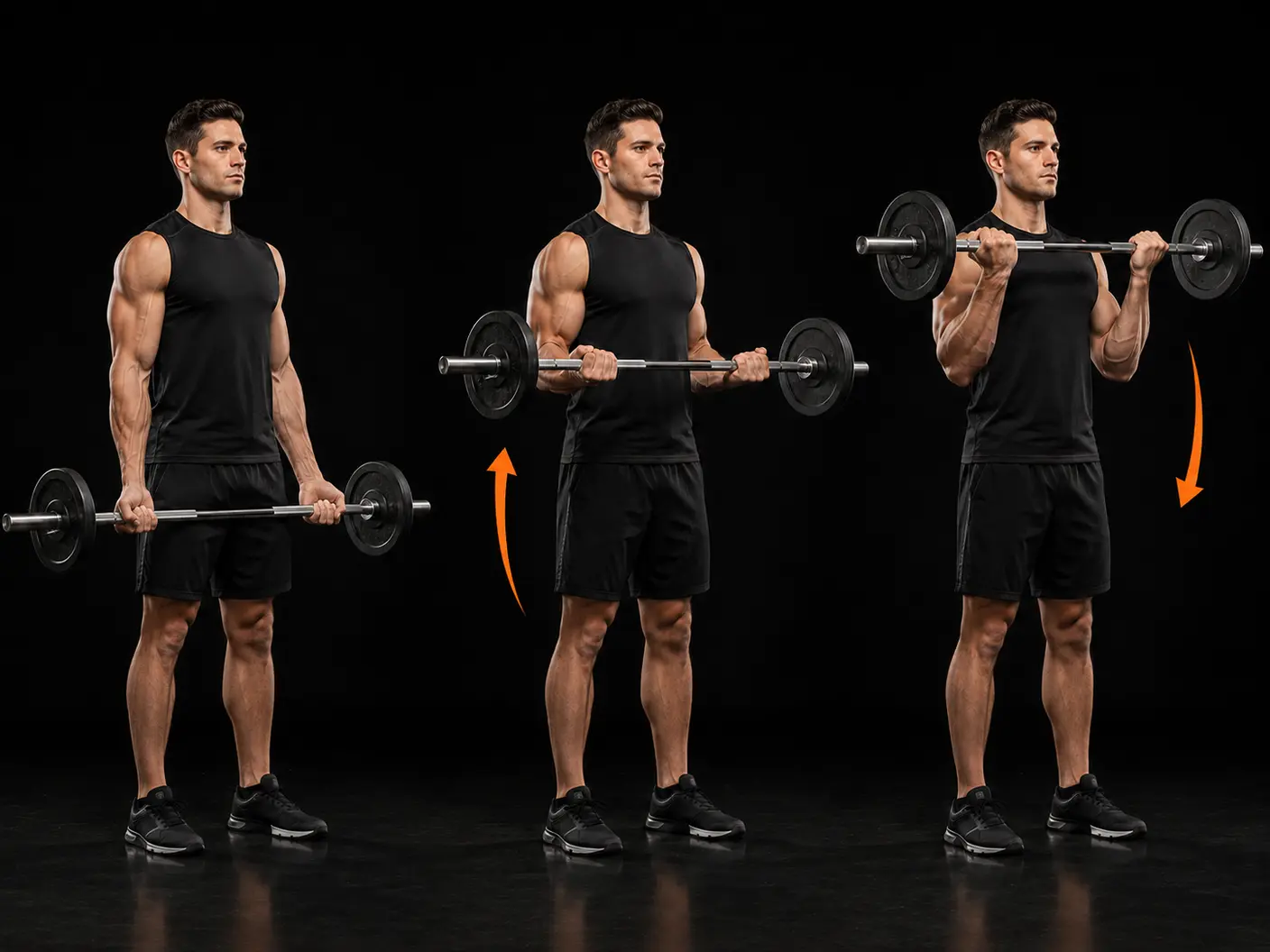
The barbell curl is a foundational isolation exercise that trains elbow flexion against a fixed, bilateral load. It targets the biceps brachii as the primary mover, with meaningful contribution from the brachialis and brachioradialis throughout the range of motion. It suits a wide range of trainees — from those building their first dedicated arm programme to experienced lifters seeking to accumulate volume on the elbow flexors with a straightforward loading progression.
How to do it
Stand tall, barbell in the hands with a shoulder-width supinated grip. Elbows tucked to the ribs. Curl the bar up by flexing the elbows; resist body english. Peak contraction at the top with the bar near the collarbones. Lower under control to a full stretch.
Coaching cues
- Elbows tucked
- No swing
- Full stretch
- Squeeze at the top
Why train it
- A straight barbell allows you to load the elbow flexors heavier than most curl variations, making it an effective choice for building upper arm strength over time.
- Training through a full range — from complete elbow extension at the bottom to peak contraction near the collarbones — maximises the stimulus on the biceps brachii across its full working length.
- The bilateral, symmetrical grip makes load management and progressive overload straightforward to track and apply from session to session.
- The brachialis sits beneath the biceps brachii and contributes meaningfully to curl strength; developing it adds thickness to the upper arm that biceps work alone cannot fully address.
Common mistakes
- Swinging the torso to initiate the rep — brace the core, keep the elbows tucked to the ribs, and let the elbow flexors do the lifting rather than using momentum.
- Letting the elbows drift forward as the bar rises — this reduces tension on the biceps at the top; keep the upper arms vertical and stationary throughout the movement.
- Cutting the range of motion short at the bottom — allow the elbows to reach full extension on every rep to ensure the biceps are loaded through their complete working length.
- Lowering the bar too quickly on the way down — control the eccentric phase deliberately, as the downward portion of the rep contributes significantly to the hypertrophic stimulus.
Primary: Biceps Brachii.
Secondary: Brachialis, Brachioradialis.
Equipment
Good for
Easier variation
EZ-bar curl — easier on the wrists.
Similar movements
Frequently asked
- What muscles does the barbell curl work?
- The barbell curl primarily trains the biceps brachii, with the brachialis and brachioradialis acting as secondary movers. All three muscles contribute to elbow flexion, though their relative involvement shifts slightly depending on grip width and forearm angle.
- How many sets and reps should I do for the barbell curl?
- For hypertrophy, three to four sets of eight to twelve reps with a load that makes the final two reps genuinely demanding is a reliable starting point. For strength-focused work, four to five sets of four to six reps at a heavier load is more appropriate, though isolation work is most commonly programmed in moderate rep ranges.
- What is the difference between the barbell curl and the dumbbell curl?
- The barbell curl fixes both hands in a pronated-neutral position and loads both arms simultaneously, which typically allows heavier absolute loads. Dumbbell curls allow each arm to work independently and permit some forearm supination during the movement, which can alter the feel of the peak contraction.
- Where should the barbell curl sit in a programme?
- It is best placed after compound pulling movements — such as rows or pull-ups — when the back and biceps have already been warmed up but the elbow flexors have not yet been taken to fatigue. Performing it earlier in an isolation block rather than last ensures you can still apply meaningful load.
- Is the barbell curl suitable for beginners?
- Yes — its difficulty is classified as foundational, meaning the movement pattern is straightforward to learn. The main technical priorities are keeping the elbows tucked, avoiding body swing, and controlling the weight on the way down, all of which can be established quickly with a conservative starting load.
Want this movement in a plan built for you?
Adaptiv programmes the right exercises for your goal, equipment and experience — then adapts them as you train.
Build my programme