Yoke Walk
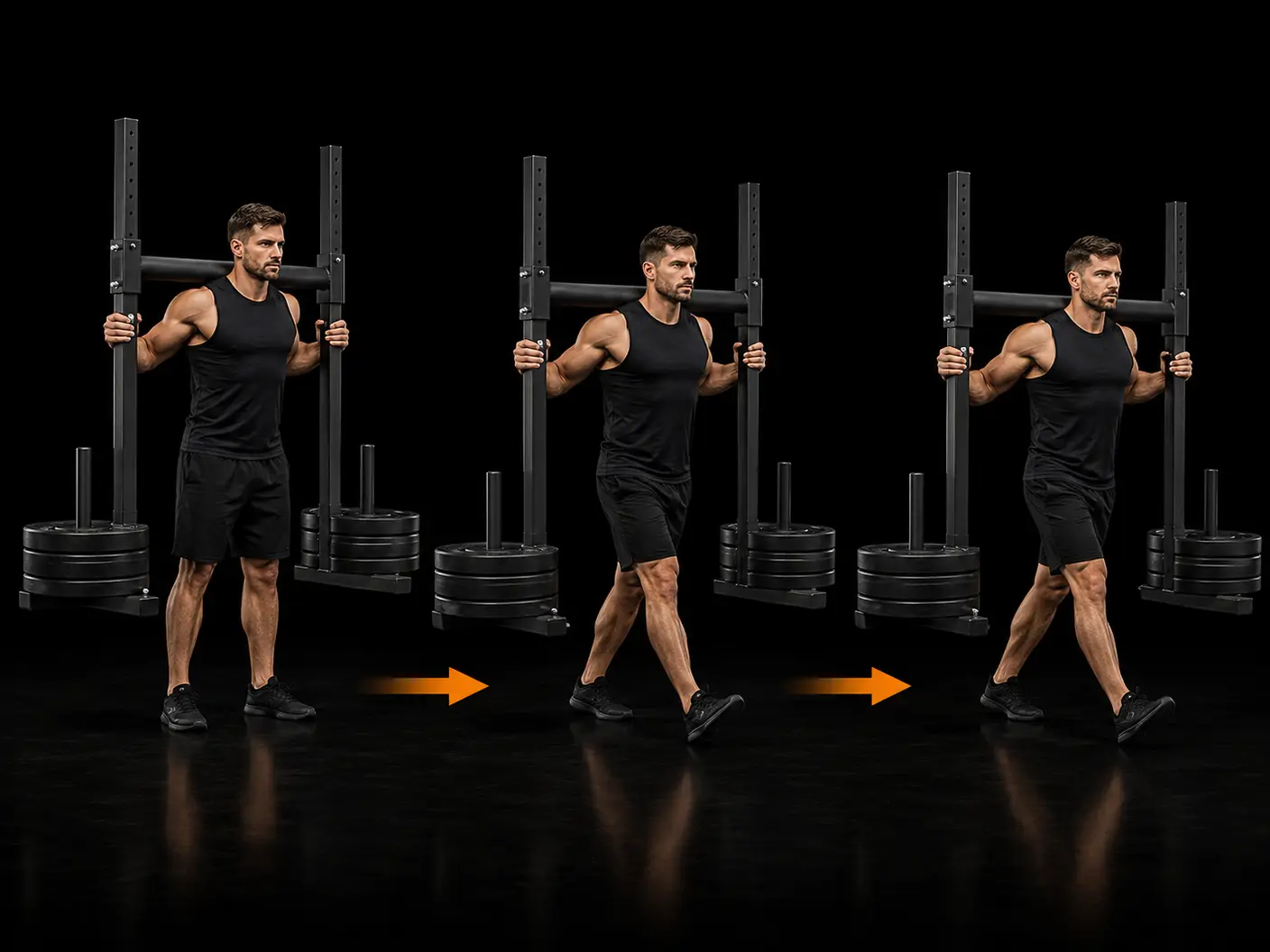
The yoke walk is a loaded carry in which the athlete supports a heavy frame across the upper traps and walks for distance, training the body to produce and maintain full-body tension under a moving load. It develops strength across all planes of the core, the lower body, and the upper back simultaneously, demanding coordination and positional control that static lifts simply cannot replicate. It suits intermediate to advanced trainees with a solid foundation in bracing and lower-body strength, and is particularly well suited to strongman athletes, rugby players, and anyone seeking to build functional carrying capacity.
How to do it
Set up under a loaded yoke with the pads on the upper traps. Walk out of the rack. Take small, controlled steps; the yoke will rock — stay tight and upright. Walk for distance.
Coaching cues
- Brace everything
- Small fast steps
- Tall posture
- Ride the rock
Why train it
- The yoke walk loads the core in all three planes of motion — sagittal, frontal, and transverse — building the kind of stabilising strength that carries over to sport and heavy compound lifts.
- Walking under a heavy, oscillating frame places substantial demand on the quads, glutes, and hamstrings, developing lower-body strength through a gait pattern rather than a fixed bilateral stance.
- The sustained load through the upper traps and erectors reinforces postural strength and resilience across the entire posterior chain during dynamic movement.
- Because the yoke rocks with each step, the athlete must continuously recalibrate tension and balance, training reactive stability and proprioception that few other exercises replicate.
Common mistakes
- Taking long, bounding strides — shorten your steps and increase cadence to reduce the amplitude of the yoke's oscillation and keep the load stable.
- Losing upper back tightness as fatigue sets in — actively retract and depress the scapulae throughout the walk to keep the pads seated firmly on the traps.
- Allowing the hips to shift laterally from side to side — drive each foot straight and maintain a narrow, purposeful gait to keep the yoke tracking linearly.
- Looking down at the ground — fix your gaze forward and maintain a tall, upright posture to reinforce a neutral spine and prevent the load from pulling you into forward lean.
Primary: Rectus Abdominis, Quadriceps, Gluteus Maximus, Trapezius.
Secondary: Hamstrings, Gastrocnemius, Erector Spinae.
Equipment
Good for
Easier variation
Trap bar carry — similar vertical load with handles.
Similar movements
Frequently asked
- What muscles does the yoke walk work?
- The primary muscles are the core across all planes, quads, glutes, and upper traps. The hamstrings, calves, and erectors provide secondary support, making it one of the most comprehensive full-body strength exercises available.
- How do I programme sets and reps for the yoke walk?
- The yoke walk is typically programmed by distance rather than reps — common prescriptions range from 10 to 20 metre runs per set, with 3 to 5 sets and full recovery between efforts. Start conservatively with load and distance, as the oscillating nature of the yoke makes it more taxing than the weight alone suggests.
- What are good alternatives to the yoke walk if I do not have access to a yoke?
- Farmer's carries and heavy barbell front rack carries are the closest accessible alternatives, as they share the demand for full-body tension during a loaded gait. Neither fully replicates the upper-trap loading or the oscillation management the yoke requires, but both build comparable carrying strength.
- Is the yoke walk suitable for building general strength or is it mainly a strongman exercise?
- While the yoke walk is a competitive strongman event, its application extends well beyond that context — it is a highly effective tool for building loaded carry strength, postural resilience, and lower-body power in any athlete who needs to move under load. It is classified as an advanced movement, so a solid base of compound strength and proficient bracing technique should be established before introducing it.
- Why does the yoke rock, and how should I deal with it?
- The rocking occurs because each step creates a lateral and longitudinal impulse through the frame, setting it in motion. The coaching cue 'ride the rock' means staying tall and absorbing that oscillation through full-body tension rather than fighting it with rigid, halting movement — small, fast steps reduce the rocking amplitude and allow the athlete to move with rather than against the yoke.
Want this movement in a plan built for you?
Adaptiv programmes the right exercises for your goal, equipment and experience — then adapts them as you train.
Build my programme