Trap Bar Carry
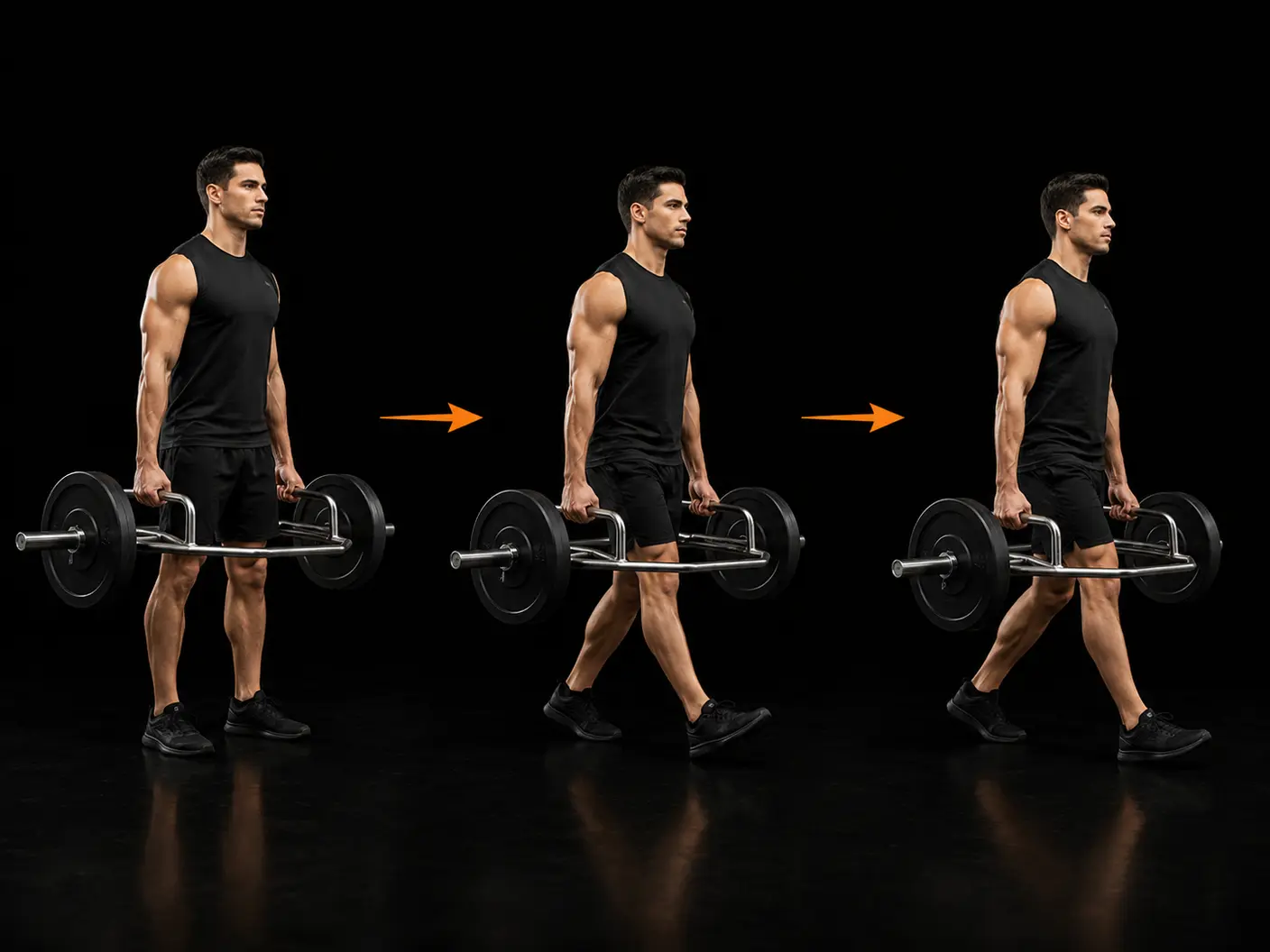
The trap bar carry is a loaded carry variation performed with a hex bar, combining a deadlift-style pick-up with a structured walk for distance or time. It trains the carry movement pattern, demanding coordinated effort from the grip, upper traps, and core to maintain upright posture under load. The centred, symmetrical loading of the trap bar makes it a practical choice for intermediate lifters developing functional strength and athletic capacity.
How to do it
Step inside the trap bar and deadlift the weight to a standing position. Walk forward for a set distance or time, maintaining an upright posture. The neutral handles are comfortable on the hands and shoulders; the centred loading is more symmetrical than a farmer's walk with separate implements. Set the weight down carefully.
Coaching cues
- Tall posture
- Crush the handles
- Steady stride
- Long spine
Why train it
- The neutral handles and centred weight distribution reduce asymmetrical stress on the hands and shoulders, making it more accessible than a traditional farmer's walk with separate implements.
- Sustained grip demand across the full distance directly develops forearm flexor and grip strength, which transfers to pulling movements and sport performance.
- Walking under a heavy load challenges the upper traps and core to stabilise the spine continuously, building postural endurance that supports both training and daily movement.
- The movement suits a wide range of training goals — from general fitness to athletic performance — and can be programmed by distance, time, or load with minimal technical complexity.
Common mistakes
- Allowing the torso to lean forward — brace the core, set a long spine, and keep the chest tall throughout the walk.
- Taking short, shuffling steps — use a steady, controlled stride that keeps the load stable and maintains natural gait mechanics.
- Gripping too loosely and allowing the bar to shift in the hands — squeeze the handles firmly from the moment you lift to the moment you set down.
- Dropping the weight rather than lowering it with control — hinge at the hips and return the bar to the floor with the same mechanics used to pick it up.
Primary: Forearm Flexors, Trapezius.
Secondary: Rectus Abdominis, Gluteus Maximus, Gastrocnemius.
Equipment
Good for
Easier variation
Farmer's Walk with lighter implements — easier to load progressively.
Similar movements
Frequently asked
- What muscles does the trap bar carry work?
- The primary muscles are the forearm flexors, grip, and upper traps. The core, glutes, and calves work as secondary stabilisers to maintain posture and drive each stride.
- How many sets and reps should I programme for a trap bar carry?
- Because the exercise is measured by distance or time rather than reps, a practical starting point is three to four sets of 20–40 metres or 20–30 seconds, resting fully between efforts. Adjust load and distance based on whether your goal is strength or conditioning.
- What is the difference between a trap bar carry and a farmer's walk?
- The trap bar centres the load around your body rather than placing it at your sides with separate implements, which produces more symmetrical loading and is generally easier to balance. The trap bar carry is often a useful entry point before progressing to the farmer's walk with dumbbells or farmer's walk handles.
- Is the trap bar carry suitable for building grip strength?
- Yes — the sustained isometric demand on the hands and forearms across the full set makes it an effective grip developer, particularly when load or distance is progressively increased over time.
- Can beginners use the trap bar carry?
- The exercise is classed as intermediate, primarily because it requires a competent trap bar deadlift before adding the walking component. If you are comfortable picking up and setting down a trap bar with sound technique, the carry itself is not technically complex to learn.
Want this movement in a plan built for you?
Adaptiv programmes the right exercises for your goal, equipment and experience — then adapts them as you train.
Build my programme