Farmer's Walk (Heavy)
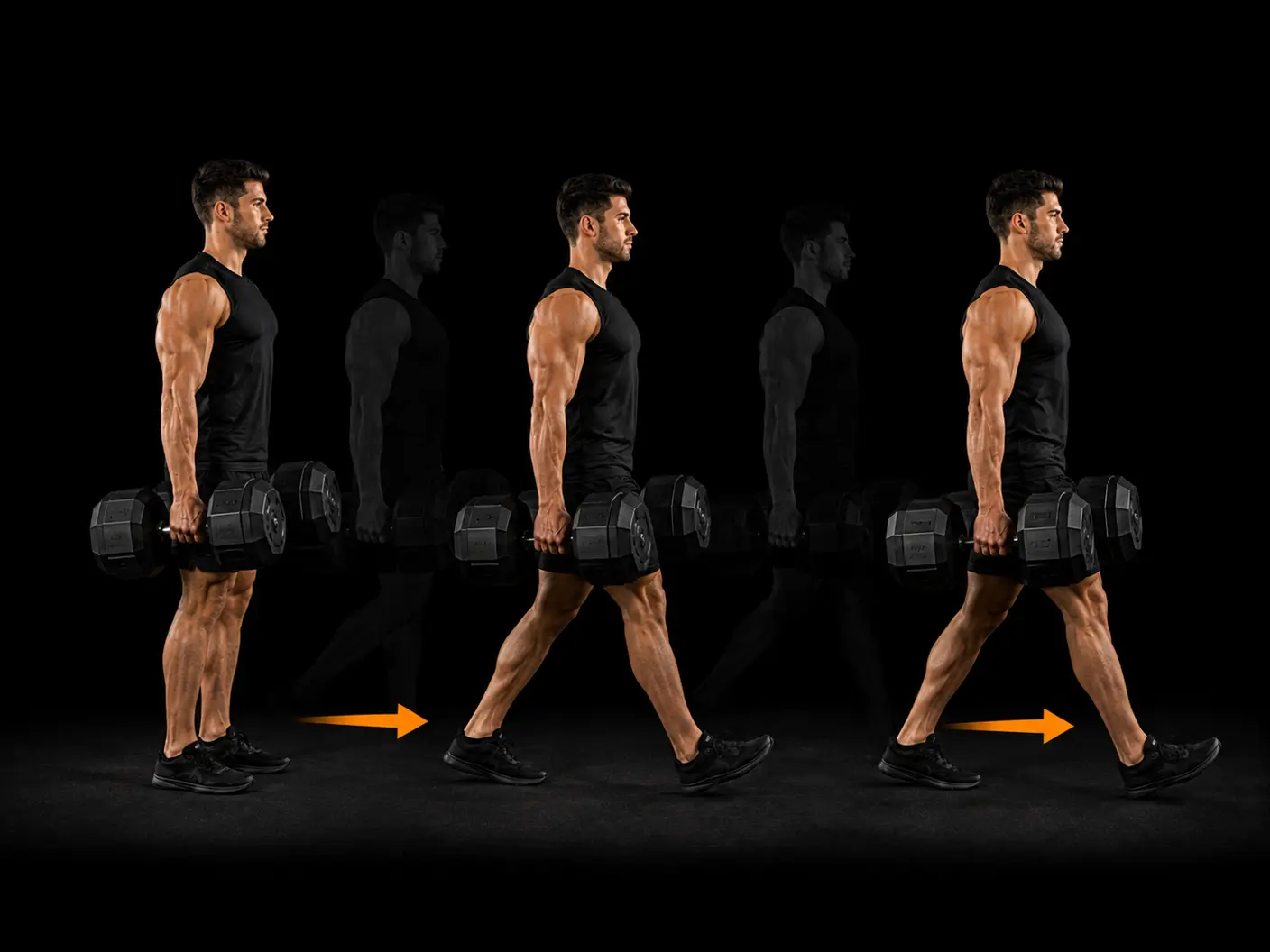
The farmer's walk is a loaded carry in which the athlete picks up heavy implements — farmer's handles or heavy dumbbells — and walks a set distance under maximal grip demand. It trains the carry pattern, challenging grip strength, upper trap stability, and whole-body tension simultaneously. It suits intermediate lifters looking to build functional strength and athletic capacity that transfers directly to sport and general physical preparedness.
How to do it
Load the farmer's handles heavy — close to max single-effort. Stand tall; pick up with a deadlift pattern. Walk for shorter distances (10–30 metres) with max-effort grip.
Coaching cues
- Crush the handles
- Tall posture
- Steady stride
- Accept the grip burn
Why train it
- Heavy farmer's walks develop grip and forearm strength that is difficult to replicate with isolation exercises, making them a highly efficient addition to any strength programme.
- The movement demands co-ordinated effort from the glutes, quads, and core across all planes, reinforcing full-body tension during locomotion.
- Upper trap engagement throughout the carry builds the postural resilience needed to stabilise loads during competition lifts and field sport demands.
- Short, near-maximal distances make farmer's walks time-efficient for developing athletic performance without excessive fatigue accumulation.
Common mistakes
- Rounding the upper back on the pick-up — initiate with a deadlift pattern, bracing the lats and keeping the chest tall before you take your first step.
- Letting the torso lean or rotate with each stride — maintain tall, upright posture throughout and keep the steps controlled and even.
- Gripping the implement loosely when the forearms begin to fatigue — maintain full grip pressure for the duration of the carry, accepting the burn as part of the training stimulus.
- Taking overly long strides to cover distance faster — shorten your stride and prioritise postural stability over speed, particularly as load increases.
Primary: Forearm Flexors, Trapezius.
Secondary: Rectus Abdominis, Gluteus Maximus, Quadriceps.
Equipment
Good for
Easier variation
Moderate-load farmer's walk for distance.
Similar movements
Frequently asked
- What muscles does the farmer's walk work?
- The primary muscles loaded are the grip, forearms, and upper traps. The glutes, quads, and core across all planes contribute as secondary movers to maintain posture and drive locomotion.
- How heavy should I go on a farmer's walk?
- For this variation, the intent is near-maximal loading — close to a single-effort maximum for the carry distance. Distances of 10 to 30 metres are appropriate at this intensity, allowing you to sustain posture and grip without technique breaking down.
- How many sets and reps should I do?
- Farmer's walks are typically programmed by distance rather than reps. Two to four sets of 10 to 30 metres at a heavy load suits a strength or athletic performance goal, with full recovery between sets to maintain grip quality.
- Can the farmer's walk replace deadlifts in a programme?
- The two movements complement rather than replace each other — the deadlift trains maximal hip hinge force production, while the farmer's walk develops grip endurance, postural stability under load, and moving strength. Most well-structured programmes include both.
- Are farmer's walks suitable if I have wrist or shoulder concerns?
- If you have a pre-existing wrist, shoulder, or lower back concern, check with a qualified professional before loading this movement heavily, as it places significant demand on grip, the shoulder girdle, and spinal stability throughout the carry.
Want this movement in a plan built for you?
Adaptiv programmes the right exercises for your goal, equipment and experience — then adapts them as you train.
Build my programme