Farmer's Walk
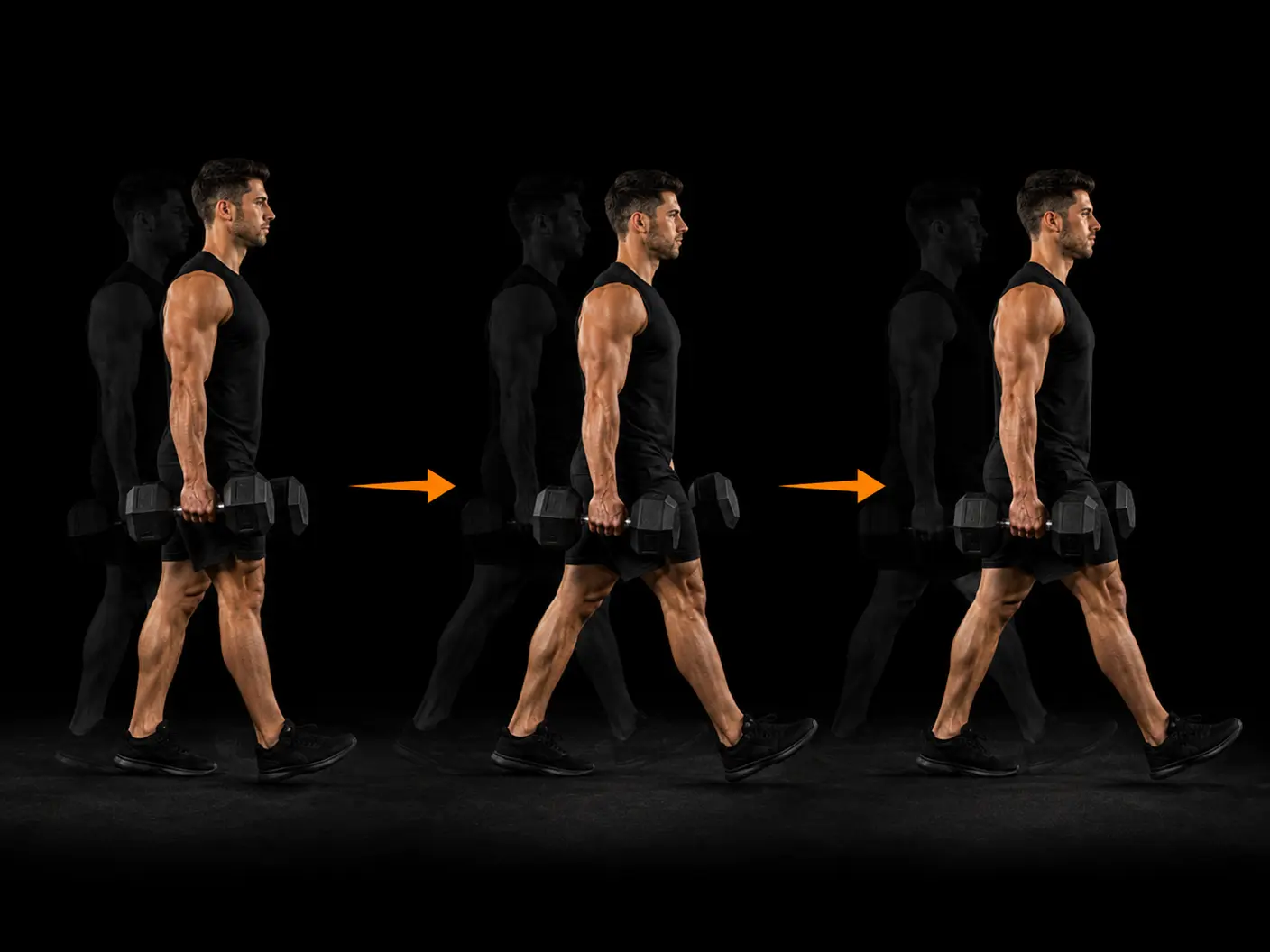
The farmer's walk is a loaded carry in which the lifter picks up heavy implements — dumbbells, a trap bar, or dedicated farmer's handles — and walks a set distance or duration whilst maintaining an upright posture and braced core. It trains the body's ability to stabilise under load during locomotion, making it one of the more practical expressions of strength available in a training programme. It suits intermediate trainees who have a baseline of postural control and grip strength, as well as athletes seeking to bridge the gap between gym strength and real-world performance.
How to do it
Pick up heavy implements at the sides. Stand tall with a braced core and neutral spine. Walk with small, controlled steps; do not let the implements swing. Walk for distance or time.
Coaching cues
- Tall posture
- Crush the handles
- Small controlled steps
- Breathe steady
Why train it
- The farmer's walk develops grip strength and forearm endurance simultaneously, which carries over to pulling movements such as deadlifts and rows.
- Walking under load places sustained demand on the upper traps, core, glutes, quads, and calves, making it an efficient compound stimulus for a wide range of muscle groups in a single exercise.
- Because it can be programmed for distance, time, or load, it scales readily across goals — from general fitness and fat loss through to sport-specific conditioning and maximal strength work.
- The movement reinforces upright posture and core bracing under real compressive load, qualities that transfer directly to both athletic performance and everyday carrying tasks.
Common mistakes
- Letting the shoulders round forward — retract and depress the scapulae before you lift and maintain that position throughout the walk.
- Allowing the implements to swing away from the body — keep them close to your sides with a firm grip so load stays centred and posture is not compromised.
- Taking long, overreaching strides — use short, controlled steps to maintain balance and prevent the torso from shifting laterally with each footfall.
- Holding the breath for the duration of the set — breathe steadily throughout, inhaling and exhaling in a controlled rhythm without releasing the brace in the abdominals.
Primary: Forearm Flexors, Trapezius.
Secondary: Rectus Abdominis, Gluteus Maximus, Quadriceps, Gastrocnemius.
Equipment
Good for
Easier variation
Suitcase carry — one hand at a time for anti-lateral flexion.
Similar movements
Frequently asked
- What muscles does the farmer's walk work?
- The primary muscles trained are the forearms, grip, and upper traps. Secondary muscles recruited to stabilise and propel the body include the core, glutes, quads, and calves, making it a genuinely full-body carry pattern.
- How many sets and reps should I do for the farmer's walk?
- Because the movement is measured in distance or time rather than reps, a common starting point is three to four sets of 20–40 metres, or 20–40 seconds, with two to three minutes of rest between sets. Adjust load and duration based on your primary goal — shorter, heavier sets favour strength; longer, moderate-load sets suit conditioning or fat loss.
- What equipment do I need for the farmer's walk?
- The movement can be performed with dumbbells, a trap bar, or dedicated farmer's walk handles. Dumbbells are the most accessible option for those training in a commercial gym, whilst farmer's handles allow heavier loading and a more traditional grip position if they are available.
- Is the farmer's walk suitable for fat loss?
- Yes — the combination of heavy loading, full-body muscle recruitment, and continuous movement creates a significant metabolic demand, which makes it a practical choice within a fat-loss programme when paired with appropriate nutrition and overall training volume.
- What are good alternatives to the farmer's walk?
- If the farmer's walk is not feasible due to space or equipment constraints, suitcase carries (a single implement held at one side) or trap bar deadlift holds are reasonable alternatives that challenge grip and postural stability in a comparable way.
Want this movement in a plan built for you?
Adaptiv programmes the right exercises for your goal, equipment and experience — then adapts them as you train.
Build my programme