Suitcase Carry
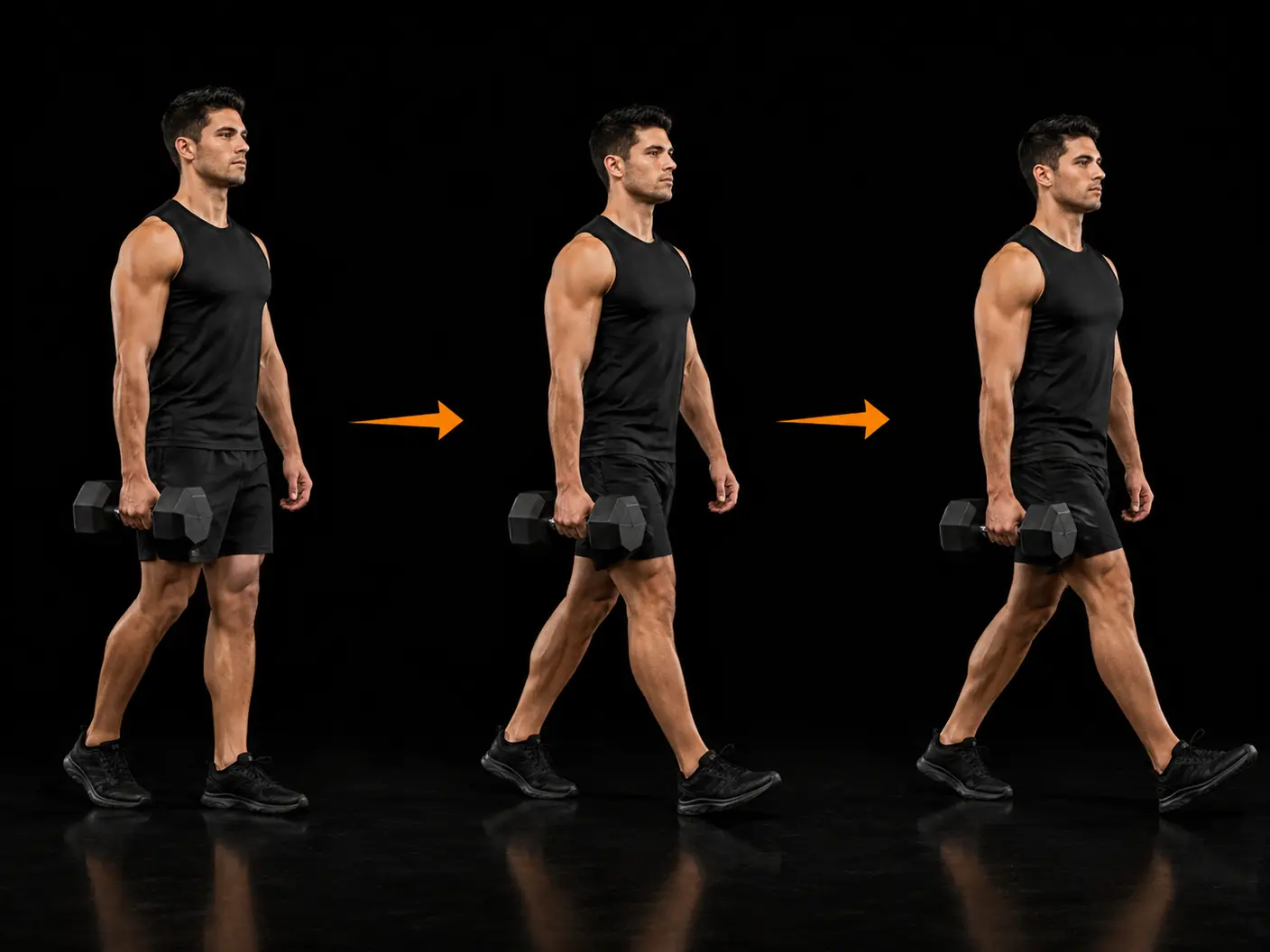
The suitcase carry is a loaded unilateral walking exercise in which a single dumbbell or kettlebell is held at one side while the torso resists lateral flexion throughout the movement. It trains anti-lateral flexion — the ability to prevent the spine from bending sideways under an asymmetrical load — making it a direct challenge to the obliques and quadratus lumborum. It suits intermediate trainees looking to build functional core strength, improve gait stability, or develop the kind of carrying capacity that transfers to sport and everyday life.
How to do it
Pick up a heavy weight in one hand. Stand tall. Resist any side bending — torso stays perfectly upright. Walk for distance or time. Switch sides.
Coaching cues
- Stay tall
- Resist side bend
- Steady stride
- Breathe steady
Why train it
- It develops genuine anti-lateral core strength by forcing the obliques and QL to work isometrically against a real asymmetrical load, rather than through isolated flexion exercises.
- The single-sided loading integrates grip, trap, and glute involvement simultaneously, making it an efficient compound stimulus across multiple muscle groups in a single movement.
- Carrying under load reinforces upright posture and steady gait mechanics, qualities that transfer directly to athletic performance and general physical resilience.
- It scales easily by adjusting the load or duration, making it a practical addition to general fitness programmes as well as strength and conditioning blocks.
Common mistakes
- Allowing the torso to lean away from the load — brace the obliques and keep the shoulders level throughout the entire walk, as if balancing a glass of water on your head.
- Shrugging the loaded shoulder upward — let the arm hang naturally and keep the trap relaxed, resisting the urge to hitch the weight higher.
- Taking rushed or uneven strides — maintain a deliberate, steady pace so the challenge remains in resisting lateral displacement rather than compensating with momentum.
- Holding the breath through the set — breathe steadily and rhythmically, as sustained intra-abdominal pressure over a longer carry requires controlled breathing rather than a single brace.
Primary: Obliques, Quadratus Lumborum.
Secondary: Forearm Flexors, Gluteus Maximus, Trapezius.
Equipment
Good for
Easier variation
Lighter weight or shorter distance — reduces demand.
Similar movements
Frequently asked
- What muscles does the suitcase carry work?
- The primary muscles are the obliques and quadratus lumborum, which resist lateral bending throughout the carry. The grip, glutes, and traps work as secondary contributors to stabilise the load and maintain upright posture.
- How many sets and reps should I do for the suitcase carry?
- Because this is a distance or time-based movement, a practical starting point is 3 sets of 20–30 metres per side, or 30–45 seconds per side, with a load that makes maintaining a perfectly upright torso genuinely challenging. Increase load or distance progressively as technique becomes consistent.
- What is the difference between a suitcase carry and a farmer's carry?
- A farmer's carry uses a weight in each hand, creating a bilateral and more symmetrical loading demand. The suitcase carry uses only one hand, which introduces an asymmetrical pull that specifically targets the anti-lateral core muscles on the opposite side of the load.
- Can the suitcase carry improve athletic performance?
- Yes — resisting lateral spinal flexion under load mirrors many real-world and sporting demands, from sprinting and changing direction to carrying equipment. Strengthening this pattern can improve force transfer and postural control during dynamic movement.
- Is the suitcase carry suitable for beginners?
- It is classed as an intermediate movement because it requires sufficient body awareness to maintain a perfectly upright torso under an asymmetrical load. Beginners would benefit from first developing basic core stability through less complex exercises before progressing to loaded carries.
Want this movement in a plan built for you?
Adaptiv programmes the right exercises for your goal, equipment and experience — then adapts them as you train.
Build my programme