Side Plank
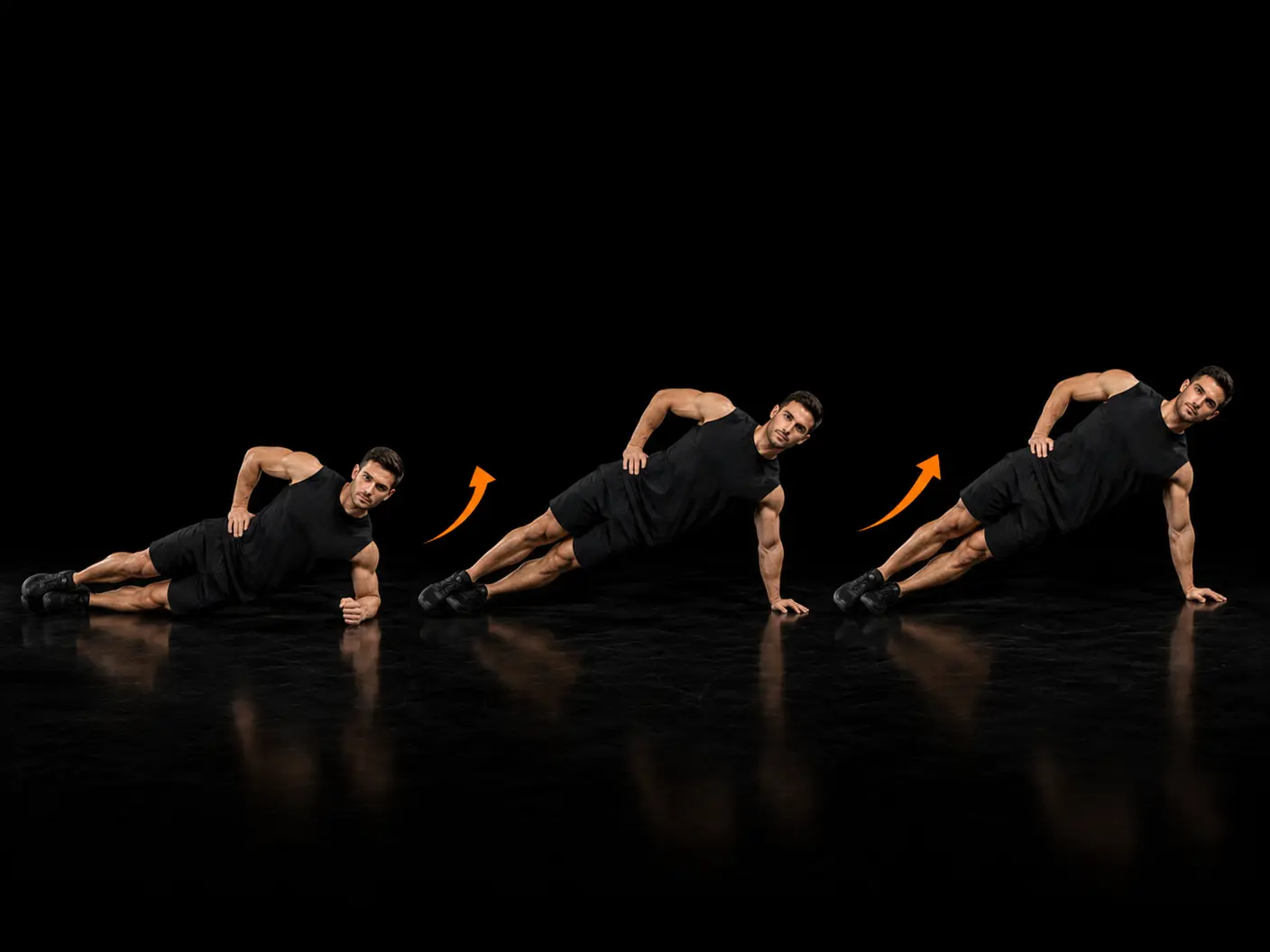
The side plank is a static, bodyweight hold that trains anti-lateral flexion — the ability to resist the spine bending sideways under load. Performed by bracing from a side-lying position with the hips elevated and the body forming a straight line, it develops lateral core stiffness that underpins most sport and daily movement. It suits everyone from beginners establishing foundational stability to athletes reinforcing the lateral chain.
How to do it
Lie on one side, elbow directly under the shoulder, feet stacked. Lift the hips off the floor; create a straight line from head to feet. Top hand on the hip or extended overhead. Hold for time.
Coaching cues
- Stacked feet
- Straight line
- Hips high
- Steady breathing
Why train it
- It directly strengthens the obliques and quadratus lumborum, muscles responsible for keeping the spine stable when forces pull it sideways.
- Because it is a static hold requiring no equipment, it can be programmed into any session as a warm-up, accessory, or cool-down movement without additional loading.
- The recruitment of the glute medius during the hold means it contributes to hip stability, which supports single-leg movements such as running and lunging.
- As a foundational pattern, it builds the lateral stiffness needed to safely progress to more complex loaded carries and rotational exercises.
Common mistakes
- Allowing the hips to sag toward the floor — actively drive the hips upward and maintain a straight line from head to feet throughout the hold.
- Rotating the torso so the chest faces downward — keep the body stacked vertically by engaging the obliques and pointing the top shoulder directly overhead.
- Protracting the shoulder of the supporting arm — actively pack the shoulder blade down and back so the joint is stable rather than passive.
- Holding the breath to compensate for insufficient bracing — breathe steadily and rhythmically, allowing the core to remain engaged without relying on intra-abdominal pressure alone.
Primary: Obliques, Quadratus Lumborum.
Secondary: Gluteus Medius, Anterior Deltoid.
Equipment
Good for
Easier variation
Side plank on knees — reduces lever arm.
Similar movements
Frequently asked
- What muscles does the side plank work?
- The primary muscles are the obliques and quadratus lumborum, which resist lateral flexion of the spine. The glute medius and shoulder musculature work as secondary stabilisers throughout the hold.
- How long should I hold a side plank?
- For general fitness, accumulating 20–45 seconds per side is a practical starting point; athletes or more advanced trainees may work toward 60 seconds or beyond. Quality of position matters more than duration — reduce the hold time before form deteriorates.
- How do I make the side plank easier or harder?
- To reduce difficulty, perform the hold with the bottom knee on the floor rather than stacking the feet. To increase demand, extend the top arm overhead, add a hip abduction by raising the top leg, or incorporate a slow hip dip to introduce movement.
- How many sets should I do per session?
- Two to three sets per side is sufficient for most programmes. Rest 30–60 seconds between sides and ensure the quality of the position is consistent across all sets before extending duration or adding variation.
- Is the side plank suitable if I have lower back discomfort?
- The side plank is often used in rehabilitation contexts because it loads the lateral core without placing compressive flexion forces on the lumbar spine, but if you are managing a specific back condition you should consult a qualified professional before including it in your programme.
Want this movement in a plan built for you?
Adaptiv programmes the right exercises for your goal, equipment and experience — then adapts them as you train.
Build my programme