Offset Dumbbell Carry
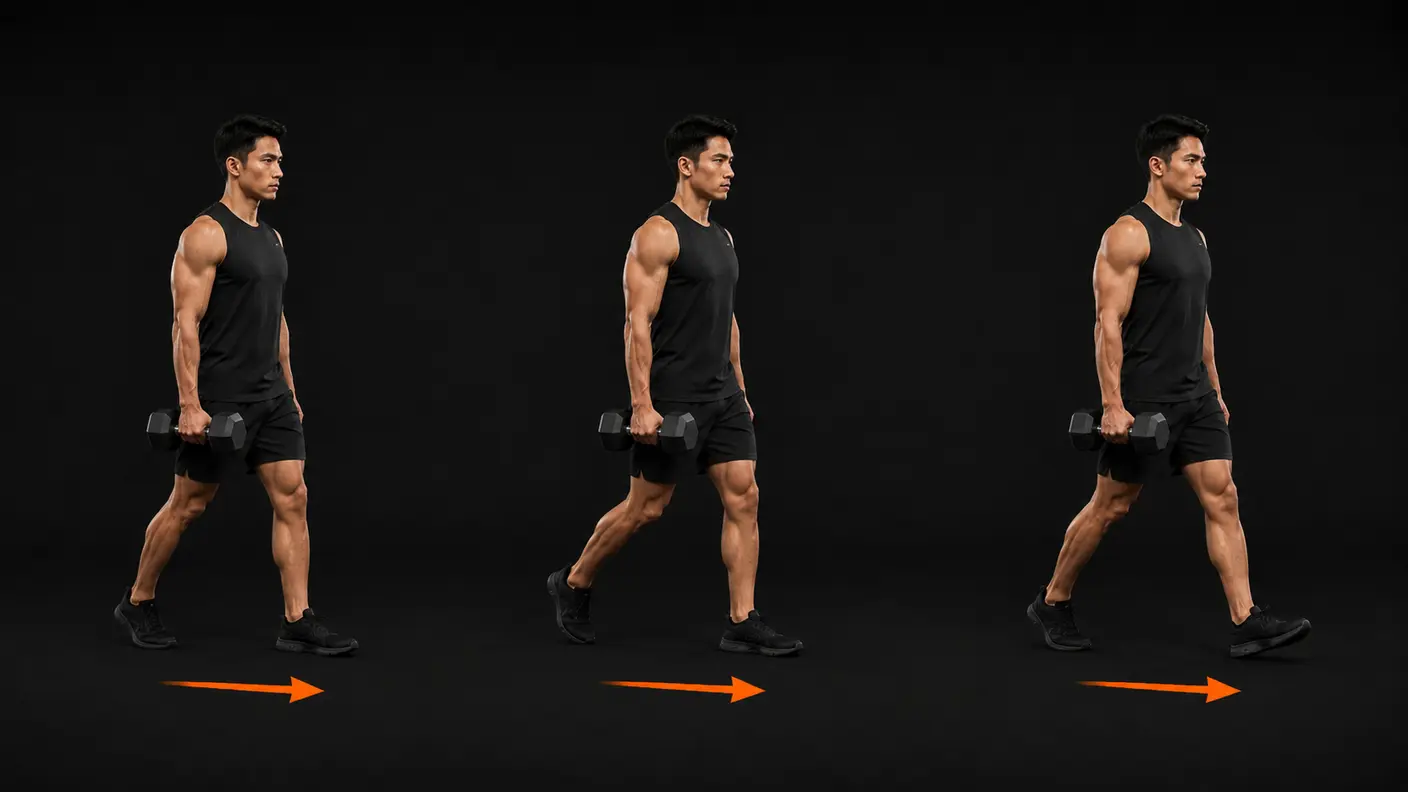
The offset dumbbell carry is a unilateral loaded carry performed with a single dumbbell or kettlebell held in one hand while walking for a set distance or time. The asymmetric load forces the obliques and quadratus lumborum to work continuously against lateral flexion, making the anti-lateral demand significantly greater than a bilateral farmer's walk. It suits intermediate trainees looking to address lateral core strength, improve postural control under load, or add functional carry work to a general fitness or athletic performance programme.
How to do it
Pick up a single dumbbell or kettlebell in one hand. Stand tall. Resist the urge to lean toward the loaded side — the torso stays perfectly upright. Walk for a set distance or time, maintaining posture. Switch sides and repeat. The asymmetric load creates a greater anti-lateral flexion demand than a bilateral farmer's walk.
Coaching cues
- Stay tall
- No side bend
- Steady stride
- Crush the handle
Why train it
- The asymmetric load places a sustained anti-lateral flexion demand on the obliques and quadratus lumborum that bilateral carries simply cannot replicate.
- Carrying a single implement requires the grip, traps, and glutes to work in coordination, making it an efficient compound stimulus across multiple muscle groups in a single drill.
- Because the pattern is walked rather than stationary, it trains the core to stabilise dynamically across a stride cycle, which transfers well to sport and everyday movement demands.
- The exercise scales easily by adjusting load or distance, making it a practical addition to both strength-focused and general fitness training blocks.
Common mistakes
- Leaning toward the loaded side — keep the torso perfectly upright throughout the walk, as any lateral tilt reduces the anti-lateral flexion demand and reinforces the pattern you are trying to resist.
- Shortening the stride or shuffling — maintain a steady, normal stride length so the core is challenged across a realistic gait pattern rather than a cautious shuffle.
- Gripping the implement loosely — a firm grip on the handle helps maintain tension through the arm and shoulder, which supports postural stability throughout the carry.
- Rushing through the set distance — walk at a controlled, even pace that allows you to monitor torso position; speed compromises posture and reduces the quality of the stimulus.
Primary: Obliques, Quadratus Lumborum.
Secondary: Forearm Flexors, Gluteus Maximus, Trapezius, Rectus Abdominis.
Equipment
Good for
Easier variation
Suitcase carry with a lighter load — reduce the weight to maintain strict form.
Similar movements
Frequently asked
- What muscles does the offset dumbbell carry work?
- The primary muscles are the obliques and quadratus lumborum, which resist lateral flexion throughout the walk. Secondary contributors include the grip, glutes, traps, and broader core musculature, all of which work to maintain upright posture and a stable stride.
- How many sets and reps should I do for offset dumbbell carries?
- Because the exercise is distance- or time-based, a practical starting point is three to four sets of 20–30 metres per side, or 20–30 seconds per side, with full recovery between sets. Adjust load and volume based on your overall training block and how the movement fits within your session.
- What is the difference between an offset carry and a farmer's walk?
- A farmer's walk typically uses equal loads in both hands, distributing the lateral demand symmetrically. The offset carry uses a single implement, which creates an uneven pull on the trunk and forces the opposite-side lateral flexors to work considerably harder to keep the torso upright.
- Is the offset dumbbell carry suitable for building core strength?
- Yes — because the obliques and quadratus lumborum must sustain tension against a meaningful load across a full carry distance, it is an effective stimulus for lateral core strength. It complements rotational and anti-rotation exercises well within a balanced core programme.
- What are good alternatives if I do not have a dumbbell or kettlebell?
- A single loaded farmers carry handle, a heavy bag gripped in one hand, or a suitcase carry with any suitably weighted implement will replicate the offset loading pattern. The key variable is the asymmetric load, not the specific piece of equipment.
Want this movement in a plan built for you?
Adaptiv programmes the right exercises for your goal, equipment and experience — then adapts them as you train.
Build my programme