Copenhagen Plank
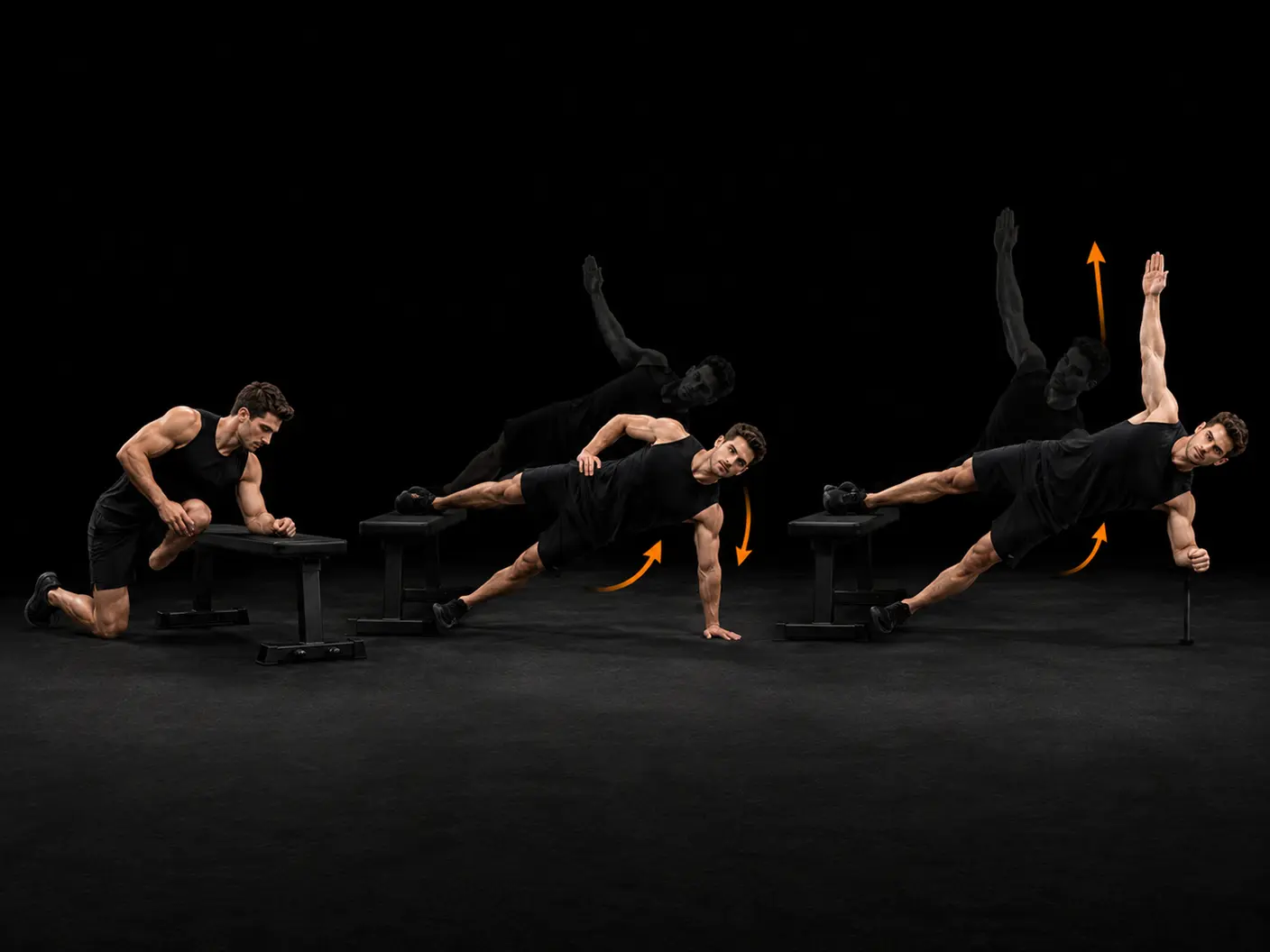
The Copenhagen plank is a side-supported isometric hold in which the top leg drives into a bench to elevate the body, training the adductors and obliques under significant lateral anti-flexion demand. Unlike a standard side plank, the load through the inner thigh makes this one of the most direct adductor-strengthening positions available with minimal equipment. It suits intermediate trainees who have already established a solid foundation in conventional core work and are looking to address hip and lateral trunk stability.
How to do it
Lie on one side with the top leg resting on a bench (ankle or knee on the bench). Push up into a side plank using the top leg only; the bottom leg hangs or rests lightly. Hold for time.
Coaching cues
- Drive the top leg into the bench
- Hips high
- Squared torso
- Breathe steady
Why train it
- The position places the adductors under sustained isometric load, making it an efficient choice for building inner-thigh strength that transfers to running, cutting, and change-of-direction tasks.
- Training the obliques to resist lateral flexion helps reinforce spinal alignment during compound lifts and unilateral movements alike.
- The exercise requires no complex set-up — a standard bench and bodyweight are sufficient, keeping it accessible within a broad range of training environments.
- Holding the position for time builds local muscular endurance in the hip and trunk stabilisers, which supports long-duration athletic output and postural control.
Common mistakes
- Letting the hips sag toward the floor — consciously drive the top leg into the bench to keep the hips elevated and the spine in a neutral lateral line.
- Rotating the torso toward or away from the floor — maintain a squared chest position throughout the hold so the obliques, not momentum, are managing the load.
- Placing too much of the work through the bottom foot — the bottom leg should hang or rest only lightly, ensuring the top leg and adductor are the primary drivers.
- Holding the breath — breathe steadily throughout the hold, as breath-holding artificially inflates core pressure and masks genuine stability capacity.
Primary: Adductors, Obliques.
Secondary: Gluteus Medius, Rectus Abdominis.
Equipment
Good for
Easier variation
Short-lever Copenhagen (knee on bench) — reduces adductor demand.
Similar movements
Frequently asked
- What muscles does the Copenhagen plank work?
- The primary muscles are the adductors of the top leg and the obliques on the working side. The glute medius and broader core musculature act as secondary stabilisers throughout the hold.
- How long should I hold a Copenhagen plank?
- For most intermediate trainees, sets of 20–40 seconds per side are a practical starting point, accumulated across 2–4 sets. Progress by extending hold duration before adding elevation or weighted variations.
- Is the ankle or the knee on the bench — which is harder?
- Resting the ankle on the bench creates a longer lever arm, placing considerably greater demand on the adductor and oblique than resting at the knee. Begin with the knee on the bench if you are new to the movement and progress to ankle placement as strength develops.
- Can the Copenhagen plank help with groin injury prevention?
- There is reasonable evidence in sports science literature that adductor strengthening exercises in this family are associated with reduced groin injury rates in field sport athletes. If you have an existing groin complaint, check with a qualified professional before programming this movement.
- What are good alternatives if I do not have a bench?
- A sturdy chair, a stacked set of weight plates, or a low box can substitute for the bench provided the surface is stable and at an appropriate height for your limb length.
Want this movement in a plan built for you?
Adaptiv programmes the right exercises for your goal, equipment and experience — then adapts them as you train.
Build my programme