Adductor Squeeze
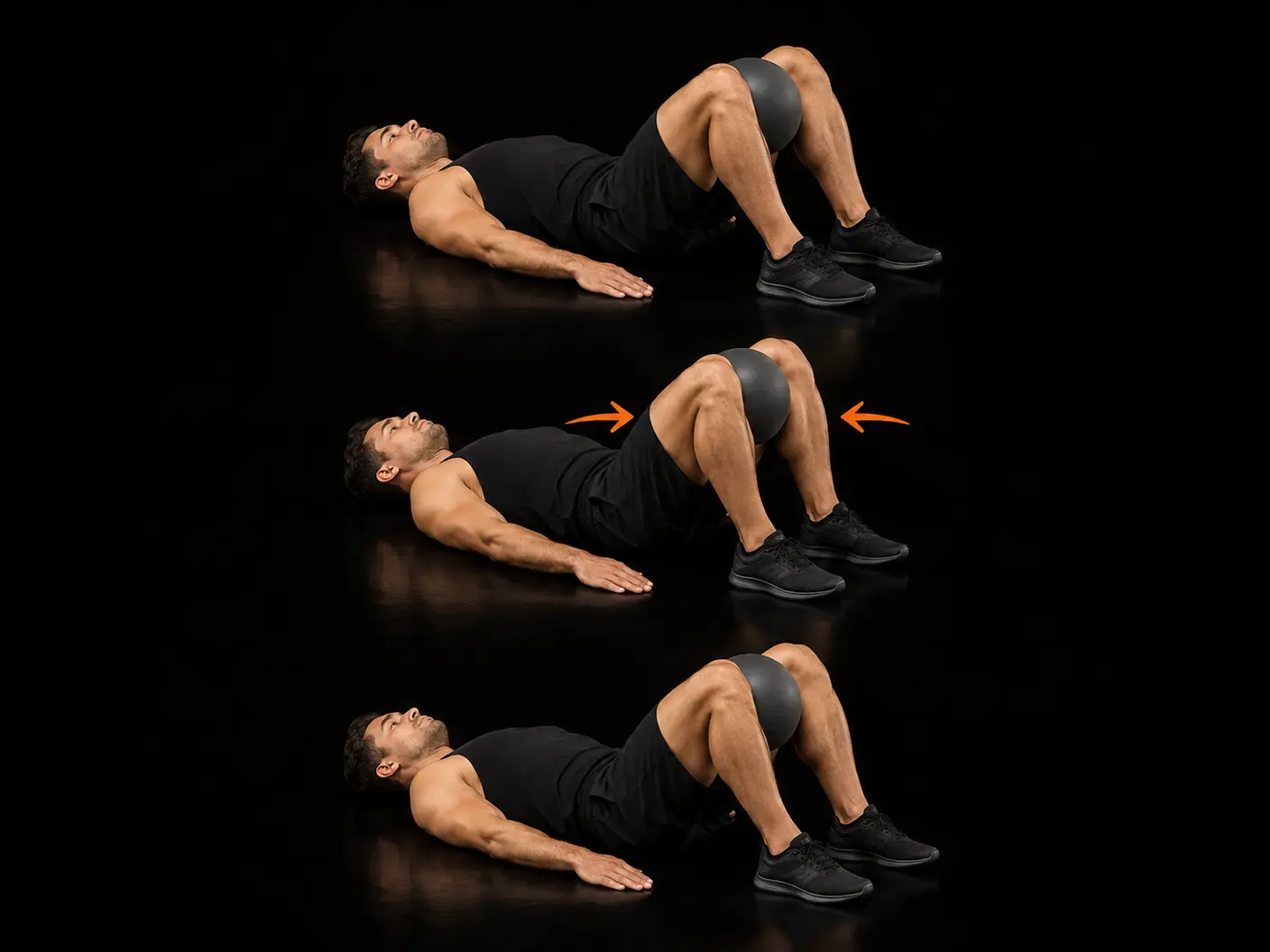
The adductor squeeze is a foundational isolation exercise that trains the hip adductors by squeezing the knees inward against a medicine ball, pilates ball, or rolled-up towel. Performed lying on the back with knees bent, it places direct, low-load demand on the inner thigh musculature with minimal joint stress. It suits beginners building pelvic stability, athletes addressing adductor weakness, and those reintroducing lower-body work after a period of reduced training.
How to do it
Lie on your back with knees bent and feet flat. Place a medicine ball, pilates ball, or rolled-up towel between the knees. Squeeze the knees inward against the ball, activating the adductors. Hold for 2–3 seconds, then release. Repeat for reps or time.
Coaching cues
- Squeeze steadily
- Hold at peak
- Neutral spine
- Breathe throughout
Why train it
- Directly targets the hip adductors, a group that is often underdeveloped relative to the abductors and can contribute to movement imbalances when neglected.
- The supine position and controlled squeeze-and-hold format allow the pelvic floor and glutes to work as stabilisers, making it a useful movement for whole-pelvis conditioning.
- Its foundational difficulty and minimal equipment requirement make it easy to programme as a warm-up activation drill or as an accessory movement within a lower-body session.
- The isometric hold element encourages deliberate muscle recruitment, helping lifters develop the mind-muscle connection needed before progressing to more complex adductor-loaded patterns.
Common mistakes
- Using a jerky or ballistic squeeze — apply steady, controlled inward pressure and hold at peak contraction rather than pulsing quickly through the movement.
- Holding the breath during the hold — maintain relaxed, continuous breathing throughout each repetition to avoid unnecessary intra-abdominal pressure spikes.
- Losing a neutral spine by pressing the lower back into the floor — keep a natural lumbar curve and avoid flattening or arching as you squeeze.
- Letting the feet lift or shift — keep both feet flat on the floor throughout to ensure the pelvis remains stable and the adductors do the intended work.
Primary: Adductors.
Secondary: Gluteus Maximus.
Equipment
Good for
Easier variation
Supine adductor squeeze with hands — apply manual resistance from both sides of the knees.
Similar movements
Frequently asked
- What muscles does the adductor squeeze work?
- The primary muscles targeted are the hip adductors, the group of muscles along the inner thigh responsible for drawing the legs toward the midline. The glutes and pelvic floor act as secondary stabilisers during the movement.
- How many sets and reps should I do?
- A practical starting point is 2–3 sets of 10–15 repetitions, holding each squeeze for 2–3 seconds at peak contraction. If using it as an activation drill before a session, 1–2 sets of 10 controlled reps is typically sufficient.
- What can I use if I don't have a medicine ball or pilates ball?
- A firmly rolled-up towel works well as a substitute and provides enough resistance to generate meaningful adductor activation. The key is that the object offers enough firmness to squeeze against without collapsing immediately.
- Is the adductor squeeze useful for athletic performance?
- Yes — strong, well-conditioned adductors contribute to hip stability during change-of-direction movements, sprinting, and single-leg loading patterns common in most sports. Using this exercise to address adductor weakness can support more demanding lower-body work in a broader athletic programme.
- Can I do this exercise if I have groin discomfort?
- If you are experiencing groin pain or have a history of adductor injury, check with a qualified professional before adding this or any adductor-loaded exercise to your programme, as the appropriate loading and timing will depend on your individual circumstances.
Want this movement in a plan built for you?
Adaptiv programmes the right exercises for your goal, equipment and experience — then adapts them as you train.
Build my programme