Lying Leg Curl
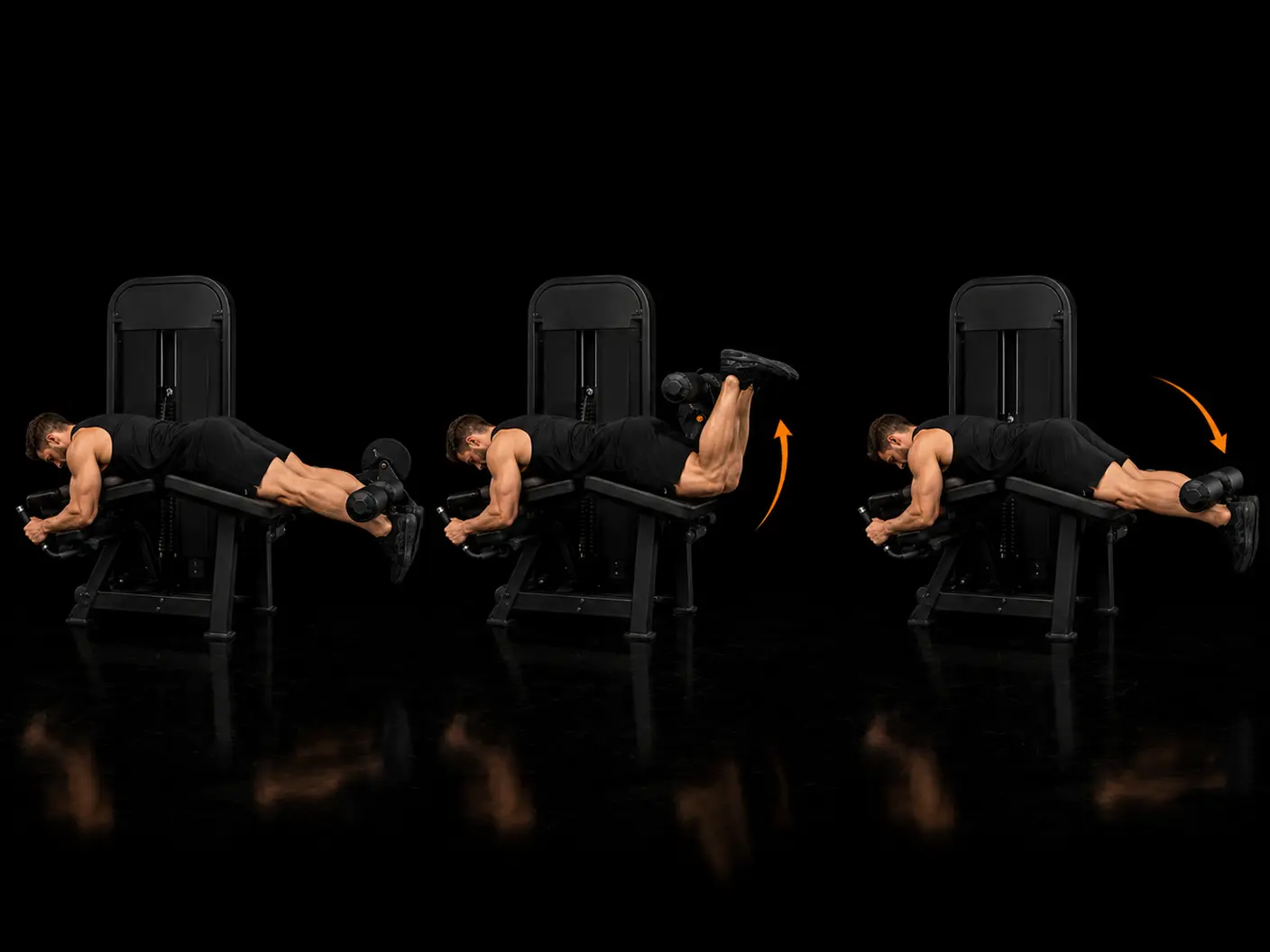
The lying leg curl is a machine-based isolation exercise that trains the hamstrings through knee flexion, with secondary involvement from the gastrocnemius. Performed face-down on a dedicated machine, it allows direct, controlled loading of the posterior chain without the postural demands of compound movements. It suits lifters of all experience levels looking to develop hamstring hypertrophy or address a strength imbalance between the front and back of the thigh.
How to do it
Lie face-down on the bench. Align the knee joint with the pivot point. Set the leg pad just above the Achilles. Grip the handles, hips pressed into the pad. Curl the heels toward the glutes, fully flexing the knees. Pause briefly. Lower with a 2–3 second eccentric.
Coaching cues
- Hips pinned to pad
- Full knee flexion
- Pause at top
- Controlled descent
Why train it
- Directly targets the hamstrings in a way that compound lower-body movements cannot fully replicate, making it a reliable tool for hypertrophy-focused programming.
- The fixed movement path of the machine removes the need for significant stabilisation, allowing effort to be concentrated entirely on the working muscles.
- The gastrocnemius receives secondary stimulus, adding cumulative volume to the calf musculature without additional exercise selection.
- The controlled eccentric prescribed with this exercise — two to three seconds on the descent — maximises time under tension, a key driver of muscle growth.
Common mistakes
- Lifting the hips off the pad during the curl — keep the hips pressed firmly into the bench throughout to ensure the hamstrings, not the lower back, are producing the movement.
- Misaligning the knee joint with the machine's pivot point — take a moment to adjust the bench length before loading so that the joint tracks correctly and stress is not transferred to the knee.
- Using momentum to swing the load up — initiate each repetition deliberately and reduce the weight if a controlled curl through full range is not achievable.
- Rushing the lowering phase — resist the temptation to let the weight drop and instead maintain a two to three second eccentric to get the most from each repetition.
Primary: Hamstrings.
Secondary: Gastrocnemius.
Equipment
Good for
Easier variation
Single-leg lying leg curl — allows corrective work for asymmetry.
Similar movements
Frequently asked
- What muscles does the lying leg curl work?
- The primary muscle worked is the hamstrings, which flex the knee against the resistance of the pad. The gastrocnemius, the large superficial muscle of the calf, acts as a secondary contributor throughout the movement.
- How many sets and reps should I do on the lying leg curl?
- For hypertrophy, three to four sets of eight to twelve repetitions is a well-established range. Prioritise a load that allows full knee flexion, a brief pause at the top, and a controlled two to three second descent on every repetition.
- Is the lying leg curl suitable for beginners?
- Yes — it is classified as a foundational movement precisely because the machine provides a fixed path and removes the balance and coordination demands of free-weight alternatives. It is a practical starting point for anyone learning to train the hamstrings in isolation.
- What is a good alternative to the lying leg curl if I do not have access to the machine?
- If the lying leg curl machine is unavailable, the seated leg curl machine trains the same primary musculature and is a direct substitute. If no leg curl machine is accessible at all, consult a qualified coach for appropriate free-weight alternatives that match your training goals.
- Can I use the lying leg curl to complement my squat or deadlift training?
- Yes — because it isolates knee flexion, it targets the hamstrings in a manner that heavy compound lifts do not fully address, making it a useful accessory movement to programme alongside squats or deadlifts for more balanced posterior chain development.
Want this movement in a plan built for you?
Adaptiv programmes the right exercises for your goal, equipment and experience — then adapts them as you train.
Build my programme