Razor Curl (Assisted Nordic)
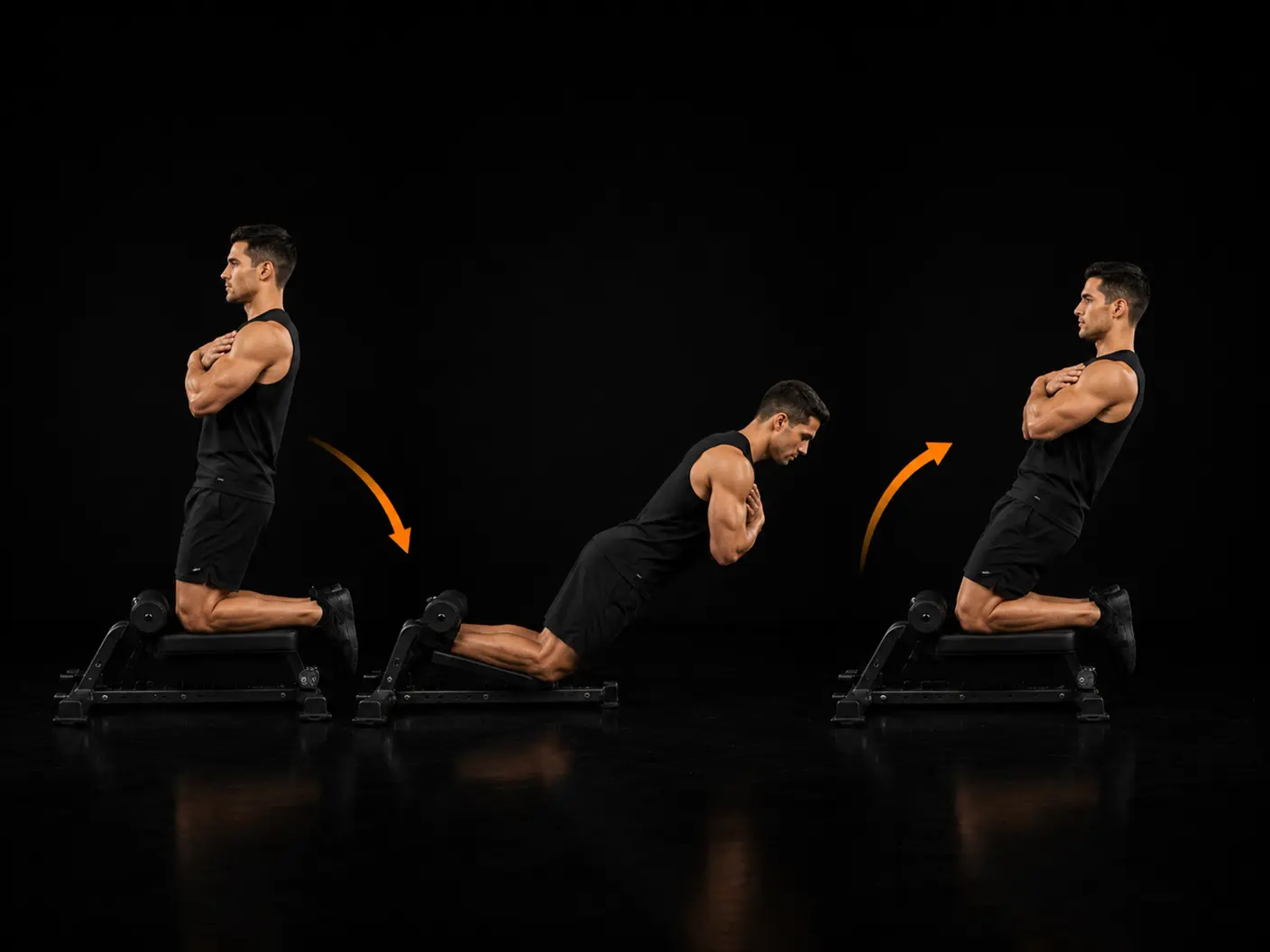
The razor curl is an assisted variation of the Nordic hamstring curl performed on a glute-ham raise or with a Nordic strap, distinguished by a hip-hinged starting position rather than a fully upright one. That broken-hip angle reduces the eccentric demand at the knee slightly, making the pattern more accessible than a strict Nordic whilst still training the hamstrings through a long, demanding range. It suits intermediate to advanced lifters who need to build hamstring capacity for athletic performance or hypertrophy and who have already established a base of posterior-chain strength.
How to do it
Set up as a Nordic curl but initiate from a hinged position — hips broken rather than fully extended. Lower the torso as the knees extend, then reverse by driving the knees against the pad to curl the body back up with hip flexion assisting.
Coaching cues
- Hinge at the hips
- Pull with the hamstrings
- Drive the knees into pad
- Control both directions
Why train it
- Training the hamstrings in a lengthened position under load is strongly associated with hypertrophic adaptations, and the razor curl's hip-hinged setup emphasises exactly that range.
- The movement develops eccentric hamstring strength — a quality directly linked to sprint performance and reduced soft-tissue injury risk in field sport athletes.
- Because hip flexion assists the concentric phase, the razor curl provides a more manageable entry point to Nordic-style loading without abandoning the fundamental mechanics.
- The glutes and core are recruited as stabilisers throughout, making this a time-efficient choice when posterior-chain work is the training priority.
Common mistakes
- Losing the hip hinge and letting the hips rise to vertical at the bottom — maintain a consistent degree of hip flexion throughout the descent to keep the target muscles under tension.
- Relying on momentum to reverse the movement rather than actively driving the knees into the pad — initiate the concentric phase by pressing the knees firmly down before the hips assist.
- Letting the lower back hyperextend as fatigue sets in — brace the core and keep a neutral spine from setup through to lockout.
- Dropping the torso too quickly on the eccentric — control the lowering phase deliberately, as this portion of the lift is where a significant proportion of the training stimulus is generated.
Primary: Hamstrings.
Secondary: Gluteus Maximus, Rectus Abdominis.
Equipment
Good for
Easier variation
Band-assisted Nordic — loop a band overhead to offload bodyweight.
Similar movements
Frequently asked
- What muscles does the razor curl work?
- The primary muscle is the hamstrings, trained through a long range of motion under both eccentric and concentric load. The glutes and core work as secondary stabilisers throughout the movement.
- How many sets and reps should I do for the razor curl?
- For hypertrophy, three to four sets of six to ten reps with full eccentric control is a sound starting point. For athletic performance development, lower rep ranges of three to six with emphasis on eccentric tempo are commonly programmed, particularly in pre-season blocks.
- How does the razor curl differ from a strict Nordic curl?
- The strict Nordic begins with the hips fully extended and the torso upright, placing the hamstrings under maximum tension from the outset. The razor curl starts with the hips already hinged, which reduces the initial eccentric load and allows hip flexion to assist the return — making it a useful progression step between machine leg curls and full Nordic work.
- What equipment do I need to perform the razor curl?
- You need either a glute-ham raise machine, which allows the knees to be anchored against the pad, or a Nordic strap secured to a fixed anchor point. Both options provide the ankle and knee fixation the movement requires.
- Is the razor curl suitable for someone who cannot yet perform a Nordic curl?
- The razor curl is classified as an advanced movement and assumes a reasonable baseline of hamstring strength. If unassisted Nordic curls are currently out of reach, building capacity through Romanian deadlifts, glute-ham raises, and band-assisted Nordics first would be advisable before progressing to this variation.
Want this movement in a plan built for you?
Adaptiv programmes the right exercises for your goal, equipment and experience — then adapts them as you train.
Build my programme