Glute-Ham Raise (GHR)
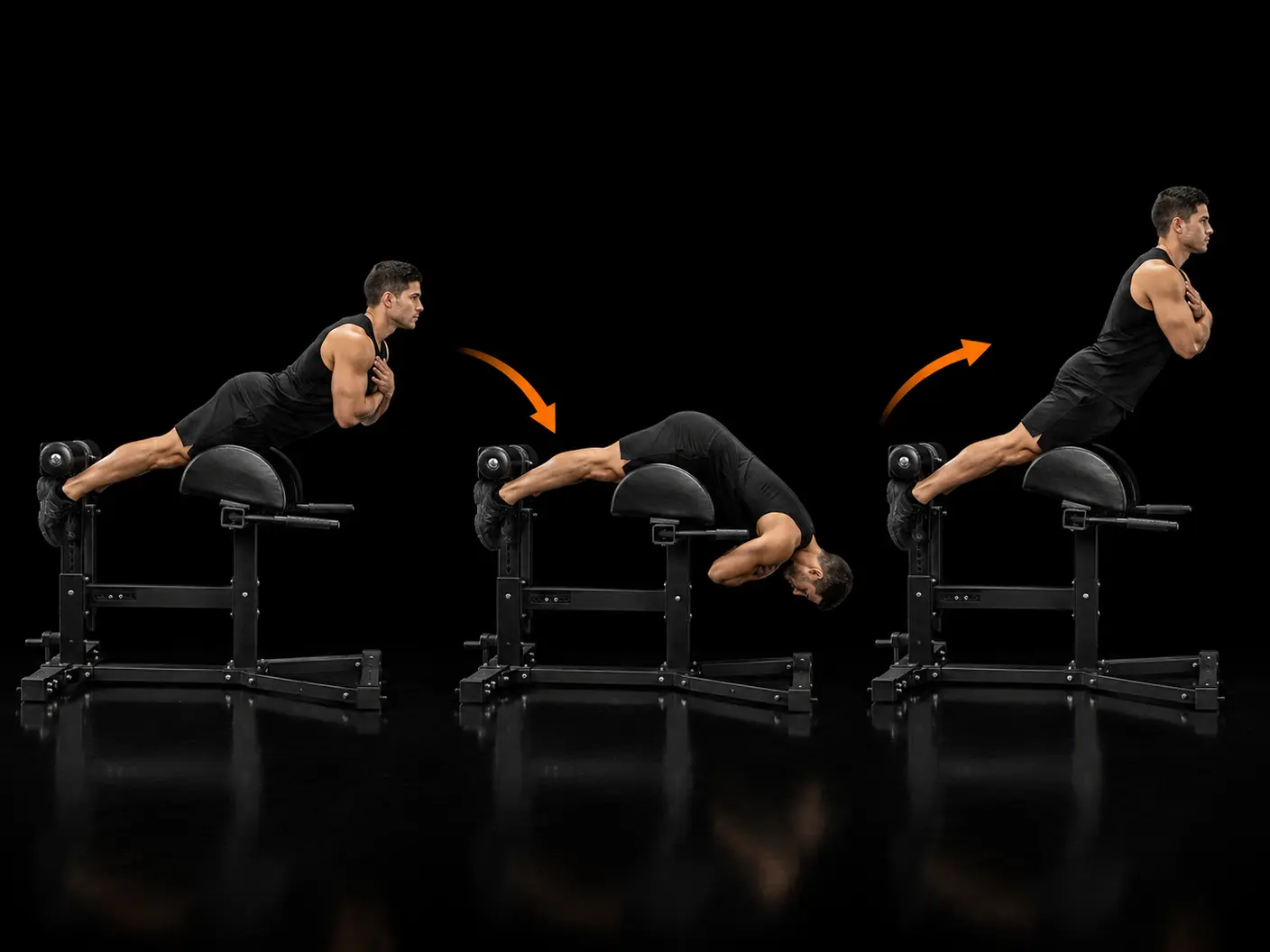
The glute-ham raise is a posterior chain exercise performed on a glute-ham developer (GHD), in which the lifter curls from a horizontal position to vertical by simultaneously flexing the knees and extending the hips. It trains the hamstrings through their dual function — knee flexion and hip extension — making it one of the few movements to load the muscle across its full mechanical role. It suits intermediate to advanced trainees who already have a solid foundation of posterior chain strength and body control.
How to do it
Set the GHD pad so the knees sit just behind it. Feet pressed into the plate, toes down. Start with the torso horizontal, hands across the chest. Curl the torso up by driving the toes into the plate and flexing the knees. Finish in a vertical position. Lower under control to horizontal.
Coaching cues
- Drive toes into plate
- Pull with hamstrings
- Tall finish
- Controlled descent
Why train it
- The GHR loads the hamstrings through both knee flexion and hip extension simultaneously, providing a training stimulus that most bilateral leg exercises cannot replicate.
- Eccentric control during the descent places significant demand on the hamstrings under length, which is strongly associated with muscle hypertrophy over time.
- The movement reinforces a tall, upright finish position that carries over to sprinting mechanics and athletic tasks requiring powerful hip and knee extension.
- Secondary involvement of the erectors and calves means the exercise contributes to broader posterior chain development within a single pattern.
Common mistakes
- Setting the pad too far forward — position the knees just behind the pad so the joint has a stable pivot point throughout the curl.
- Relying on the lower back to initiate the movement rather than the hamstrings — focus on driving the toes into the footplate and actively pulling with the knee flexors from the start of every rep.
- Losing the vertical finish position by stopping short — fully extend the torso so the body is upright at the top before beginning the descent.
- Dropping into the descent rather than controlling it — lower the torso under muscular tension throughout, maintaining the same hamstring engagement used on the way up.
Primary: Hamstrings, Gluteus Maximus.
Secondary: Erector Spinae, Gastrocnemius.
Equipment
Good for
Easier variation
Band-assisted GHR — reduces bodyweight load.
Similar movements
Frequently asked
- What muscles does the glute-ham raise work?
- The primary muscles are the hamstrings and glutes. The erectors and calves contribute as secondary muscles throughout the movement.
- How many sets and reps should I do on the GHR?
- For hypertrophy, three to four sets of six to ten controlled reps works well. For strength and athletic performance, three to five sets of four to six reps with a greater emphasis on tempo and quality of contraction is appropriate. Rest fully between sets, as the movement is technically demanding.
- Is the glute-ham raise suitable for beginners?
- The GHR is rated as an advanced exercise and is not recommended as a starting point for posterior chain training. A solid base of strength in Romanian deadlifts, leg curls, and hip hinges should be established first before progressing to this movement.
- What can I use as an alternative if I do not have a GHD machine?
- If a glute-ham developer is unavailable, Nordic hamstring curls (anchored at the feet with a partner or attachment) train a similar knee-flexion pattern under load. However, no direct substitute replicates the simultaneous hip and knee demand of the GHR without the specific equipment.
- How does the GHR differ from a back extension on the same machine?
- A back extension on the GHD primarily trains hip extension with the knees remaining straight, targeting the glutes and erectors. The GHR adds knee flexion to the pattern, bringing the hamstrings in as the primary driver and making it a more comprehensive posterior chain exercise.
Want this movement in a plan built for you?
Adaptiv programmes the right exercises for your goal, equipment and experience — then adapts them as you train.
Build my programme