45° Back Extension
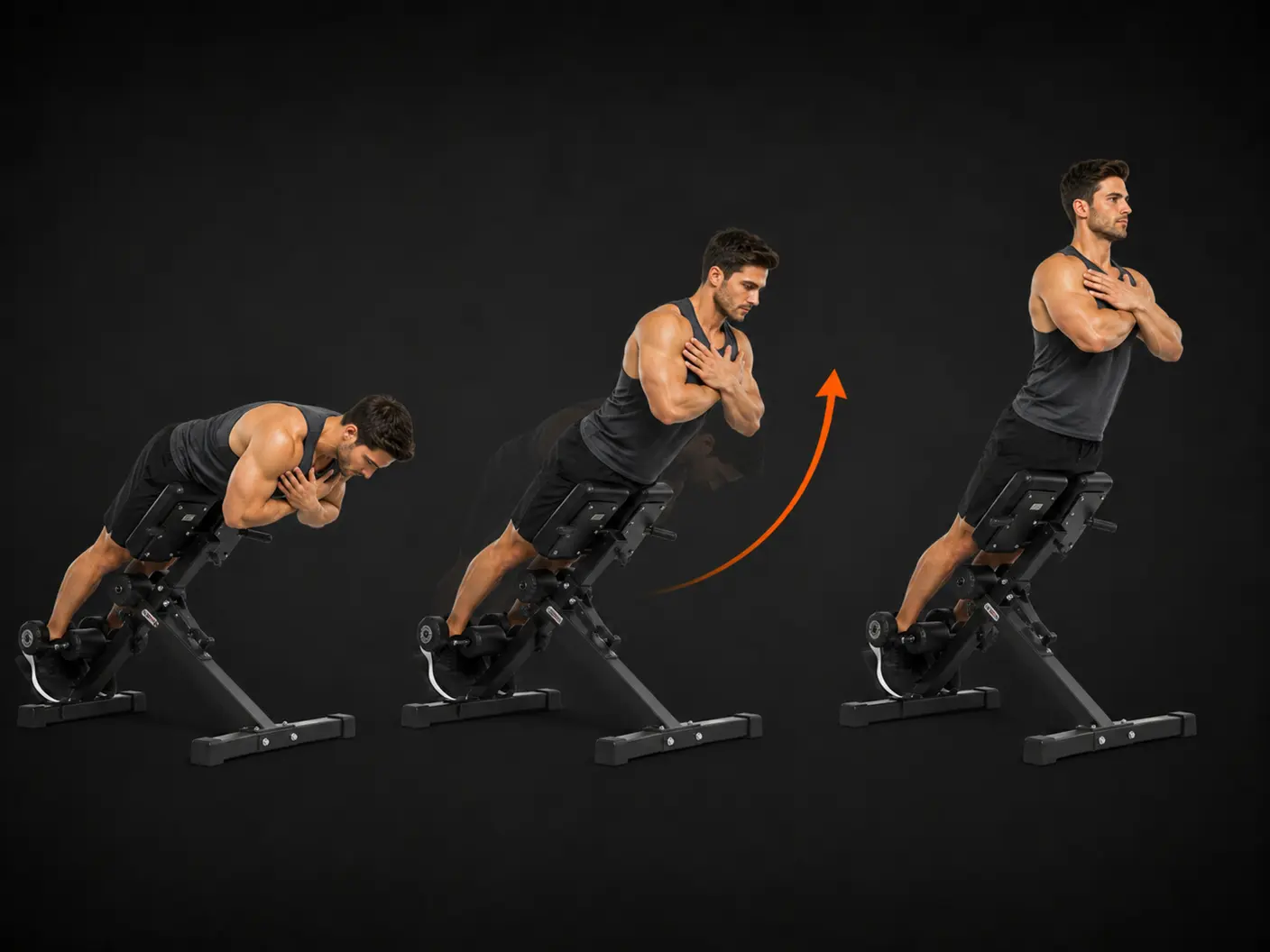
The 45° back extension is a hip-hinge movement performed on an angled bench that loads the posterior chain through a controlled range of motion. It trains the erector spinae, glutes, and hamstrings simultaneously, making it a practical compound exercise for building lower-back integrity and posterior-chain strength. It suits intermediate trainees who have established a sound hip-hinge pattern and are looking to develop or supplement their posterior-chain work.
How to do it
Adjust the pad so the hip crease sits just below the top edge. Hook the ankles. Cross arms over the chest or hold a plate. Hinge at the hips, lowering the torso under control. Drive the hips into the pad to return; finish in a straight line from head to heels — do not hyperextend. Control the eccentric.
Coaching cues
- Hinge from the hips
- Tall finish
- No hyperextension
- Control the descent
Why train it
- It develops the erector spinae, glutes, and hamstrings in a single movement, making it an efficient posterior-chain exercise for a well-structured programme.
- The 45° angle provides a consistent loading curve that keeps the target muscles under tension throughout both the lowering and lifting phases.
- Load can be progressed incrementally by adding a weight plate, allowing the movement to serve hypertrophy goals over a sustained period.
- The emphasis on a controlled eccentric builds the kind of posterior-chain resilience that supports performance in heavier compound lifts such as deadlifts and squats.
Common mistakes
- Setting the pad too high — adjust it so the hip crease sits just below the top edge of the pad, which allows a full hinge rather than a lumbar-dominant movement.
- Hyperextending at the top — finish in a straight line from head to heels and stop there; extending beyond neutral shifts stress onto the lumbar vertebrae rather than the target muscles.
- Rushing the descent — lower the torso under deliberate control rather than dropping freely, as the eccentric phase is where much of the posterior-chain stimulus is generated.
- Rounding through the lower back at the bottom — maintain a neutral spine throughout the range of motion and hinge from the hips rather than collapsing into flexion.
Primary: Erector Spinae, Gluteus Maximus, Hamstrings.
Secondary: Rectus Abdominis.
Equipment
Good for
Easier variation
Bodyweight back extension — remove any load and focus on range of motion.
Similar movements
Frequently asked
- What muscles does the 45° back extension work?
- The primary muscles are the erector spinae, glutes, and hamstrings. The core musculature works as a secondary contributor to stabilise the spine throughout the movement.
- How many sets and reps should I do on the 45° back extension?
- For hypertrophy, three to four sets of eight to fifteen reps with a controlled tempo is a practical starting point. General fitness trainees can work in a similar rep range using bodyweight or light load before progressing to a plate.
- Should I hold a weight plate on the 45° back extension?
- Begin with bodyweight or arms crossed over the chest to establish sound mechanics first. Once you can complete full sets with a neutral spine and controlled tempo, introduce a plate held at the chest to add progressive overload.
- Is the 45° back extension suitable as a deadlift accessory?
- Yes — it targets the same posterior-chain muscles involved in the deadlift and is commonly programmed as an accessory movement to reinforce hip-hinge mechanics and build erector and glute volume without heavy spinal loading.
- What is the difference between finishing tall and hyperextending?
- A tall finish means the body forms a straight line from head to heels at the top of the movement, with the hips fully extended and the spine neutral. Hyperextension takes the lumbar spine beyond neutral, which removes tension from the target muscles and is the error the cue is designed to prevent.
Want this movement in a plan built for you?
Adaptiv programmes the right exercises for your goal, equipment and experience — then adapts them as you train.
Build my programme