Superman Hold
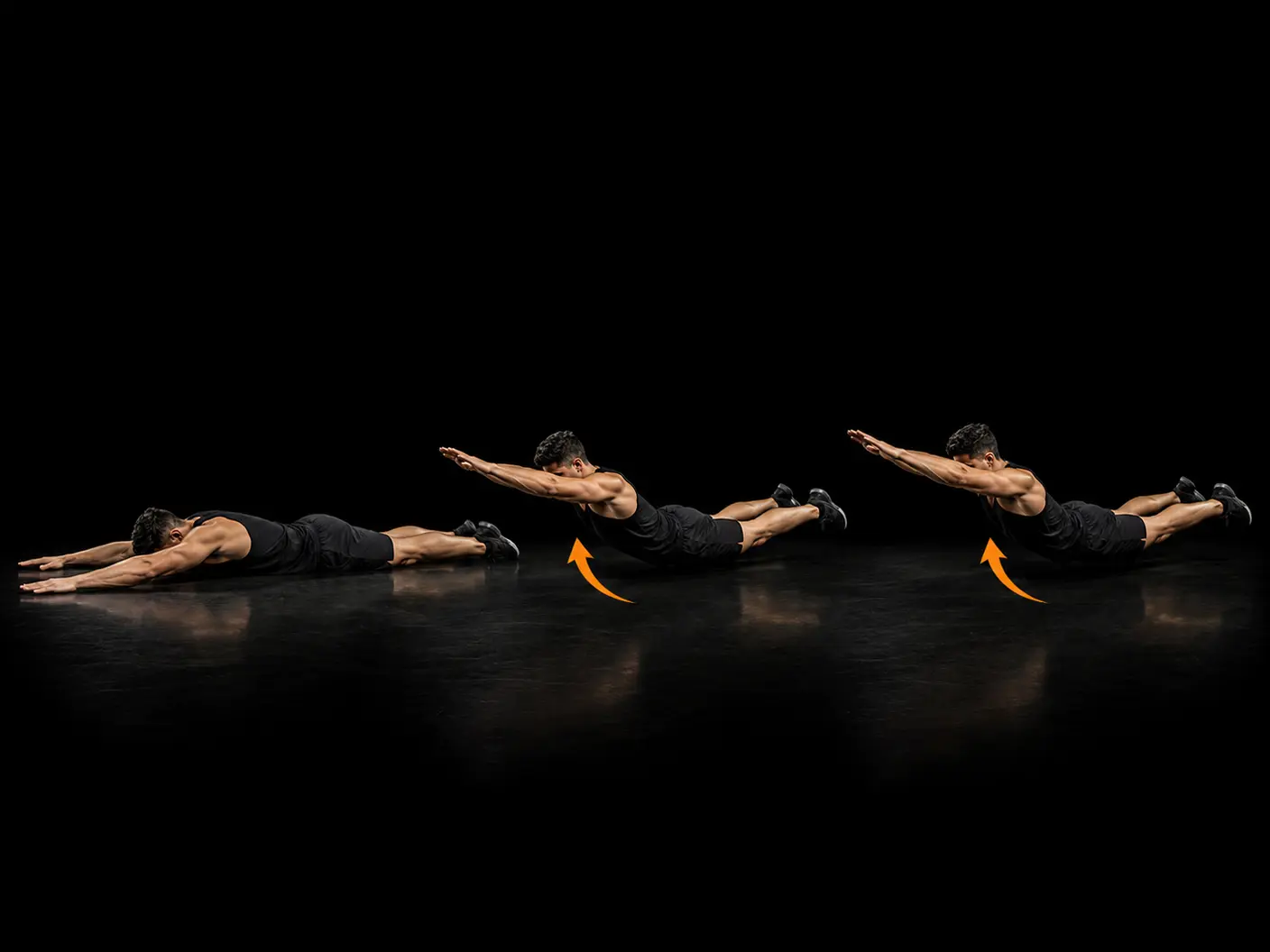
The Superman hold is a bodyweight posterior-chain exercise performed prone on the floor, in which the arms, chest, and legs are simultaneously raised by contracting the glutes and erector spinae. It trains the hip-extension hinge pattern in an unloaded, isometric context, making it accessible to those at the start of their training or returning from a period of inactivity. Its low technical demand and zero equipment requirement make it a practical choice for general fitness programming and structured rehabilitation work.
How to do it
Lie face down on the floor with arms extended overhead. Simultaneously lift the arms, chest, and legs off the floor by contracting the glutes and posterior chain. Hold the extended position for the prescribed time. Keep the neck neutral — look down at the floor, not forward.
Coaching cues
- Squeeze glutes
- Arms long
- Look down
- Lift through the back
Why train it
- It strengthens the erector spinae and gluteus maximus simultaneously, reinforcing the posterior chain that underpins almost every loaded hinge and carry pattern.
- The isometric hold develops muscular endurance in the lower back and glutes, which supports postural control during daily activity and sport.
- Because no equipment is required and the movement is performed on the floor, it can be programmed in warm-ups, cool-downs, or home sessions without modification.
- The rear deltoids and rhomboids are recruited as secondary movers, adding a degree of upper-back stimulus that complements pressing-heavy programmes.
Common mistakes
- Lifting the head and looking forward — keep the neck neutral and direct your gaze at the floor throughout the hold to avoid unnecessary cervical compression.
- Relying on momentum to reach the raised position — contract the glutes and posterior chain deliberately before lifting, rather than jerking the limbs upward.
- Allowing the arms to drop or bend during the hold — extend them fully overhead and maintain that length for the duration, as shortened levers reduce the demand on the upper back.
- Holding the breath — breathe steadily throughout the hold, as bracing without breathing is unsustainable and limits the time under tension you can accumulate.
Primary: Erector Spinae, Gluteus Maximus.
Secondary: Hamstrings, Posterior Deltoid, Rhomboids.
Equipment
Good for
Easier variation
Alternating Superman — lift opposite arm and leg one at a time.
Similar movements
Frequently asked
- What muscles does the Superman hold work?
- The primary movers are the erector spinae and gluteus maximus. The hamstrings, rear deltoids, and rhomboids contribute as secondary muscles to sustain the raised position.
- How long should I hold the Superman position?
- For foundational work, holds of two to five seconds per repetition across three to four sets are a reasonable starting point. As endurance improves, the hold duration can be extended progressively before adding sets or repetitions.
- Is the Superman hold suitable for rehabilitation purposes?
- It is one of the exercise goals listed for this movement, and its low load makes it appropriate in many early-stage posterior-chain programmes. If you are managing a specific condition or injury, check with a qualified professional before including it.
- What is a good progression from the Superman hold?
- Once you can perform controlled, sustained holds with consistent form, you can progress to loaded hip-extension patterns such as the Romanian deadlift or back extension, which place greater demand on the same primary muscles under external resistance.
- Can I include the Superman hold in a warm-up?
- Yes — because it requires no equipment and activates the glutes and erector spinae, it suits a warm-up sequence ahead of deadlifts, squats, or any session where posterior-chain readiness is a priority.
Want this movement in a plan built for you?
Adaptiv programmes the right exercises for your goal, equipment and experience — then adapts them as you train.
Build my programme