Bird Dog
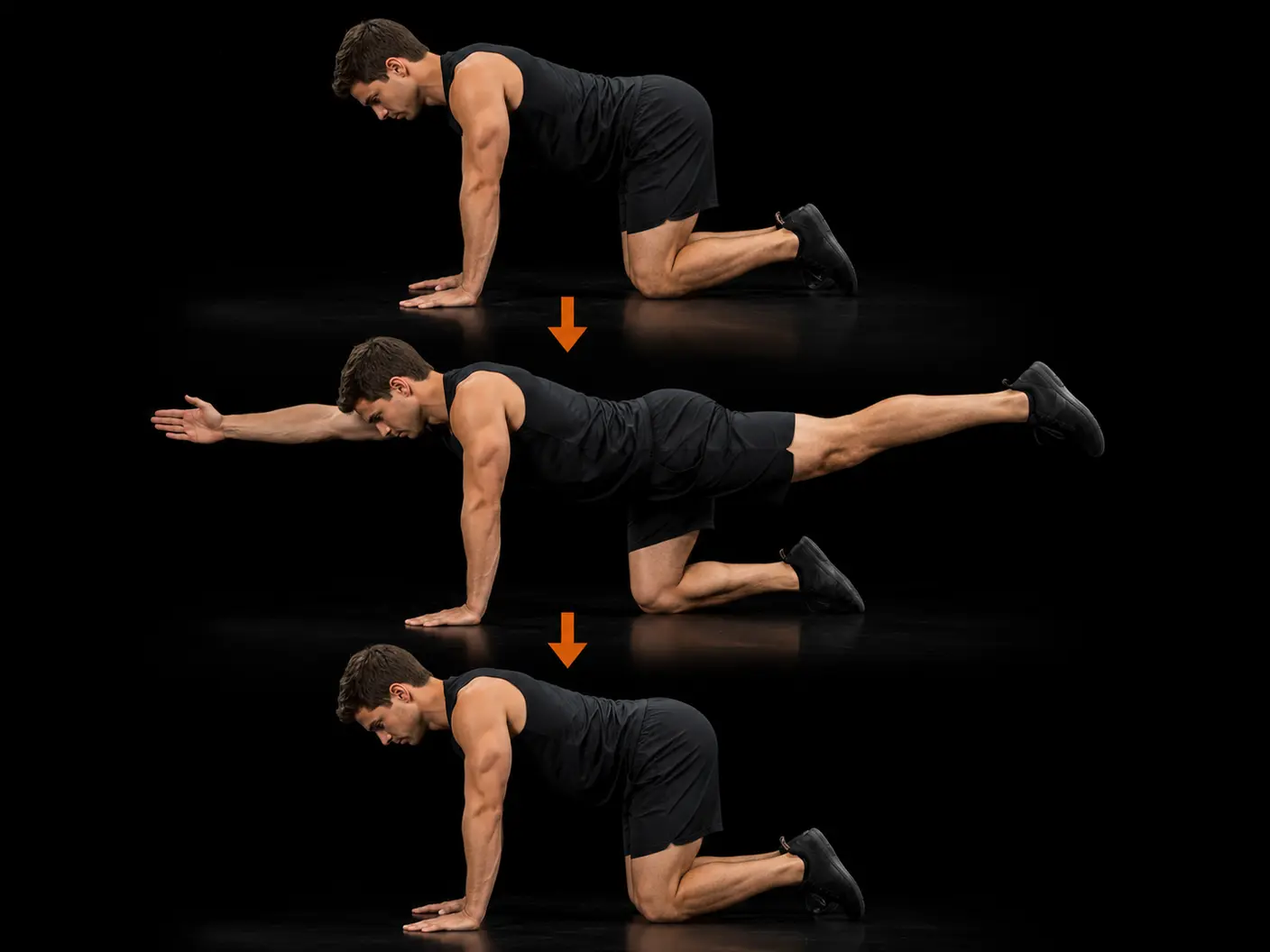
The bird dog is a bodyweight quadruped movement that trains simultaneous spinal extension and limb reach against a stable, braced trunk. It develops the coordination between the erectors and core across all planes of motion, demanding that the hips and shoulders remain square throughout the rep. It suits beginners establishing movement fundamentals and experienced athletes maintaining lumbar control within a broader programme.
How to do it
Start on all fours. Brace the core. Extend opposite arm and leg until they are straight and parallel to the floor; keep hips and shoulders square — no rotation. Pause briefly. Return under control. Alternate.
Coaching cues
- Hips stay square
- Reach long
- Pause at extension
- Brace the core
Why train it
- It directly trains the erectors and core to resist rotation and extension forces, a pattern that underpins nearly every standing athletic movement.
- The requirement to pause at full extension builds genuine neuromuscular control rather than relying on momentum to complete the rep.
- Because it is entirely bodyweight and performed on the floor, it can be programmed as a warm-up, active recovery, or standalone core work without any equipment.
- The alternating pattern reinforces left-to-right symmetry, making it a practical choice for identifying and addressing side-to-side coordination differences.
Common mistakes
- Allowing the hips to rotate as the leg extends — brace the core before the limb moves and keep both hip bones level throughout the rep.
- Lifting the arm or leg above parallel in search of a greater range — reach long and keep the extended limb flush with the torso rather than hyperextending at the spine.
- Rushing through the movement without pausing at extension — hold the end position briefly to confirm control before returning under control.
- Letting the lower back sag toward the floor during the reach — maintain a neutral spine by engaging the core as if bracing for light contact before each repetition.
Primary: Erector Spinae, Rectus Abdominis.
Secondary: Gluteus Maximus, Anterior Deltoid.
Equipment
Good for
Easier variation
Arm-only or leg-only version — simpler challenge.
Similar movements
Frequently asked
- What muscles does the bird dog work?
- The primary muscles are the erectors and core, which work across all planes to stabilise the spine during the reach. The glutes and shoulders contribute as secondary movers to control the extended arm and leg.
- How many sets and reps should I do for the bird dog?
- A common starting point is 2–3 sets of 8–10 controlled repetitions per side, with a brief pause at full extension on each rep. Quality of position matters far more than volume, so reduce reps before allowing form to deteriorate.
- Is the bird dog suitable for complete beginners?
- Yes — it is classified as a foundational movement and requires no equipment beyond a flat surface. Beginners often benefit from starting slowly, confirming that the hips stay square before progressing to a full reach.
- Can the bird dog help with general fitness as well as athletic performance?
- It is listed under both goals because stable spinal control is relevant whether you are managing everyday movement or training for sport. Athletes use it to reinforce the trunk stiffness needed in dynamic actions; general fitness trainees use it to build baseline core coordination.
- What are good alternatives or progressions to the bird dog?
- A regression would be to extend the arm and leg separately rather than simultaneously, reducing the rotational demand. A progression involves adding a brief isometric hold of three to five seconds at extension, or introducing a light resistance band around the wrists or ankles to increase the load on the stabilising muscles.
Want this movement in a plan built for you?
Adaptiv programmes the right exercises for your goal, equipment and experience — then adapts them as you train.
Build my programme