Front Plank
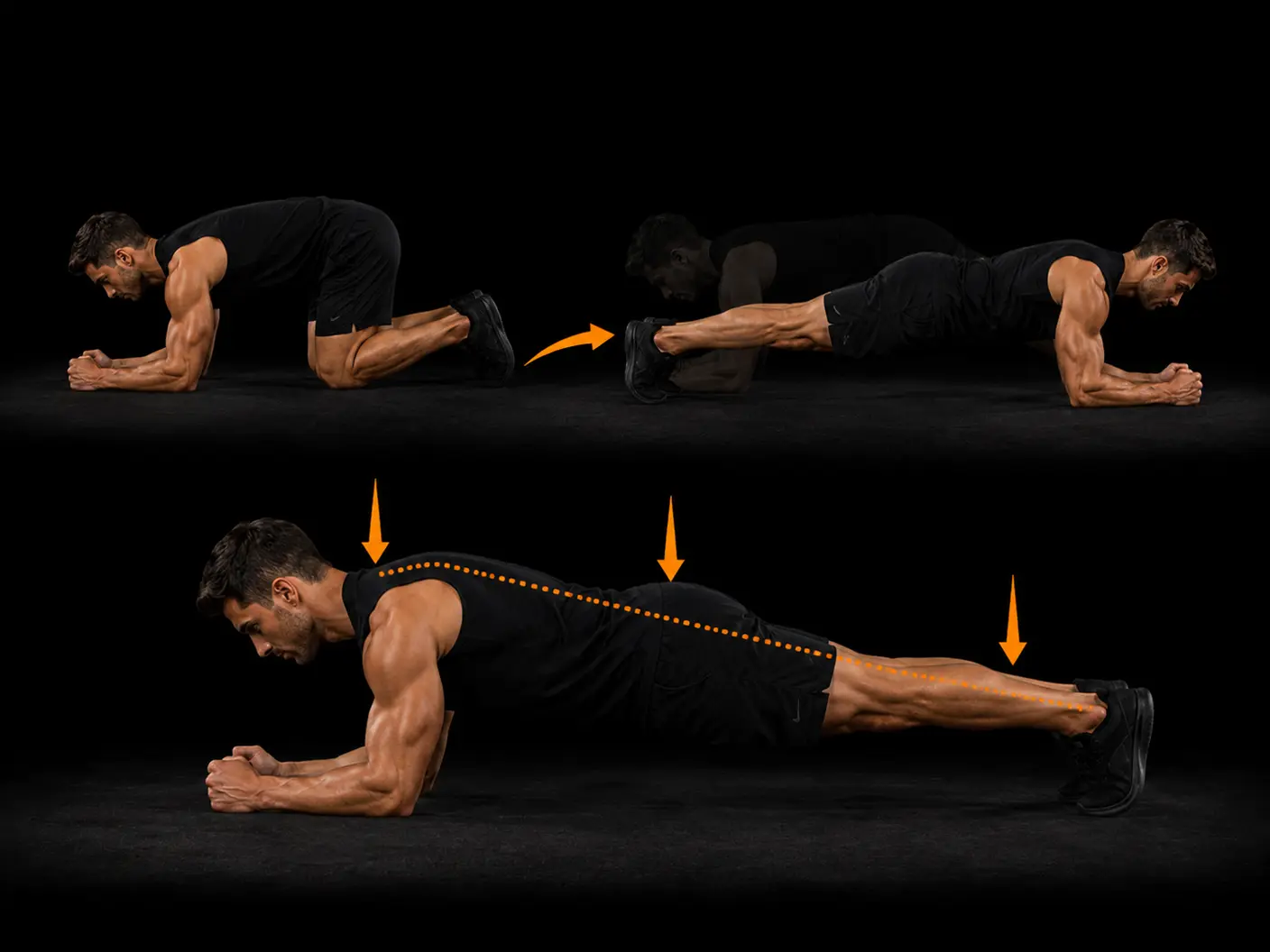
The front plank is a bodyweight hold that trains anti-extension — the ability of the core to resist forces that would otherwise pull the spine into excessive extension. Performed on the forearms with a straight line from head to heels, it demands coordinated bracing across the rectus abdominis, transverse abdominis, and obliques, with the glutes and shoulders working to maintain that position. It suits beginners establishing foundational core control as well as more experienced athletes using it as a warm-up or accessory movement.
How to do it
Set up on forearms, elbows directly under shoulders. Feet hip-width. Create a straight line from head to heels. Brace the abs, squeeze the glutes, tuck the pelvis under. Do not let the hips sag or pike up. Hold for time, breathing steadily.
Coaching cues
- Ribs stacked over hips
- Tucked pelvis
- Squeeze the glutes
- Breathe steadily
Why train it
- It develops the deep and superficial core musculature simultaneously, building the whole-trunk bracing capacity that underpins nearly every loaded movement in a programme.
- Because it requires no equipment, it can be performed anywhere and progressed simply by increasing hold duration or manipulating leverage.
- The glutes must actively contract to maintain pelvic position, making it a useful cue-reinforcement tool for athletes who struggle to engage them under load.
- It teaches steady breathing under tension — a skill that carries directly into heavier compound lifts where breath control and intra-abdominal pressure matter.
Common mistakes
- Letting the hips sag toward the floor — actively squeeze the glutes and tuck the pelvis under to restore a neutral spine throughout the hold.
- Piking the hips too high — lower them until your shoulders, hips, and heels form a single straight line as viewed from the side.
- Holding the breath — practise slow, controlled inhales and exhales without losing abdominal tension, as breath-holding spikes fatigue and defeats the purpose of the drill.
- Allowing the head to drop or crane forward — keep the gaze a few centimetres in front of the hands so the cervical spine stays in line with the rest of the body.
Primary: Rectus Abdominis, Transverse Abdominis, Obliques.
Secondary: Gluteus Maximus, Anterior Deltoid.
Equipment
Good for
Easier variation
Incline plank with forearms on a bench — reduces load.
Similar movements
Frequently asked
- What muscles does the front plank work?
- The primary muscles are the rectus abdominis, transverse abdominis, and obliques, which collectively resist the spine being pulled into extension. The glutes and shoulders work as secondary stabilisers to maintain the straight-line position from head to heels.
- How long should I hold a front plank?
- For general fitness, sets of 20–60 seconds are a practical starting point, with the goal of maintaining perfect form throughout rather than chasing duration. Once you can hold 60 seconds with full control, consider adding challenge through a more demanding variation rather than simply extending the hold time.
- How many sets should I do per session?
- Two to four sets is a reasonable range for most general fitness programmes, depending on where the plank sits in the session — as a warm-up drill, fewer sets suffice, whereas as a standalone core exercise it warrants more volume.
- Is the front plank suitable if I have lower back discomfort?
- The plank is often recommended as a low-load core exercise, but individual responses vary; if you experience discomfort during or after the movement, consult a qualified professional before continuing.
- What are good alternatives to the front plank?
- Any exercise that trains core anti-extension is a functional substitute — the dead bug and hollow body hold both challenge the same pattern with slightly different demands on limb position and coordination. If equipment is available, the ab wheel rollout is a more demanding progression of the same movement pattern.
Want this movement in a plan built for you?
Adaptiv programmes the right exercises for your goal, equipment and experience — then adapts them as you train.
Build my programme