RKC Plank
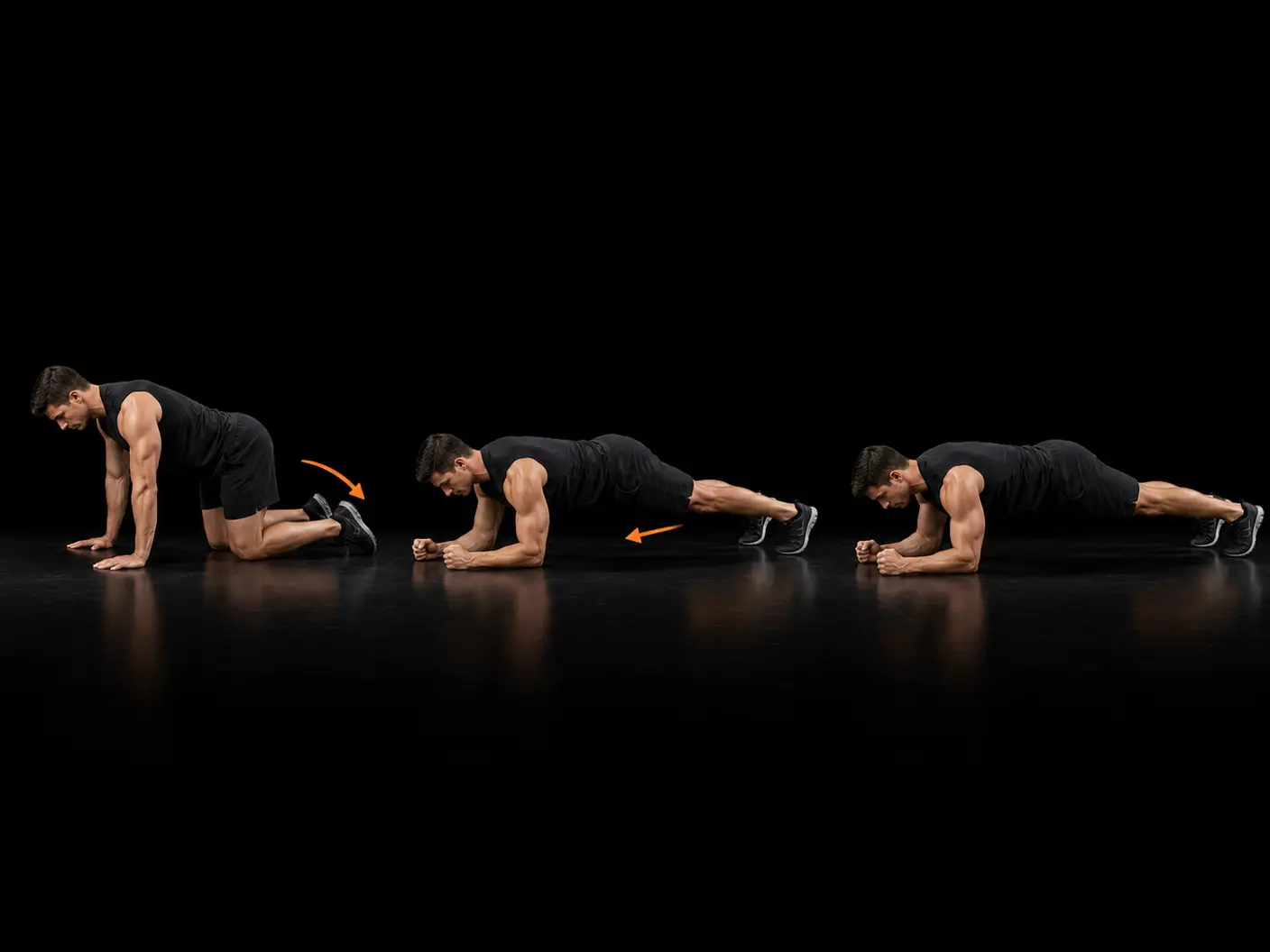
The RKC plank is a high-tension variation of the standard forearm plank that trains anti-extension of the lumbar spine through full-body irradiation rather than passive endurance. By actively pulling the elbows toward the toes, tucking the pelvis, and squeezing the glutes simultaneously, the lifter generates significantly greater muscular demand than a conventional held plank. It suits intermediate trainees who have mastered basic plank mechanics and want to develop functional core stiffness for athletic or general fitness goals.
How to do it
Set up in a front plank. Pull the elbows toward the toes as if shortening the body; squeeze glutes hard, tuck the pelvis aggressively, crush the fists. Create maximum full-body tension for 10–20 seconds.
Coaching cues
- Pull elbows toward toes
- Crush everything
- Maximum tension
- Short hold
Why train it
- The active tension protocol recruits the rectus abdominis, TVA, and obliques far more effectively than a passive plank, making short holds genuinely demanding for experienced lifters.
- Aggressive glute engagement during the hold reinforces the pelvis-to-ribcage relationship that underpins safe loading in squats, deadlifts, and overhead movements.
- Because maximum tension is the goal rather than duration, sets of 10–20 seconds fit cleanly into programmes without accumulating unnecessary fatigue.
- The lat and shoulder engagement required to maintain the pulling action develops shoulder girdle stability that carries over to pressing and pulling movements.
Common mistakes
- Holding a passive position rather than actively pulling the elbows toward the toes — consciously drive the forearms into the floor and think of shortening the distance between elbows and feet throughout the hold.
- Forgetting to tuck the pelvis — rotate the hips under and squeeze the glutes hard so the lower back is not left in extension.
- Letting the tension dissipate after the first few seconds — treat every second of the hold as a conscious effort to maintain maximal irradiation across every muscle group.
- Holding the breath — practise a tight, controlled exhale or a pressurised brace to maintain intra-abdominal pressure without losing tension at the trunk.
Primary: Rectus Abdominis, Transverse Abdominis, Obliques, Gluteus Maximus.
Secondary: Latissimus Dorsi, Anterior Deltoid.
Equipment
Good for
Easier variation
Standard front plank — less intensity, longer hold.
Similar movements
Frequently asked
- What muscles does the RKC plank work?
- The primary muscles are the rectus abdominis, transverse abdominis, obliques, and glutes. The lats and shoulders act as secondary contributors, particularly through the pulling action at the elbows.
- How long should I hold an RKC plank?
- Holds of 10–20 seconds per set are the standard prescription. Because the intensity is far higher than a conventional plank, longer holds are neither necessary nor typically achievable with genuine maximum tension maintained throughout.
- How many sets and reps should I do?
- Three to five sets of a 10–20 second hold, with full recovery between sets, is a practical starting point. Quality of tension matters more than accumulating total time, so rest long enough to reproduce true maximal effort each set.
- What is the difference between an RKC plank and a standard forearm plank?
- A standard plank is largely an isometric endurance hold in which the body resists sagging over time. The RKC plank uses active irradiation — pulling the elbows toward the toes, tucking the pelvis, and squeezing the glutes simultaneously — to create a much higher level of muscular tension across the same position.
- Is the RKC plank suitable for beginners?
- It is rated as an intermediate movement because it requires good body awareness and the ability to co-ordinate simultaneous tension across multiple muscle groups. Lifters who cannot yet maintain a clean standard plank for 30–45 seconds would benefit from building that foundation first before progressing to the RKC variation.
Want this movement in a plan built for you?
Adaptiv programmes the right exercises for your goal, equipment and experience — then adapts them as you train.
Build my programme