Hollow Hold
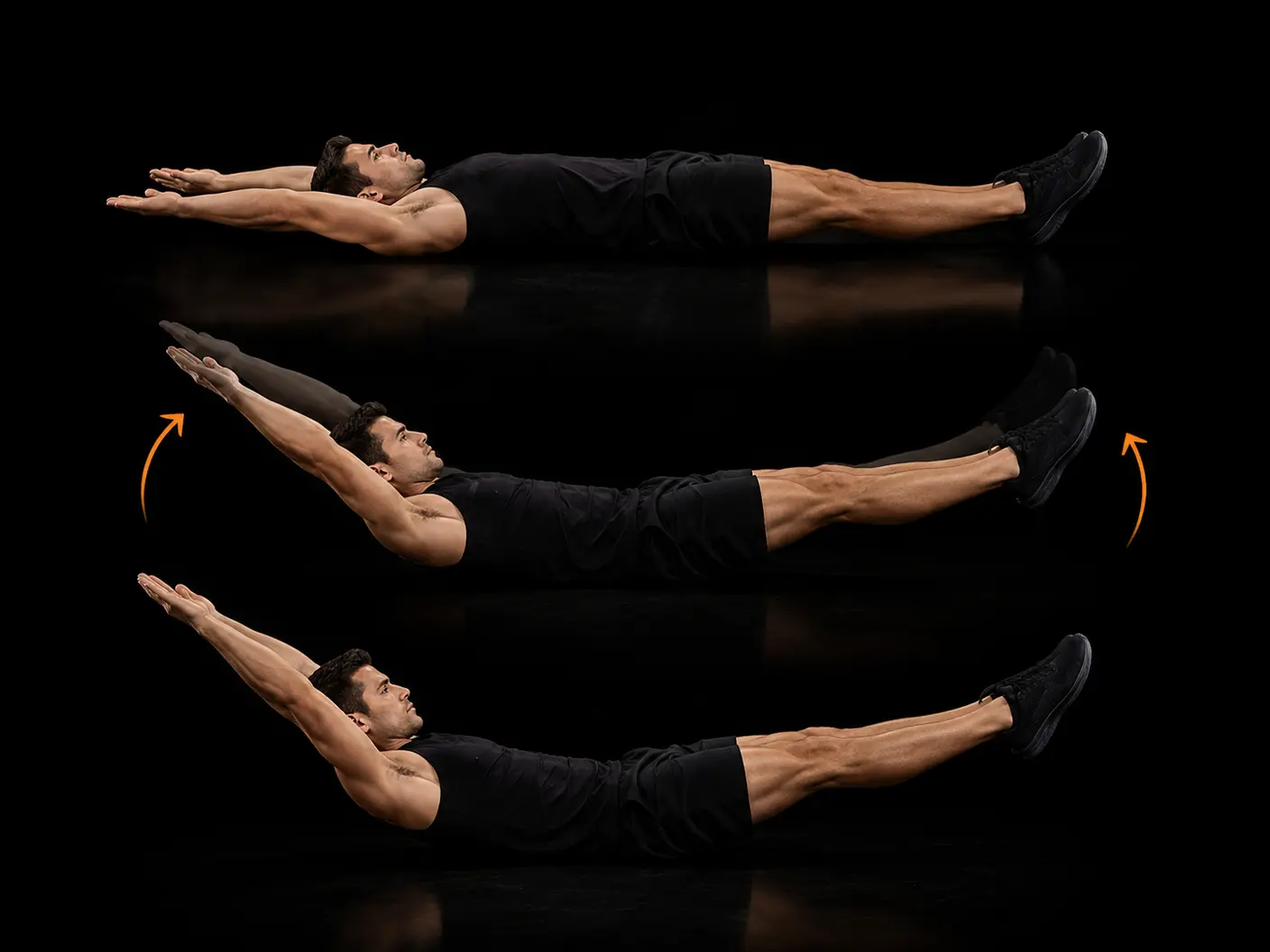
The hollow hold is a static bodyweight exercise that trains the core in an anti-extension pattern, requiring the athlete to maintain a rigid, slightly curved body position against the pull of gravity. Performed on the floor with the low back pinned flat, shoulders lifted, and legs raised, it demands sustained co-contraction of the rectus abdominis, hip flexors, TVA, and obliques simultaneously. It suits intermediate trainees looking to develop genuine midline stability rather than isolated abdominal strength alone.
How to do it
Lie on your back, low back pressed into the floor. Lift the shoulders and legs off the floor into a 'banana' shape, arms overhead. Maintain this rigid hollow shape; tuck the pelvis, brace the abs. Hold for time.
Coaching cues
- Low back pinned
- Banana shape
- Pointed toes
- Steady breathing
Why train it
- Builds enduring anti-extension strength through the entire anterior chain, making it directly transferable to gymnastics, lifting, and running mechanics.
- Because it requires no equipment whatsoever, it can be programmed as a warm-up, finisher, or standalone core session regardless of training environment.
- The isometric nature of the hold develops the capacity to brace under sustained tension, a quality that underpins safe technique in heavier compound lifts such as the squat and deadlift.
- Training the rectus abdominis and hip flexors together in a co-contraction pattern reinforces pelvic control that carries over to virtually every athletic movement pattern.
Common mistakes
- Allowing the low back to arch off the floor — tuck the pelvis actively and think of pressing the lumbar spine into the ground before lifting anything else.
- Raising the legs too high to compensate for insufficient core strength — lower legs only increase the lever arm and demand; if the back lifts, raise the legs until control is restored.
- Holding the breath to manage the tension — practise steady, controlled breathing throughout the hold, as the ability to breathe under a rigid brace is the point of the exercise.
- Letting the shoulders sink back down mid-set — keep the shoulder blades lifted clear of the floor for the duration, treating the upper and lower body as a single connected unit.
Primary: Rectus Abdominis, Hip Flexors.
Secondary: Transverse Abdominis, Obliques.
Equipment
Good for
Easier variation
Tucked hollow hold (knees bent) — shorter lever, easier entry.
Similar movements
Frequently asked
- What muscles does the hollow hold work?
- The primary muscles are the rectus abdominis and hip flexors, which work together to maintain the curved hollow position. The TVA and obliques contribute as secondary stabilisers, keeping the trunk rigid and the pelvis tucked throughout the hold.
- How long should I hold a hollow hold and how many sets should I do?
- A useful starting target is three to four sets of 20–30 seconds with full control, progressing toward sets of 45–60 seconds as competency improves. Quality of position matters more than duration; end the set the moment the low back lifts from the floor.
- What is the difference between a hollow hold and a plank?
- The plank is primarily a prone anti-extension exercise that loads the posterior and lateral chain, whereas the hollow hold is a supine exercise that emphasises the anterior chain — specifically the rectus abdominis and hip flexors under a sustained co-contraction. Both train midline stability but from different positions and with different muscular emphases.
- Is the hollow hold suitable for beginners?
- It is classified as an intermediate movement because maintaining a flat lumbar spine while simultaneously holding the legs and shoulders off the floor requires a reasonable baseline of core strength and body awareness. Beginners may find it useful to start with one limb raised at a time — for example, arms only or legs only — before combining both.
- What exercises can I do instead of the hollow hold?
- Movements that train a similar anti-extension pattern include the dead bug, which allows each limb to be loaded independently and offers more control over intensity, and the ab wheel rollout, which challenges anti-extension in a more dynamic way. Both make practical alternatives depending on training goal and equipment availability.
Want this movement in a plan built for you?
Adaptiv programmes the right exercises for your goal, equipment and experience — then adapts them as you train.
Build my programme