L-Sit
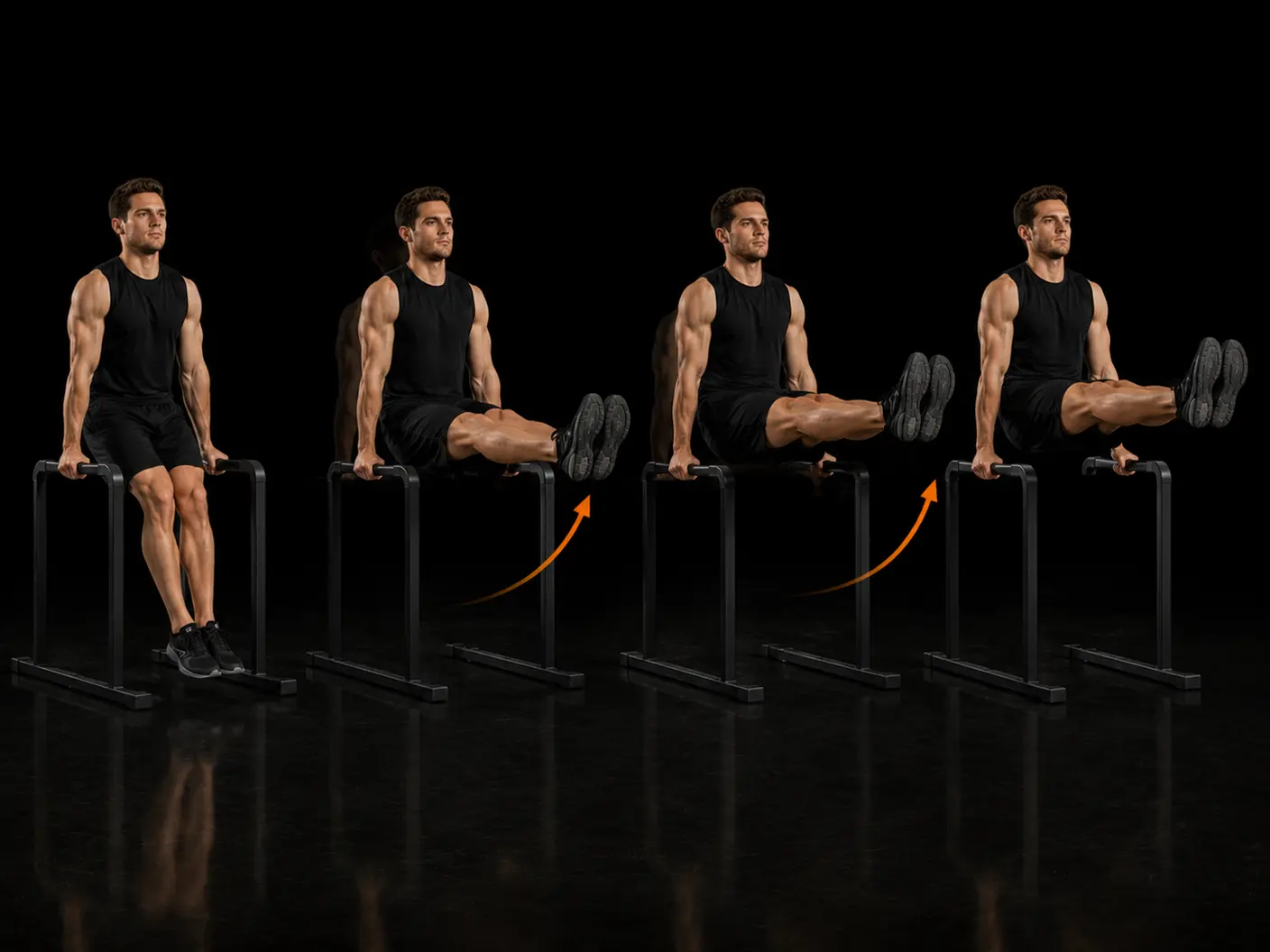
The L-sit is an isometric bodyweight hold in which the lifter supports their entire body weight on straight arms while maintaining the legs parallel to the floor, forming the eponymous L-shape. It trains anti-extension of the core alongside significant demands on hip flexor strength, triceps, and the ability to depress and stabilise the shoulder girdle simultaneously. It suits intermediate to advanced trainees who have already developed a foundation of pressing strength and core control.
How to do it
Support bodyweight on straight arms (parallettes or floor). Depress the shoulders. Lift the legs until they are parallel to the floor — L-shape. Keep the legs straight and together. Hold for time.
Coaching cues
- Shoulders depressed
- Legs straight
- Parallel to the floor
- Tight core
Why train it
- It develops genuine hip flexor strength under load, since holding the legs parallel to the floor requires active, sustained muscular effort rather than passive positioning.
- The strict requirement to keep the arms straight and shoulders depressed builds triceps endurance and scapular stability that transfers well to other gymnastic and pressing movements.
- As an isometric hold, it improves the lifter's ability to brace and maintain intra-abdominal pressure for extended durations, reinforcing core anti-extension patterns.
- It can be progressed or regressed simply by adjusting the implement — parallettes, parallel bars, or the floor — making it adaptable within a home or gym setting.
Common mistakes
- Allowing the shoulders to shrug upward — actively depress the scapulae before lifting the legs and maintain that depression throughout the hold.
- Bending the knees to make the position easier — keep the legs fully extended and together from the start, even if this means reducing the hold duration initially.
- Letting the hips sag so the legs drop below parallel — focus on driving the thighs upward toward the floor-parallel position rather than simply holding whatever height feels comfortable.
- Holding the breath rather than maintaining a controlled brace — breathe steadily while keeping the core tight, as prolonged breath-holding will cut the set short unnecessarily.
Primary: Hip Flexors, Rectus Abdominis, Triceps Brachii.
Secondary: Quadriceps, Latissimus Dorsi.
Equipment
Good for
Easier variation
Tuck L-sit (knees bent) — shorter lever, easier entry.
Similar movements
Frequently asked
- What muscles does the L-sit work?
- The primary muscles are the hip flexors, rectus abdominis, and triceps. The quadriceps and lats contribute as secondary muscles, with the lats assisting in shoulder depression and the quadriceps helping to keep the legs fully extended.
- How long should I hold an L-sit?
- For strength and skill development, accumulate total hold time in sets of three to five seconds when learning the movement, building toward a continuous hold of ten to thirty seconds as competency improves. Programme multiple sets with short rest periods rather than grinding a single maximal hold.
- What are good progressions if I cannot hold a full L-sit yet?
- Begin by tucking both knees toward the chest rather than extending the legs, which reduces the lever arm considerably. From there, extend one leg at a time before attempting the full bilateral hold. Strengthening the hip flexors with hanging knee raises and building triceps lockout strength will also accelerate progress.
- Can I do an L-sit on the floor without parallettes?
- Yes, though the range available is limited because the hands need to be elevated enough to allow the legs to clear the ground. Parallettes or parallel bars provide more clearance and are generally preferable; if using the floor, placing the hands on books or low blocks can help create the necessary height.
- How does the L-sit fit into a training programme?
- It works well as a skill and strength accessory after primary pressing or pulling work, or as part of a gymnastic-style circuit. Two to four sets of maximal holds, with sixty to ninety seconds of rest between sets, is a practical starting point for most trainees.
Want this movement in a plan built for you?
Adaptiv programmes the right exercises for your goal, equipment and experience — then adapts them as you train.
Build my programme