Tuck Front Lever
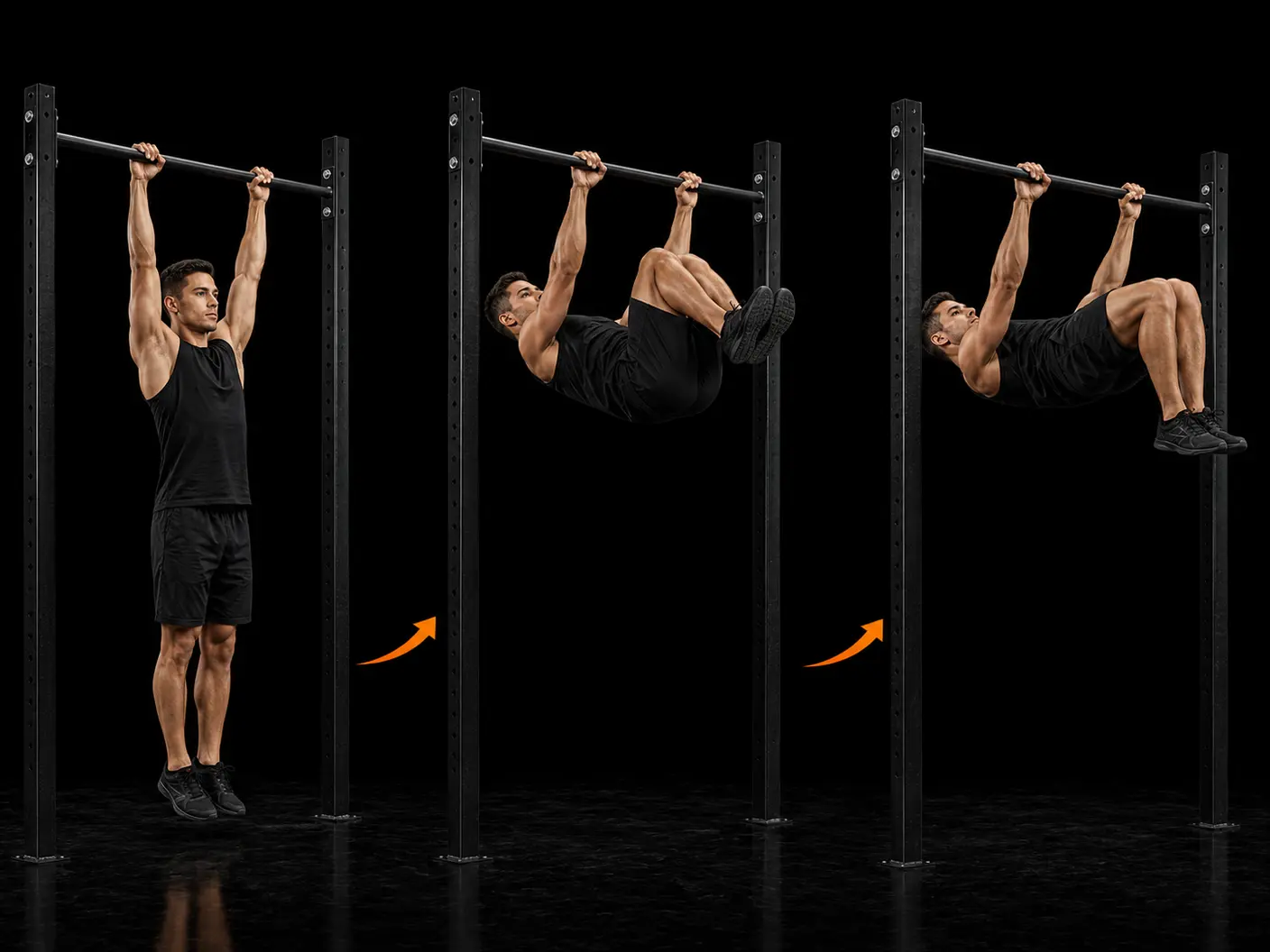
The tuck front lever is a static gymnastic hold performed on a pull-up bar or rings, in which the body is suspended horizontally with the knees drawn tightly to the chest. It trains the horizontal pull pattern under isometric load, demanding coordinated effort from the lats, posterior shoulders, and core to maintain a rigid, parallel position against gravity. It suits intermediate-to-advanced trainees building towards the full front lever or seeking to develop serious pulling strength and body-tension awareness.
How to do it
Hang from a bar with a pronated grip. Pull the body up and into a tuck position, bringing the knees to the chest. Lean back so the torso is parallel to the floor, knees still tucked. Hold. The body is horizontal.
Coaching cues
- Lean back to horizontal
- Knees tight to chest
- Drive the arms down
- Hollow body
Why train it
- Develops high levels of lat and posterior shoulder strength through an isometric horizontal pull that is difficult to replicate with conventional bar movements.
- Training the hollow-body position under load builds the core stiffness required for more advanced gymnastic progressions and compound pulling work.
- Because it is performed on a bar or rings with bodyweight only, it requires minimal equipment while imposing a substantial strength demand.
- The tuck variation offers a manageable entry point into front lever training, allowing a lifter to accumulate quality hold time before progressing to more demanding lever variants.
Common mistakes
- Allowing the hips to drop below horizontal — actively drive the arms downward and brace the core to keep the torso level throughout the hold.
- Letting the lower back arch rather than maintaining a hollow position — tuck the pelvis and squeeze the abdominals so the spine stays neutral.
- Keeping the knees too loose or partially open — draw them firmly to the chest to shorten the lever and make the position mechanically achievable.
- Initiating the hold with a swing or kip — pull the body into position under control, as momentum undermines the isometric demand the exercise is intended to develop.
Primary: Latissimus Dorsi, Rectus Abdominis, Posterior Deltoid.
Secondary: Forearm Flexors, Biceps Brachii.
Equipment
Good for
Easier variation
Tuck front lever with feet on the ground — partial lean only.
Similar movements
Frequently asked
- What muscles does the tuck front lever work?
- The primary muscles are the latissimus dorsi, core, and posterior shoulder. The biceps and grip musculature contribute as secondary stabilisers throughout the hold.
- How long should I hold the tuck front lever?
- A useful starting point is accumulating three to five sets of five- to ten-second holds with full control of the position. As strength and body tension improve, aim to progress hold duration before moving to harder lever progressions.
- Is the tuck front lever suitable for beginners?
- The movement is classified as expert difficulty and assumes a solid foundation in pulling strength — typically comfortable with weighted pull-ups and good body-tension awareness. Beginners should develop those qualities first before attempting front lever progressions.
- What are the best alternatives if I cannot yet hold the tuck front lever?
- Scapular pull-ups and hollow-body dead hangs build the foundational pulling and bracing qualities needed. Inverted rows performed with a slow, controlled tempo also develop the horizontal pull pattern at a more accessible load.
- What is the difference between performing the tuck front lever on a bar versus rings?
- A bar provides a fixed, stable surface that many lifters find easier to learn on, as grip position is fixed. Rings introduce rotational instability, which increases the demand on shoulder stabilisers and grip, making them the more challenging option once the bar position is secure.
Want this movement in a plan built for you?
Adaptiv programmes the right exercises for your goal, equipment and experience — then adapts them as you train.
Build my programme