Front Lever
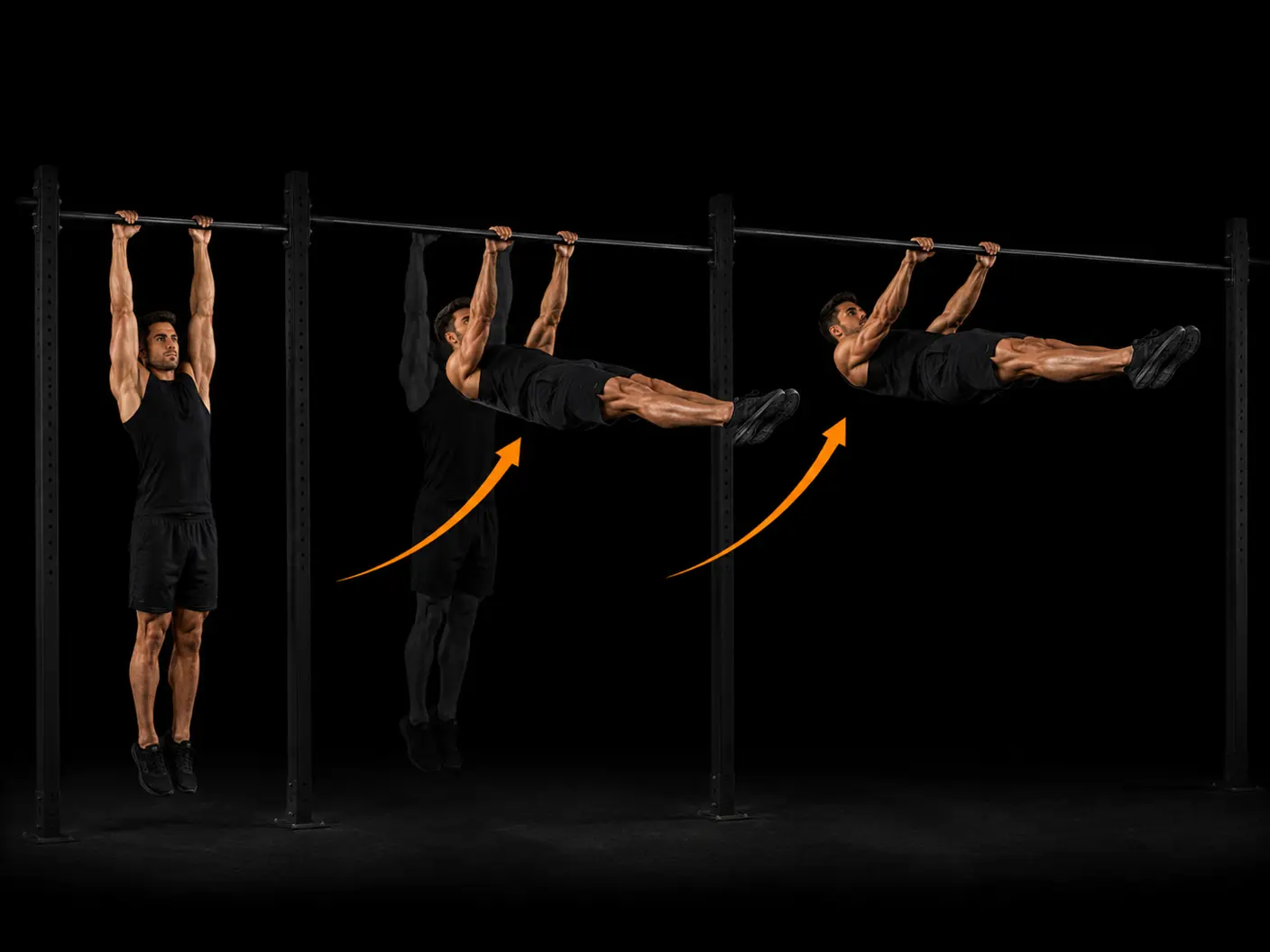
The front lever is a static gymnastics hold performed on a pull-up bar or rings, in which the body is held horizontally face-up with arms fully extended. It trains the core anti-extension pattern under extreme load, demanding simultaneous lat engagement, shoulder depression, and full-body tension to resist gravity pulling the hips downward. It suits experienced trainees with an established pulling foundation who are looking to develop high-level relative strength and body control.
How to do it
Hang from a bar or rings with a pronated grip. Engage the lats, depress the shoulder blades, and raise the body to a horizontal position — creating a straight line from head to heels, face up. Arms remain fully extended. Maintain this rigid hollow-body horizontal hold for as long as possible.
Coaching cues
- Depress and retract shoulder blades
- Hollow body
- Arms locked
- Horizontal from head to heel
Why train it
- The front lever develops exceptional lat and core strength by requiring both muscle groups to work isometrically against significant gravitational demand.
- Because bodyweight is the only load, progress is tied directly to relative strength — making it a reliable marker of functional upper-body and trunk capacity.
- The hollow-body position reinforces full-body tension and postural awareness that transfers to other compound pulling and pressing movements.
- Performing the hold on gymnastics rings adds a stabilisation demand through the shoulder girdle, increasing recruitment of the posterior deltoid, rhomboids, and middle trapezius.
Common mistakes
- Allowing the hips to sag below horizontal — brace the core aggressively and squeeze the glutes to maintain a straight line from head to heel.
- Bending the arms to compensate for insufficient lat strength — the elbows must remain fully locked throughout; if they bend, regress to a tuck or straddle variation.
- Failing to depress the shoulder blades — actively pull the shoulders away from the ears before and during the hold to protect the joint and engage the lats correctly.
- Losing the hollow-body position by arching the lower back — press the ribcage down, posteriorly tilt the pelvis, and treat the entire torso as a single rigid unit.
Primary: Latissimus Dorsi, Rectus Abdominis.
Secondary: Biceps Brachii, Posterior Deltoid, Trapezius, Rhomboids.
Equipment
Good for
Easier variation
Tuck Front Lever — knees pulled to chest reduces the lever arm dramatically.
Similar movements
Frequently asked
- What muscles does the front lever work?
- The primary muscles are the latissimus dorsi and rectus abdominis, which work isometrically to hold the body horizontal. The biceps brachii, posterior deltoid, middle trapezius, and rhomboids contribute as secondary stabilisers throughout the hold.
- How do I build up to a front lever if I cannot hold one yet?
- Progress through increasingly demanding tuck variations — tucked front lever, advanced tuck, single-leg, straddle, and finally full — spending time at each stage until you can hold the position for several seconds with good form. Supplementary work such as straight-arm pulldowns, hollow-body holds, and scapular depression exercises will accelerate progress.
- How many sets and reps should I do for the front lever?
- Because this is a static hold, programme it by duration rather than reps — aim for 3 to 5 sets of maximal or near-maximal holds, resting 2 to 3 minutes between sets. A common target for a working hold is 5 to 10 seconds; accumulating total time under tension across sets is a practical way to track progress.
- Is the front lever suitable for building muscle as well as strength?
- The movement does produce a meaningful hypertrophic stimulus in the lats and core given the sustained isometric tension, but it is primarily a strength and skill exercise. Those whose principal goal is muscle growth would typically complement it with higher-volume pulling work rather than relying on it as a standalone hypertrophy tool.
- Is there a difference between performing the front lever on a bar versus rings?
- On a fixed bar the grip position is set, which simplifies the stability challenge slightly. Rings allow the hands to rotate freely, increasing the demand on the shoulder stabilisers — posterior deltoid, rhomboids, and middle trapezius — and are generally considered the harder implement. Beginners to the movement are advised to establish the position on a bar before transitioning to rings.
Want this movement in a plan built for you?
Adaptiv programmes the right exercises for your goal, equipment and experience — then adapts them as you train.
Build my programme