Straight-Arm Pulldown
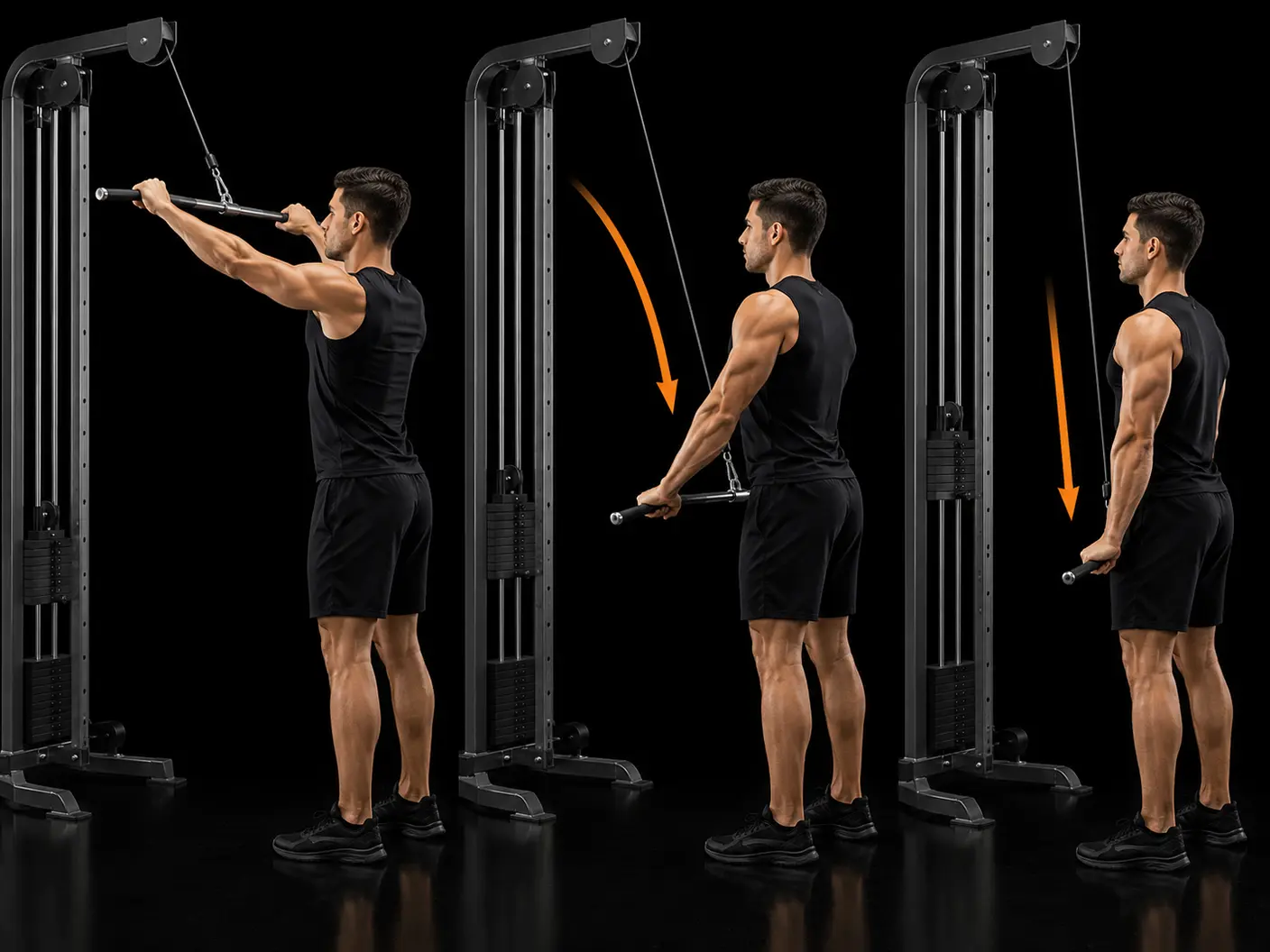
The straight-arm pulldown is a cable isolation exercise that trains the latissimus dorsi through a long arc of motion, with the arms remaining extended throughout. It sits within the pull pattern family but removes the biceps from the equation, placing almost all demand directly on the lats and their synergists. It suits lifters of any training age who want to improve lat development, mind-muscle connection, or shoulder stability under load.
How to do it
Stand facing a high pulley. Grip the bar with straight arms (or ropes), hands shoulder-width. Hinge slightly at the hips. Pull the bar down to the thighs in an arc — the arms stay straight. Squeeze the lats at the bottom. Return overhead under control.
Coaching cues
- Arms stay straight
- Pull down in an arc
- Squeeze the lats
- Overhead stretch
Why train it
- Isolating the lats with straight arms removes biceps dominance, making it easier to feel and develop the target muscle directly.
- The overhead stretch position at the top of each rep loads the latissimus dorsi in a lengthened state, which is associated with greater hypertrophic stimulus.
- The teres major and long head of the triceps act as synergists, meaning shoulder extension and upper-arm development are supported alongside primary lat work.
- Because the load is applied through a cable, tension remains consistent across the full arc, unlike free-weight alternatives that lose resistance at the bottom of the movement.
Common mistakes
- Allowing the elbows to bend during the pull — keep the arms fully extended from start to finish so the load stays on the lats rather than shifting to the biceps.
- Cutting the range of motion short at the top — let the bar travel fully overhead to achieve the lat stretch that makes the exercise effective.
- Using momentum by rocking the torso — maintain a stable hip hinge position and drive the movement purely from the shoulder joint.
- Collapsing the chest as the bar descends — keep the chest lifted and the shoulders drawn back to ensure the lats, not the shoulders, are doing the work.
Primary: Latissimus Dorsi.
Secondary: Teres Major, Triceps Brachii, Trapezius.
Equipment
Good for
Easier variation
Dumbbell pullover — similar lat stretch and contraction pattern.
Similar movements
Frequently asked
- What muscles does the straight-arm pulldown work?
- The primary muscle is the latissimus dorsi. The teres major, long head of the triceps, and lower traps all contribute as secondary muscles throughout the arc.
- How many sets and reps should I do for the straight-arm pulldown?
- For hypertrophy, 3–4 sets of 10–15 reps works well, using a weight that allows full range of motion with controlled tempo. A deliberate pause and squeeze at the bottom of each rep improves the mind-muscle connection over time.
- Is the straight-arm pulldown a good warm-up before pull-ups or rows?
- Yes — it is commonly used as a primer before compound pulling movements because it activates the lats without fatiguing the biceps, helping establish the neural connection to the target muscle early in a session.
- What is the difference between using a straight bar and a rope attachment?
- A straight bar keeps the hands in a fixed pronated position throughout the movement, while a rope allows the wrists to rotate and the hands to separate slightly at the bottom, which some lifters find produces a stronger lat contraction. Both are effective; the choice is largely one of personal preference and comfort at the wrist and elbow.
- Can beginners do the straight-arm pulldown?
- Yes — it is classified as a foundational exercise and is appropriate for newer lifters, provided the load is light enough to maintain straight arms and a stable torso throughout. It is an effective way to learn lat engagement before progressing to more demanding compound pull movements.
Want this movement in a plan built for you?
Adaptiv programmes the right exercises for your goal, equipment and experience — then adapts them as you train.
Build my programme