Cable Pullover
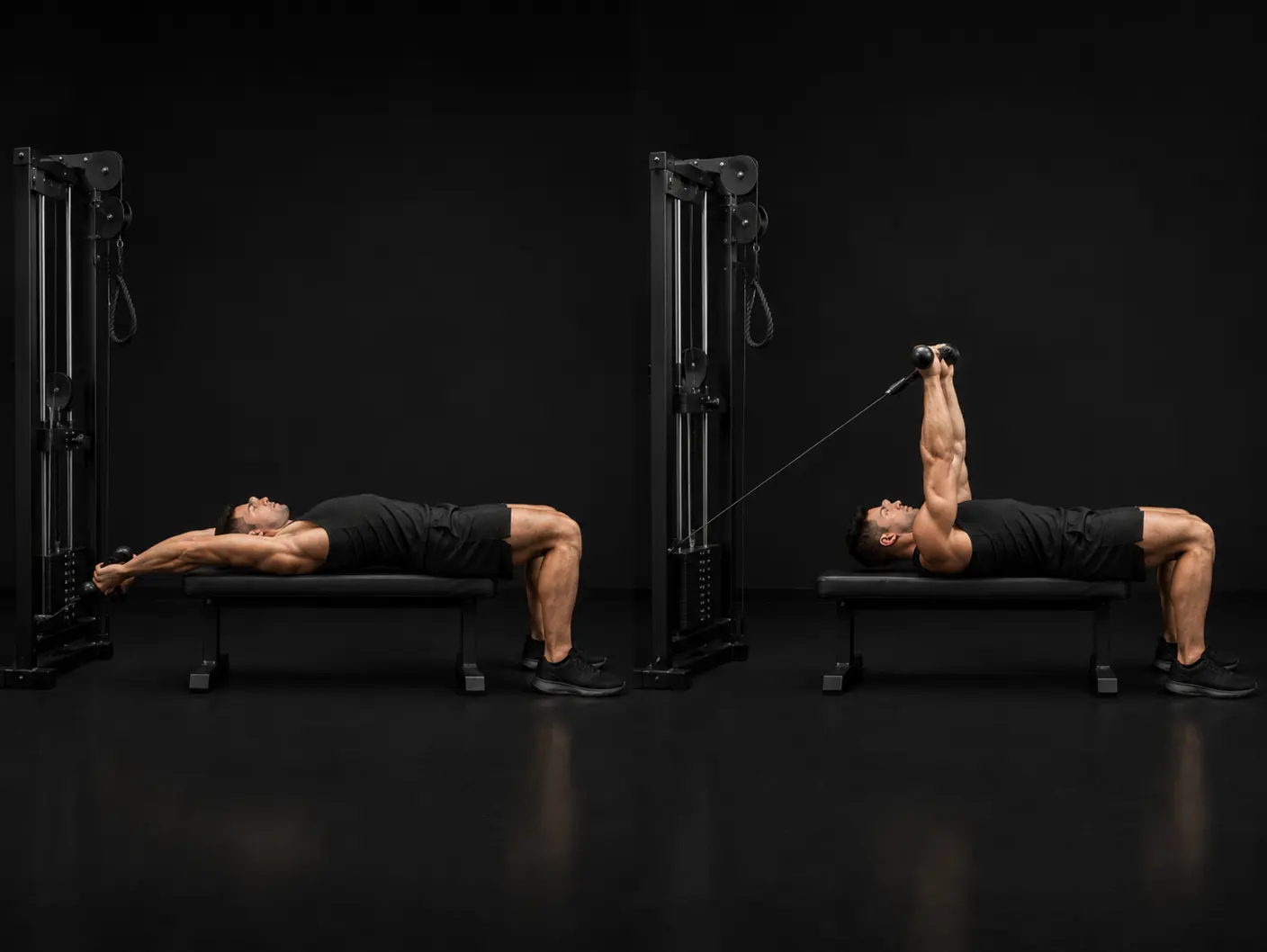
The cable pullover is an upper-body isolation exercise performed lying on a flat bench beneath a high pulley, using a rope or bar attachment to arc the load from an overhead stretch to the hips. It trains the shoulder extension pattern under continuous cable tension, which maintains resistance through both the contracted and lengthened positions in a way a dumbbell pullover cannot fully replicate. It suits intermediate trainees looking to develop lat thickness and width, and works well as an accessory movement within a hypertrophy-focused pull or back session.
How to do it
Set a high pulley. Lie on a flat bench perpendicular to or under the cable stack, head near the machine. Grip the rope or bar overhead with a slight elbow bend. Pull the attachment from overhead to the hips in an arc, keeping the arms nearly straight. Pause at peak contraction. Return slowly to the full overhead stretch.
Coaching cues
- Slight elbow bend
- Arc from overhead to hips
- Squeeze the lats
- Slow return to stretch
Why train it
- The cable's constant tension keeps the latissimus dorsi loaded throughout the full arc, maximising time under tension across both the stretch and contraction phases.
- Performing the movement in a near-straight-arm position isolates the lats and supporting musculature without the biceps acting as a limiting factor, as they might in a rowing pattern.
- The overhead start position places the lats and serratus anterior in a deep stretch, which research suggests may enhance hypertrophic stimulus when followed by a controlled contraction.
- It is relatively low in spinal loading compared to many compound back exercises, making it a practical option for accumulating lat volume late in a session.
Common mistakes
- Bending the elbows excessively — maintain a fixed, slight elbow bend throughout the arc so the movement stays at the shoulder joint rather than becoming a triceps pushdown.
- Using too much load and shortening the range — select a weight that allows the arms to travel all the way overhead into a full lat stretch, as cutting the range short removes much of the exercise's value.
- Letting the hips rise off the bench — keep the lower body stable and anchored so the lats, rather than momentum or trunk movement, are driving the arc.
- Rushing the return phase — control the attachment slowly back to the overhead position to maintain tension and take full advantage of the lengthened stretch.
Primary: Latissimus Dorsi.
Secondary: Pectoralis Major, Triceps Brachii, Serratus Anterior.
Equipment
Good for
Easier variation
Straight-arm pulldown — same lat activation standing, shorter range.
Similar movements
Frequently asked
- What muscles does the cable pullover work?
- The primary muscle is the latissimus dorsi. The pectoralis major (sternal head), long head of the triceps, and serratus anterior all contribute as secondary muscles during the movement.
- How many sets and reps should I do for the cable pullover?
- For hypertrophy, three to four sets of ten to fifteen reps works well, with a controlled tempo and a deliberate pause at peak contraction. Because it is an isolation exercise, it is best placed after compound movements in a session.
- What is the difference between a cable pullover and a dumbbell pullover?
- The cable version maintains resistance throughout the entire arc due to the pulley system, whereas a dumbbell provides peak load only at the bottom of the range and reduces tension at the top. This makes the cable variation generally more effective for sustained lat stimulation.
- Is the cable pullover suitable for beginners?
- It is classed as an intermediate exercise, primarily because it requires a degree of lat awareness and the ability to dissociate shoulder movement from elbow flexion. Beginners may find it more productive to build that body awareness through compound pulling movements first.
- What are good alternatives to the cable pullover?
- The dumbbell pullover and the straight-arm lat pulldown both train a similar shoulder extension pattern and can be used as substitutes if a cable setup is unavailable or if you want to vary the stimulus.
Want this movement in a plan built for you?
Adaptiv programmes the right exercises for your goal, equipment and experience — then adapts them as you train.
Build my programme