Wide-Grip Lat Pulldown
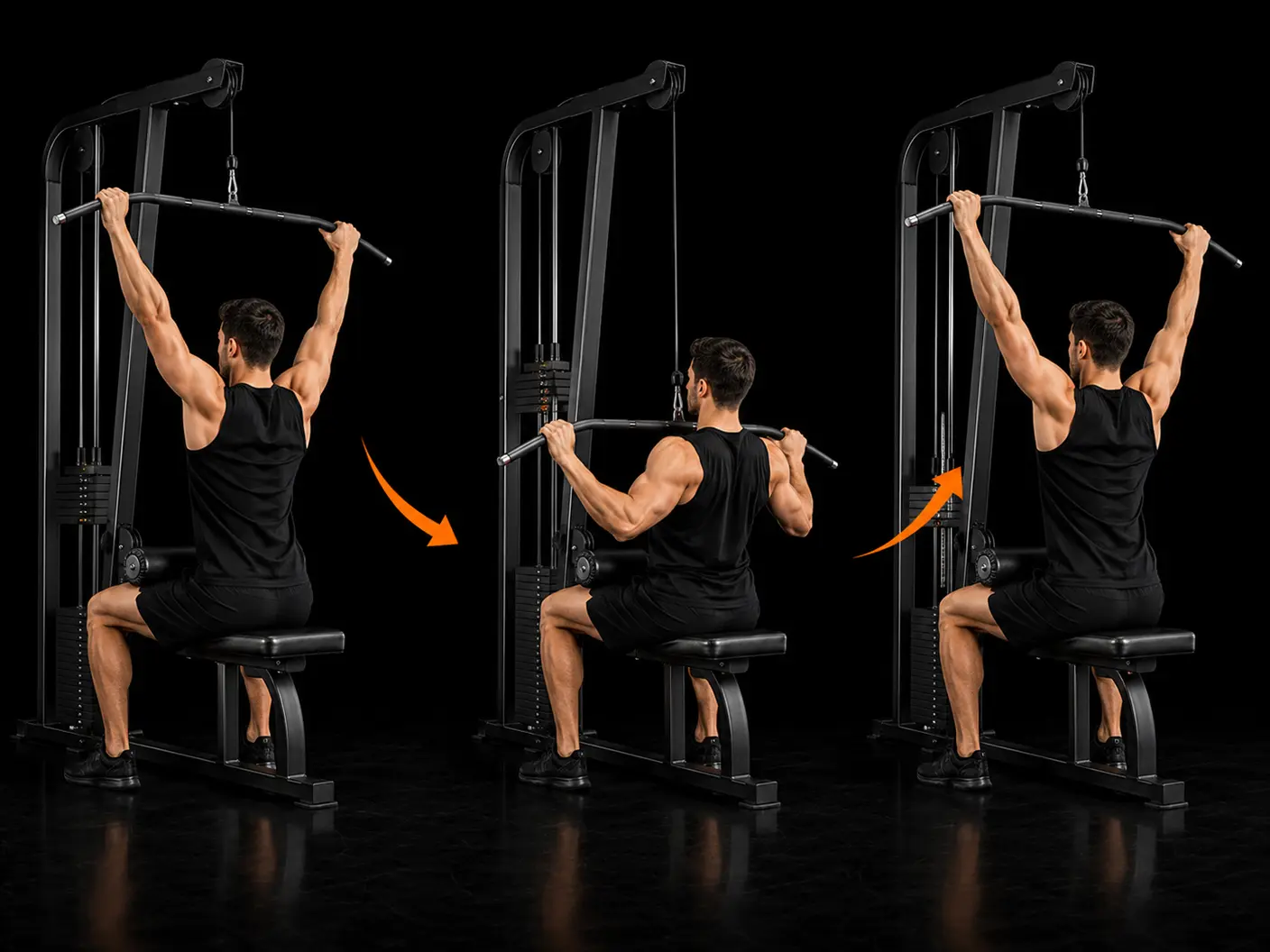
The wide-grip lat pulldown is a machine-based vertical pulling exercise that trains the latissimus dorsi and teres major through a full range of shoulder adduction and extension. Performed on a lat pulldown machine with a pronated grip set wider than shoulder-width, it suits anyone from beginners building foundational pulling strength to more experienced trainees pursuing back hypertrophy. The fixed machine path makes it a reliable option for learning the mechanics of a vertical pull before progressing to bodyweight alternatives.
How to do it
Sit with knees under the pad, feet flat. Grip the bar wider than shoulder-width, pronated. Hang from the bar with active shoulders. Lean back 15–20°. Pull the bar to the upper chest by driving the elbows down and back. Pause at peak contraction. Return under control to a full stretch.
Coaching cues
- Lean back slightly
- Pull elbows down
- Bar to upper chest
- Full stretch at the top
Why train it
- A wide grip places a strong mechanical emphasis on the latissimus dorsi and teres major, making it an effective choice for developing back width and thickness.
- The lat pulldown machine provides a stable, guided movement path, allowing trainees to focus on muscle activation and control rather than balance, which supports consistent technique development.
- Training through a full range — from a complete overhead stretch to peak contraction at the upper chest — maximises the stimulus to the primary muscles across their full working length.
- The biceps and rhomboids contribute meaningfully as secondary movers, meaning the exercise builds pulling capacity across multiple muscle groups within a single compound movement.
Common mistakes
- Using momentum to swing the torso — maintain a controlled 15–20° fixed lean throughout the set rather than rocking back and forth to assist the pull.
- Pulling the bar to the lower chest or abdomen — aim for the upper chest, as pulling further down shortens the range of effective lat engagement and increases stress on the shoulder joint.
- Allowing the shoulders to shrug up toward the ears at the top — begin each rep with active shoulders set down and back before initiating the pull.
- Letting the weight stack rush upward on the return — control the eccentric phase all the way to a full overhead stretch, as this portion of the rep is where significant muscle development stimulus occurs.
Primary: Latissimus Dorsi, Teres Major.
Secondary: Biceps Brachii, Rhomboids, Trapezius.
Equipment
Good for
Easier variation
Narrower grip or neutral grip — easier to load and better lat stretch.
Similar movements
Frequently asked
- What muscles does the wide-grip lat pulldown work?
- The primary muscles are the latissimus dorsi and teres major, which drive shoulder adduction and extension throughout the pull. The biceps, rhomboids, and middle trapezius work as secondary muscles to assist elbow flexion and scapular retraction.
- How many sets and reps should I do for the wide-grip lat pulldown?
- For hypertrophy, three to four sets of eight to twelve repetitions with a controlled tempo is a well-supported approach. For general fitness and technique development, three sets of ten to fifteen reps at a moderate load works well, prioritising full range of motion over heavier weight.
- What is the difference between a wide grip and a standard grip on the lat pulldown?
- A wider grip places the arms at a greater angle of shoulder abduction at the start of the movement, which emphasises the outer fibres of the latissimus dorsi and can contribute to the appearance of back width. A closer or neutral grip tends to allow a slightly longer effective range of motion and greater biceps involvement.
- Is the wide-grip lat pulldown a good alternative to pull-ups?
- It trains the same primary muscles and movement pattern as the pull-up, making it a practical alternative for those building the pulling strength needed to perform bodyweight pull-ups. It can also be used alongside pull-ups to add volume without the same level of fatigue to the stabilising muscles.
- Should I pull the bar behind my neck on the wide-grip lat pulldown?
- The form described here brings the bar to the upper chest, and this is the recommended technique. Pulling behind the neck places the cervical spine and shoulder joint in a compromised position and is not necessary to achieve a strong lat contraction.
Want this movement in a plan built for you?
Adaptiv programmes the right exercises for your goal, equipment and experience — then adapts them as you train.
Build my programme