Close-Grip Lat Pulldown
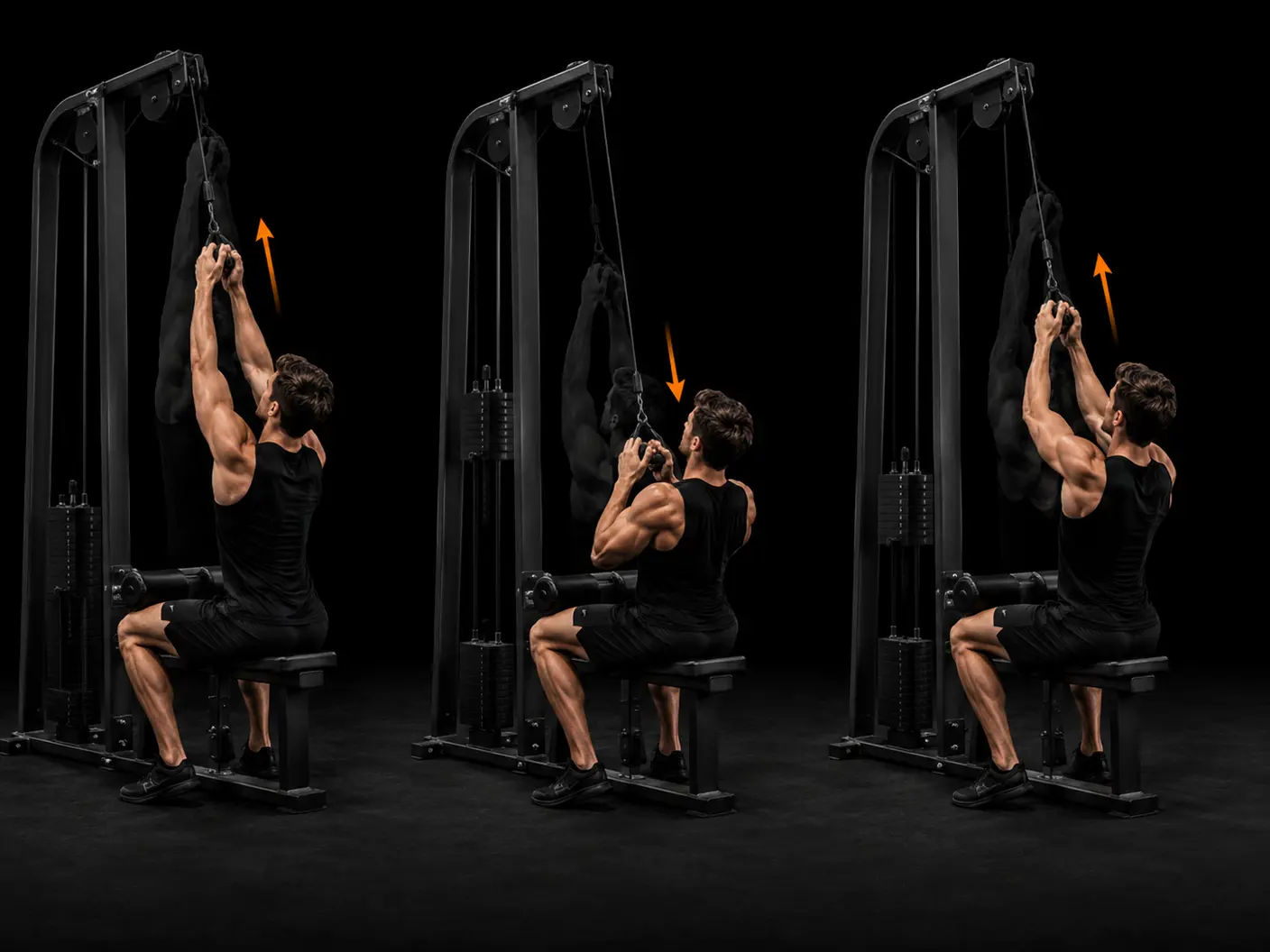
The close-grip lat pulldown is a machine-based vertical pulling exercise performed with a parallel or supinated handle, bringing the grip closer than a standard wide-grip pulldown. It trains the fundamental pattern of pulling the upper arms down toward the torso, placing significant demand on the latissimus dorsi while the narrower grip allows a more natural wrist and elbow path through the range of motion. It suits beginners building a foundation in upper-body pulling as well as intermediate lifters seeking to add volume to back development.
How to do it
Attach a close-grip (parallel or supinated) handle to the lat pulldown machine. Sit with knees under the pad, feet flat. Grip the handle at shoulder-width or closer, palms facing each other or toward you. Lean back 15–20°. Pull the handle to the sternum by driving the elbows down and back. Pause briefly. Return to a full lat stretch.
Coaching cues
- Pull elbows down
- Handle to the sternum
- Full stretch at the top
- Slow eccentric
Why train it
- The close-grip handle encourages a more neutral wrist position throughout the pull, reducing forearm fatigue and allowing greater focus on lat engagement.
- Driving the elbows down and back to bring the handle to the sternum develops the latissimus dorsi through a full, controlled range of motion, supporting back thickness and width.
- The machine setting provides a guided load path, making it a reliable option for accumulating pulling volume with consistent technique across a training session.
- Secondary involvement of the biceps brachii and brachialis means the movement contributes to elbow flexor development alongside the primary back stimulus.
Common mistakes
- Using momentum by swinging the torso excessively — maintain a fixed 15–20° lean throughout the set and initiate every rep by driving the elbows, not rocking the body.
- Pulling to the chin or upper chest instead of the sternum — focus on drawing the handle all the way down to the lower portion of the chest to maximise lat range of motion.
- Allowing the shoulders to shrug upward at the top of the rep — let the shoulder blades elevate and the lats fully lengthen at the top, but keep the shoulders away from the ears on the pull.
- Rushing the eccentric phase — control the return over two to three seconds to maintain tension through the lats and reduce the risk of losing position at the top.
Primary: Latissimus Dorsi.
Secondary: Biceps Brachii, Brachialis, Trapezius.
Equipment
Good for
Easier variation
Wide-grip lat pulldown — lighter load typical with wide grip for beginners.
Similar movements
Frequently asked
- What muscles does the close-grip lat pulldown work?
- The primary muscle worked is the latissimus dorsi. The biceps brachii, brachialis, and middle trapezius act as secondary muscles, assisting with elbow flexion and scapular control throughout the movement.
- How does the close-grip lat pulldown differ from a wide-grip pulldown?
- The close-grip version uses a parallel or supinated handle at or inside shoulder-width, which allows the elbows to travel more directly downward and typically permits a slightly greater range of motion at the shoulder. The wide-grip variation places the arms in more abduction and tends to emphasise lat width through a different line of pull.
- What sets and reps should I use for the close-grip lat pulldown?
- For hypertrophy, three to four sets of eight to twelve repetitions with a controlled tempo works well. For general fitness and technique development, three sets of ten to fifteen reps at a moderate load is a practical starting point.
- Can beginners use the close-grip lat pulldown?
- Yes — it is classified as a foundational movement and is well-suited to beginners. The machine provides a fixed path and the handle position is forgiving on the wrists, making it easier to learn the pulling pattern before progressing to more demanding variations.
- What is a good alternative to the close-grip lat pulldown?
- If the lat pulldown machine is unavailable, a cable straight-arm pulldown or a seated cable row with a similar handle targets comparable musculature. For those who can manage bodyweight, an underhand-grip assisted pull-up trains the same vertical pulling pattern with progressive load options.
Want this movement in a plan built for you?
Adaptiv programmes the right exercises for your goal, equipment and experience — then adapts them as you train.
Build my programme