Pull-Up
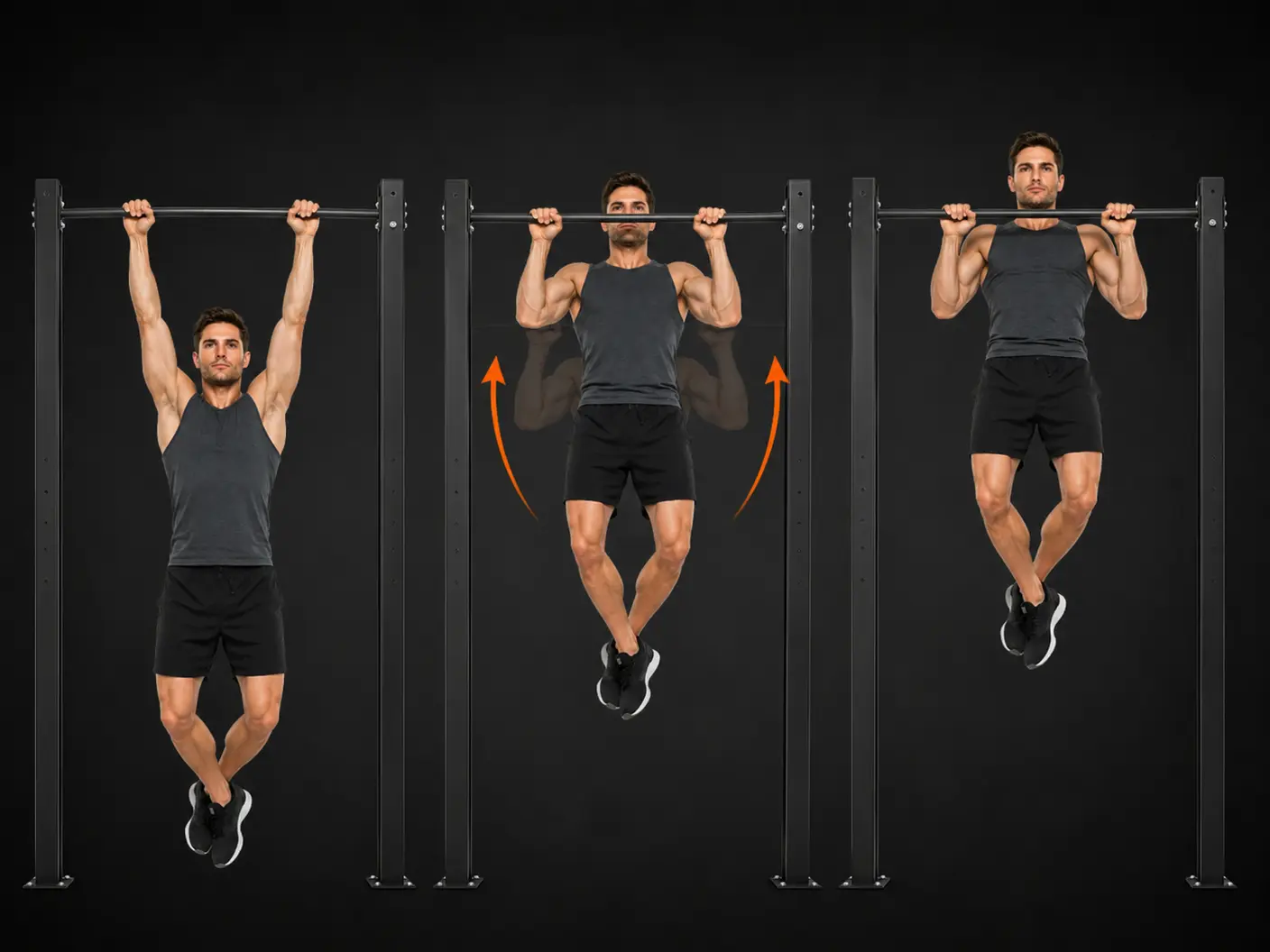
The pull-up is a compound vertical pulling movement performed on a fixed bar using a pronated (palms-away) grip. It trains the ability to move body weight through a full range of elbow and shoulder flexion, placing substantial demand on the latissimus dorsi, teres major, and biceps brachii. It suits intermediate to advanced trainees and serves as a reliable measure of relative upper-body strength.
How to do it
Hang from a bar with a pronated grip (palms away), slightly wider than shoulder-width. Dead hang — shoulders active, not jammed into the ears. Pull the chest toward the bar by driving the elbows down and back. Chin clears the bar. Lower under control to a full hang.
Coaching cues
- Pull the elbows down
- Chest to the bar
- Dead hang at the bottom
- No kipping
Why train it
- It develops the latissimus dorsi, teres major, and biceps brachii simultaneously, making it one of the most efficient upper-body pulling exercises available.
- Because the load is your own bodyweight, the pull-up provides a practical marker of strength-to-weight ratio that transfers well to athletic and functional demands.
- The requirement to maintain active shoulders throughout the movement also trains the middle and lower trapezius and rhomboids, reinforcing sound scapular mechanics under load.
- It scales well across goals — lower rep ranges with added load develop maximal strength, while moderate rep ranges at bodyweight suit hypertrophy and general fitness programming.
Common mistakes
- Starting from passive, shrugged shoulders — set the shoulder blades down and back before initiating the pull so the lats are loaded from the very first degree of movement.
- Pulling with the arms rather than driving the elbows — focus on drawing the elbows down and back toward the hips, which recruits the lats rather than allowing the biceps to dominate.
- Using a kipping or swinging action to complete the rep — maintain a controlled, near-vertical torso and eliminate momentum so the target muscles are under tension for the full range.
- Cutting the range of motion short at the bottom — return to a full dead hang between every rep to ensure the lats work through their complete lengthened position.
Primary: Latissimus Dorsi, Biceps Brachii, Teres Major.
Secondary: Brachialis, Trapezius, Rhomboids.
Equipment
Good for
Easier variation
Band-assisted pull-up or lat pulldown — reduces bodyweight load.
Similar movements
Frequently asked
- What muscles does the pull-up work?
- The primary movers are the latissimus dorsi, biceps brachii, and teres major. The brachialis, rhomboids, and middle and lower trapezius work as secondary contributors to support the pull and stabilise the scapulae throughout the movement.
- How many sets and reps should I do for pull-ups?
- For strength, three to five sets of three to six reps with added load works well. For hypertrophy or general fitness, three to four sets of six to twelve bodyweight reps, resting ninety seconds to two minutes between sets, is a practical starting point.
- I cannot do a full pull-up yet — what should I do instead?
- Assisted pull-ups using a resistance band looped over the bar, or a cable lat pulldown with a pronated grip, both train the same vertical pulling pattern and allow you to build the requisite strength progressively.
- What is the difference between a pull-up and a chin-up?
- A pull-up uses a pronated grip with palms facing away, which emphasises the latissimus dorsi and teres major. A chin-up uses a supinated grip with palms facing toward you, which places greater relative demand on the biceps brachii while still training the lats.
- Can pull-ups be used for both strength and hypertrophy goals?
- Yes — the pull-up is listed as suitable for strength, hypertrophy, and general fitness. The distinction lies in how you programme it: heavier load and lower reps for strength, moderate reps at bodyweight or with modest added load for hypertrophy.
Want this movement in a plan built for you?
Adaptiv programmes the right exercises for your goal, equipment and experience — then adapts them as you train.
Build my programme