Ab Wheel Rollout
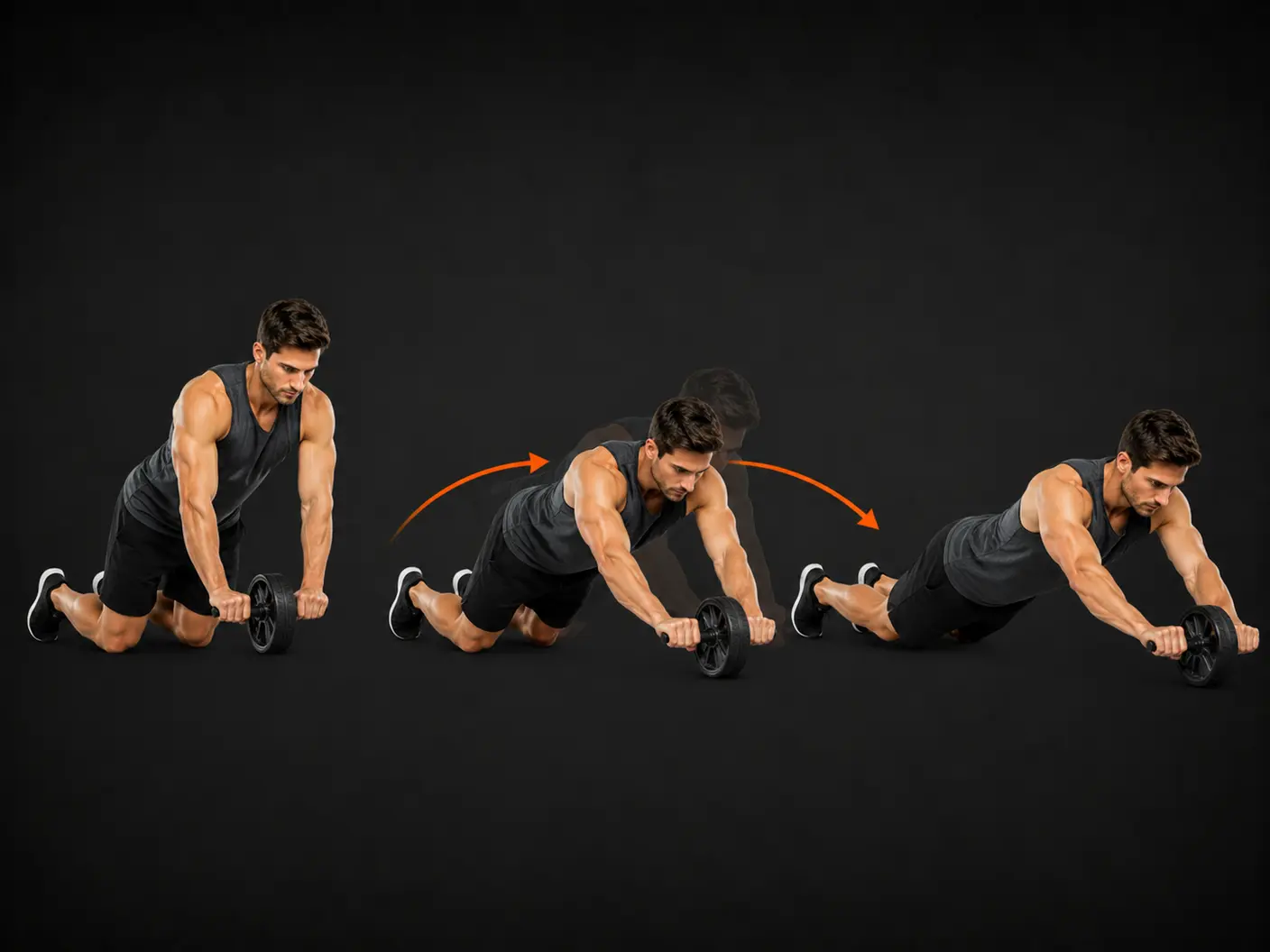
The ab wheel rollout is an advanced compound core exercise that trains anti-extension — the ability to resist the spine being pulled into extension under load. Starting from a kneeling position, you extend the wheel forward until the body is near-horizontal, then pull back using abdominal contraction rather than momentum or hip flexor drive. It suits intermediate to advanced trainees who have already established solid bracing mechanics and lumbar control.
How to do it
Kneel with the ab wheel under the shoulders. Brace hard, tuck the pelvis. Roll the wheel forward, extending the hips and shoulders. Stop before the lower back arches. Pull back to the start using the abs — not the hip flexors.
Coaching cues
- Brace hard
- Tuck the pelvis
- Stop before the back arches
- Pull with the abs
Why train it
- It trains the rectus abdominis, TVA, and obliques under a long, demanding lever, creating significant muscular challenge without adding spinal compression from external loading.
- Because the movement requires the lats, triceps, and shoulders to work alongside the core, it develops full anterior-chain coordination that isolated crunching variations cannot replicate.
- Anti-extension strength transfers directly to compound lifts such as the squat and deadlift, where resisting lumbar hyperextension under load is a performance and safety priority.
- The ab wheel is inexpensive and compact, making this one of the few advanced core movements accessible outside a fully equipped gym.
Common mistakes
- Allowing the lower back to sag at the end range — set a clear stopping point before the lumbar spine loses its neutral position and return from there, progressively extending range only as control improves.
- Pulling back with the hip flexors rather than the abs — focus on driving the ribcage toward the pelvis on the return, keeping the pelvis tucked throughout so the abdominals do the work.
- Failing to brace before the roll begins — establish full intra-abdominal pressure at the start position and maintain it for the entire repetition, not just at the point of greatest difficulty.
- Moving too quickly through both phases — control the forward roll with deliberate eccentric resistance and pause briefly at the turnaround point to eliminate momentum from the return.
Primary: Rectus Abdominis, Transverse Abdominis, Obliques.
Secondary: Latissimus Dorsi, Triceps Brachii, Anterior Deltoid.
Equipment
Good for
Easier variation
Wall rollout — roll a ball up a wall to limit the range.
Similar movements
Frequently asked
- What muscles does the ab wheel rollout work?
- The primary muscles are the rectus abdominis, transverse abdominis, and obliques, which work together to prevent the spine from extending. The lats, triceps, and shoulders act as secondary contributors, stabilising the arms and controlling the wheel throughout the movement.
- Is the ab wheel rollout suitable for beginners?
- This exercise is classified as advanced and is not recommended as a starting point for those new to core training. Beginners should first build bracing mechanics and lumbar control through exercises such as the plank and dead bug before progressing to rollout variations.
- How many sets and reps should I do?
- For hypertrophy and strength, 3–4 sets of 6–10 controlled repetitions is a practical starting range. Prioritise full control and a consistent stopping point over accumulating reps — a clean set of six is more productive than ten reps with a collapsing lower back.
- What are good alternatives if I cannot yet do a full ab wheel rollout?
- A barbell rollout on a smooth floor follows the same mechanics and allows the same progression. If the full kneeling rollout is still too demanding, you can limit the range of motion by rolling only partway forward until sufficient control is established.
- Can the ab wheel rollout help with lower back pain?
- Anti-extension core training is widely used in strength and conditioning programmes to support lumbar stability, but if you have existing lower back symptoms you should consult a qualified professional before adding this movement to your programme.
Want this movement in a plan built for you?
Adaptiv programmes the right exercises for your goal, equipment and experience — then adapts them as you train.
Build my programme