Dead Bug
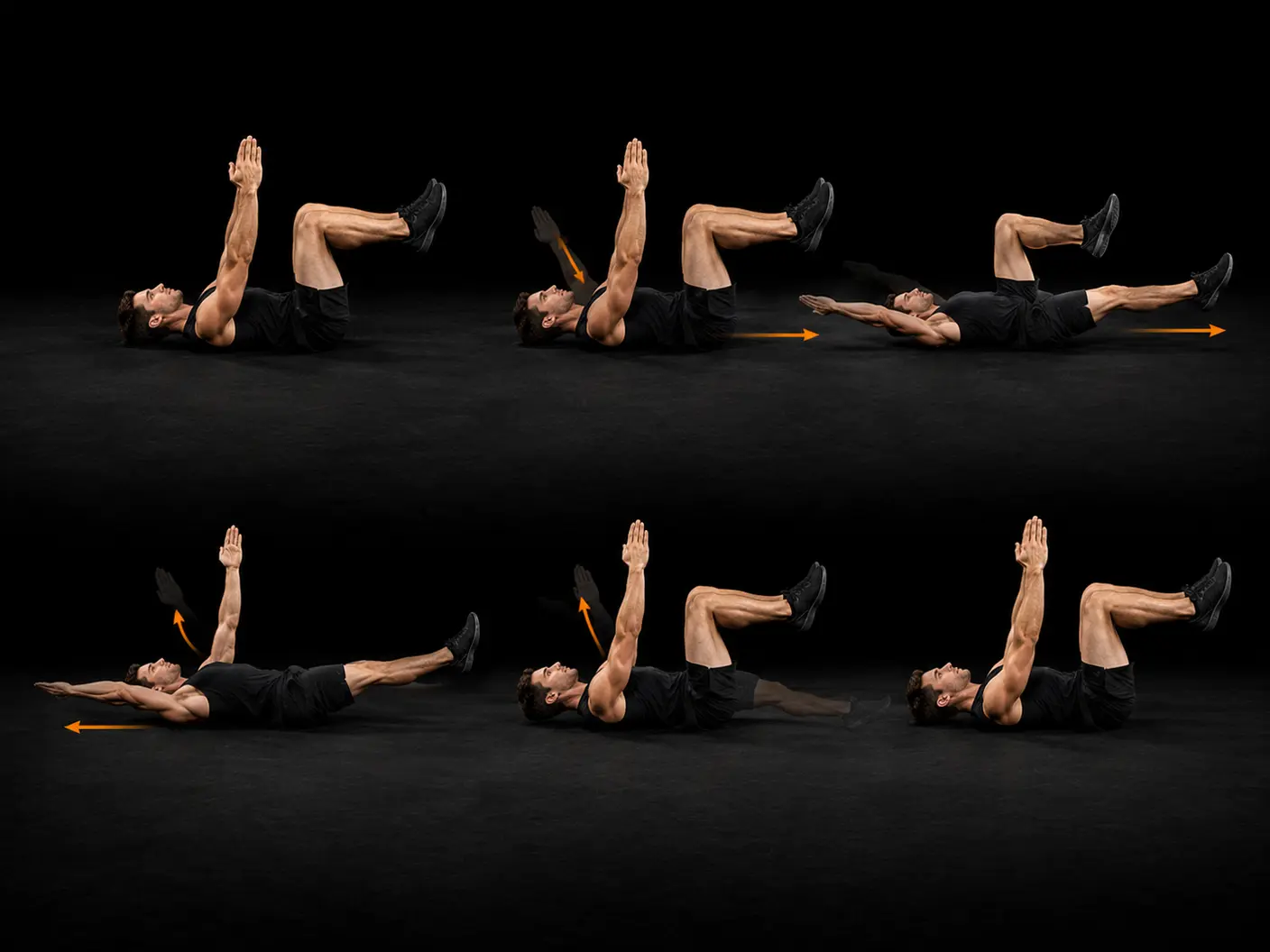
The dead bug is a supine bodyweight exercise that trains anti-extension — the ability to resist the lumbar spine arching away from neutral under load. Performed by extending opposite arm and leg while keeping the lower back pinned to the floor, it challenges the rectus abdominis, TVA, and obliques to maintain spinal position throughout the movement. It suits beginners establishing core control and more experienced trainees looking to reinforce trunk stability as a foundation for heavier compound work.
How to do it
Lie on your back, knees and hips at 90°, arms straight up over the shoulders. Press the lower back into the floor. Slowly extend the opposite arm and leg toward the floor; stop before the back arches. Return to start. Alternate sides.
Coaching cues
- Low back pinned to the floor
- Slow and controlled
- Opposite arm and leg
- Breathe throughout
Why train it
- It develops TVA and deep abdominal activation, building the foundational bracing mechanics that carry over to virtually every other loaded movement.
- The contralateral limb pattern trains coordination and anti-extension simultaneously, making it efficient for general fitness programming.
- Because it is performed on the floor with no equipment, it can be included in any session as a warm-up drill, accessory movement, or active recovery work.
- The slow, controlled tempo makes it straightforward to coach and progress, offering a clear entry point for lifters who struggle to maintain lumbar position under load.
Common mistakes
- Allowing the lower back to lift off the floor — press it firmly into the ground before and throughout each repetition, and only extend the limb as far as that contact can be maintained.
- Holding the breath during the extension — exhale steadily as the arm and leg lower, keeping the core actively engaged rather than relying on intra-abdominal pressure alone.
- Moving too quickly through the range — use a deliberate, unhurried tempo so that control rather than momentum drives the movement.
- Extending the same-side arm and leg together — the pattern is always opposite arm to opposite leg, which is what produces the rotational demand the exercise is designed to resist.
Primary: Rectus Abdominis, Transverse Abdominis, Obliques.
Secondary: Hip Flexors.
Equipment
Good for
Easier variation
Dead bug with feet only (arms stay over chest) — reduces challenge.
Similar movements
Frequently asked
- What muscles does the dead bug work?
- The primary muscles are the rectus abdominis, transverse abdominis (TVA), and obliques, which work together to prevent the lower back from arching as the limbs extend. The hip flexors assist as secondary movers during the leg extension phase.
- How many sets and reps should I do for the dead bug?
- For most general fitness goals, 2–3 sets of 8–10 controlled repetitions per side is a practical starting point. Prioritise quality of movement and lumbar contact over accumulating volume.
- Is the dead bug suitable for beginners?
- Yes — it is classified as a foundational movement precisely because it requires no equipment, loads the spine minimally, and teaches core bracing mechanics in a position that is easy to monitor and correct.
- What are good alternatives to the dead bug?
- Exercises that train the same anti-extension pattern include hollow body holds and plank variations, though these differ in position and limb load. The dead bug is often preferred early in a programme because the floor provides immediate feedback on lumbar position.
- Can the dead bug help with lower back discomfort?
- While the exercise is commonly used in rehabilitation contexts because of its low-load, floor-supported position, anyone experiencing lower back pain or a known condition should check with a qualified professional before including it in their programme.
Want this movement in a plan built for you?
Adaptiv programmes the right exercises for your goal, equipment and experience — then adapts them as you train.
Build my programme