Barbell Rollout
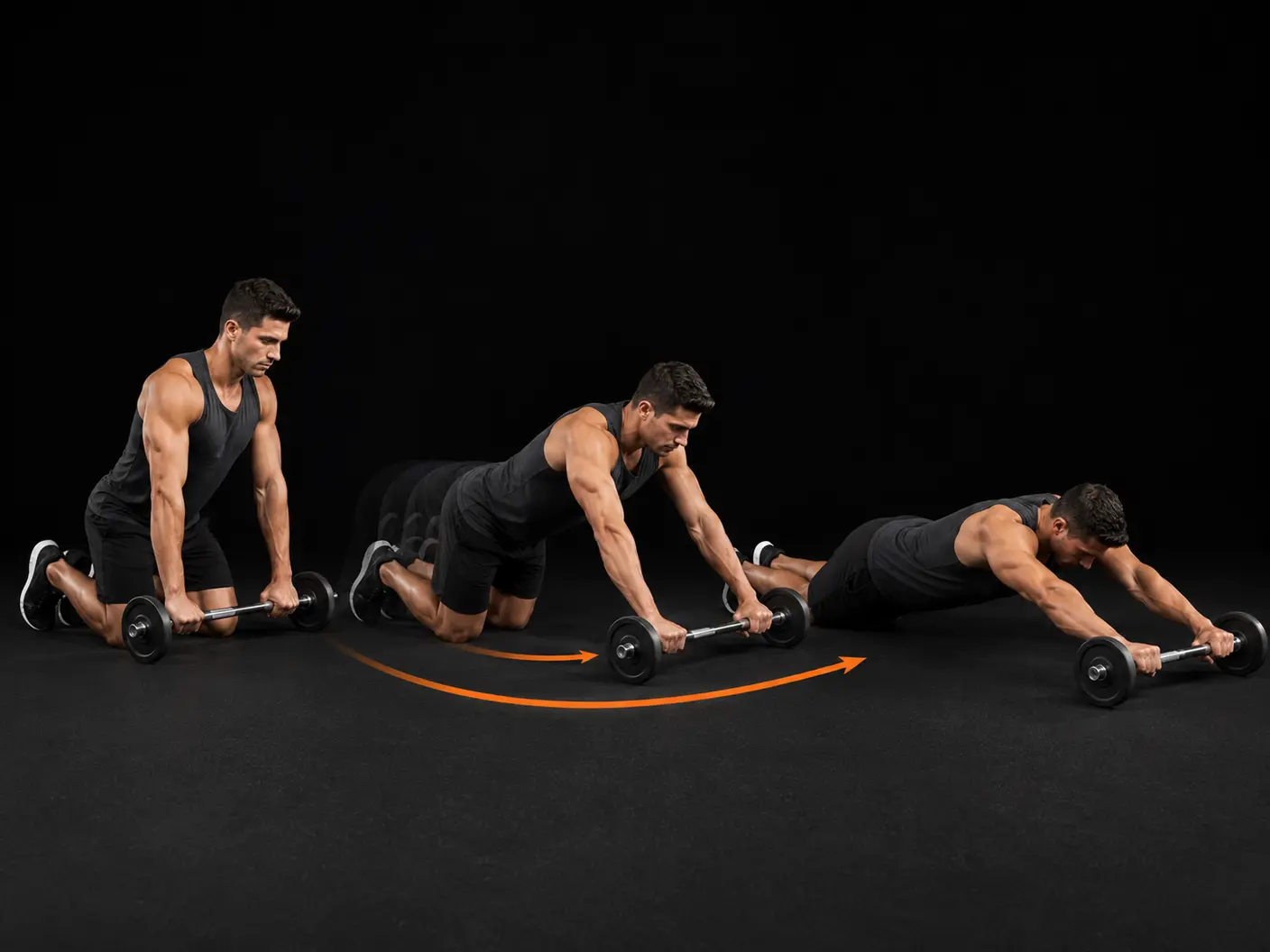
The barbell rollout is an advanced anti-extension core exercise performed from a kneeling position using a loaded barbell as a rolling implement. It challenges the rectus abdominis, TVA, and obliques to resist lumbar extension under a long, demanding lever arm — a stimulus that is difficult to replicate with most conventional core movements. It suits experienced trainees who have already built a solid foundation of core bracing and control.
How to do it
Kneel behind a loaded barbell. Grip the bar shoulder-width. Brace. Roll the bar forward, extending the hips and shoulders. Stop before the lower back arches. Pull the bar back using the abs.
Coaching cues
- Brace hard
- Tuck the pelvis
- Strict rollout
- Pull with the abs
Why train it
- Anti-extension loading places the rectus abdominis, TVA, and obliques under significant tension across a large range of motion, making it an effective stimulus for core strength and hypertrophy.
- The requirement to maintain a posterior pelvic tilt throughout the movement reinforces full-body bracing habits that transfer directly to compound lifts such as the deadlift and overhead press.
- The lats and shoulders act as secondary stabilisers during the rollout, meaning the movement develops co-ordination across the torso and upper body simultaneously.
- Because the load can be adjusted by changing the plates on the barbell, the exercise is easily progressive — heavier or wider plates alter the rolling resistance and therefore the demand on the core.
Common mistakes
- Allowing the lower back to arch at the end range — stop the rollout at the point where a neutral spine can no longer be maintained, and focus on tucking the pelvis before you initiate each rep.
- Pulling the bar back with the arms rather than the abs — the return phase should be driven by drawing the ribcage towards the hips, not by a lat pulldown motion.
- Rolling too fast through the eccentric — a slow, controlled extension increases time under tension and reduces the risk of losing position; treat each rep as a deliberate movement, not a momentum drill.
- Starting with too wide a range of motion before the pattern is established — begin by rolling only as far forward as full control allows, and extend the range incrementally across sessions.
Primary: Rectus Abdominis, Transverse Abdominis, Obliques.
Secondary: Latissimus Dorsi, Anterior Deltoid.
Equipment
Good for
Easier variation
Ab wheel rollout — same pattern, more common equipment.
Similar movements
Frequently asked
- What muscles does the barbell rollout work?
- The primary muscles are the rectus abdominis, transverse abdominis (TVA), and obliques, which work to prevent the lumbar spine from extending during the movement. The lats and shoulders contribute as secondary stabilisers throughout the roll.
- How many sets and reps should I do for the barbell rollout?
- For strength and hypertrophy, three to four sets of six to ten controlled reps is a practical starting point. Because the movement is advanced and technically demanding, prioritise quality over volume — fewer clean reps are more valuable than many reps with a broken position.
- Is the barbell rollout suitable for beginners?
- This exercise is classified as advanced and is not well-suited to those who are new to resistance training. A solid grounding in core bracing mechanics — ideally through movements such as planks and hollow body holds — should come first before progressing to the barbell rollout.
- What is the difference between a barbell rollout and an ab wheel rollout?
- The mechanics are closely related, but a barbell with plates offers a different rolling resistance depending on plate diameter and load, and the wider grip may feel more stable for some trainees. Both movements train the same anti-extension pattern; the barbell version simply uses equipment that is already present in most training environments.
- Can I do the barbell rollout if I have a history of lower back pain?
- Anti-extension core work can be appropriate for a wide range of individuals, but the barbell rollout is a high-demand variation. If you have a history of lower back issues, consult a qualified professional before incorporating this movement into your programme.
Want this movement in a plan built for you?
Adaptiv programmes the right exercises for your goal, equipment and experience — then adapts them as you train.
Build my programme