Dragon Flag
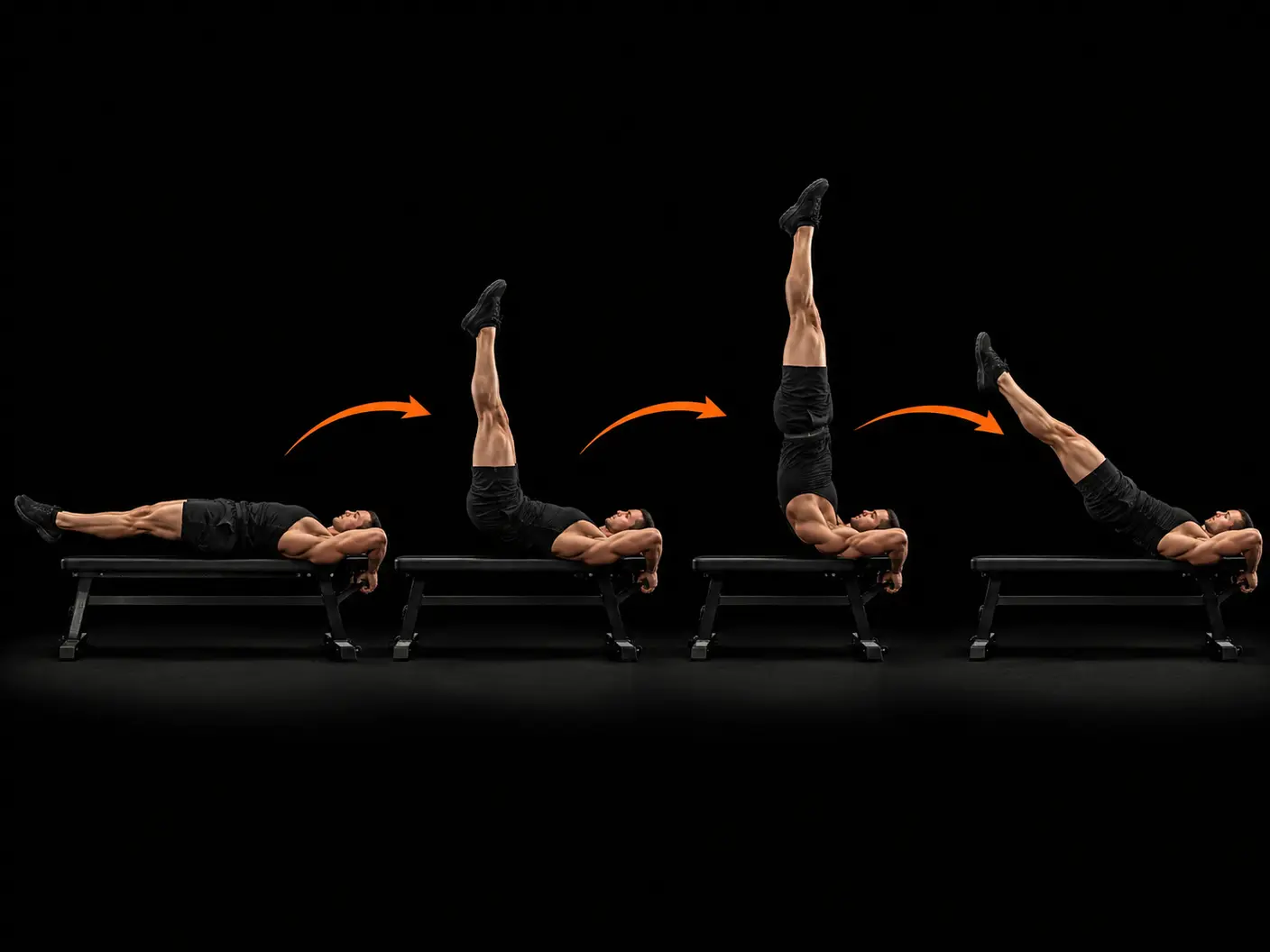
The dragon flag is an advanced anti-extension core exercise performed on a bench, in which the body is lowered and raised as a single rigid unit supported only on the upper back. It trains the entire anterior chain to resist spinal extension under load — a demanding test of full-body tension that goes well beyond conventional abdominal work. It suits experienced trainees who have already built a solid foundation in core stability and can maintain a neutral spine under significant mechanical disadvantage.
How to do it
Lie on a bench, grip behind the head. Swing the legs up so the body is near-vertical, supported only on the upper back. Lower the body as one rigid unit — straight from shoulders to feet — until nearly horizontal. Reverse back to vertical. Do not let the hips pike or the body bend.
Coaching cues
- Rigid body
- No hip bend
- Slow eccentric
- Lower only as far as you can stay rigid
Why train it
- It develops the rectus abdominis and obliques through a long range of motion under genuine load, making it one of the more demanding bodyweight core exercises available.
- Because the erectors, lats, and shoulders must all co-contract to maintain a rigid body position, it builds integrated full-body tension rather than isolating a single muscle group.
- The slow, controlled eccentric places high mechanical stress on the core musculature, which is a well-established driver of strength adaptation.
- It transfers directly to athletic movements that require trunk stiffness under dynamic conditions, making it a useful addition to performance-focused programmes.
Common mistakes
- Allowing the hips to pike — keep the body in a straight line from shoulders to feet throughout the entire movement, as any bend at the hips immediately reduces the demand on the core.
- Lowering beyond the point of control — descend only as far as you can maintain a completely rigid torso; stopping higher is far more productive than collapsing through the lower range.
- Rushing the descent — the eccentric phase should be slow and deliberate, as speed allows momentum to mask a loss of tension rather than the muscles doing the work.
- Gripping the bench too loosely — secure the bench firmly behind the head so the upper back has a stable anchor point from which to generate and transfer tension.
Primary: Rectus Abdominis, Obliques, Erector Spinae.
Secondary: Latissimus Dorsi, Anterior Deltoid.
Equipment
Good for
Easier variation
Negatives only — start from the top, lower slowly, reset.
Similar movements
Frequently asked
- What muscles does the dragon flag work?
- The primary muscles are the rectus abdominis, obliques, and spinal erectors, which work collectively to maintain a rigid, extended position throughout the movement. The lats and shoulders contribute as stabilisers, anchoring the upper body to the bench.
- How many sets and reps should I do for the dragon flag?
- Given the difficulty, most trainees benefit from treating it as a strength movement: two to four sets of three to six controlled repetitions, with full recovery between sets. Quality of form matters considerably more than volume here — a clean set of three is worth more than a sloppy set of eight.
- How do I progress towards the dragon flag if I cannot do one yet?
- A practical progression begins with tuck dragon flags, where the knees remain bent throughout, before advancing to a single-leg extended version and eventually the full movement. Supplementary work on hollow body holds and hanging leg raises will also build the prerequisite tension patterns.
- Is the dragon flag suitable for building a six-pack?
- It is an effective exercise for developing the rectus abdominis, but muscular definition is primarily a function of body composition rather than the exercise alone. It is best viewed as a strength movement for the core rather than a direct aesthetic tool.
- Can I do the dragon flag if I have lower back issues?
- This movement places considerable demand on the spinal erectors and requires the lumbar spine to resist extension under load, so anyone with a history of lower back problems should consult a qualified professional before attempting it.
Want this movement in a plan built for you?
Adaptiv programmes the right exercises for your goal, equipment and experience — then adapts them as you train.
Build my programme