Hanging Leg Raise
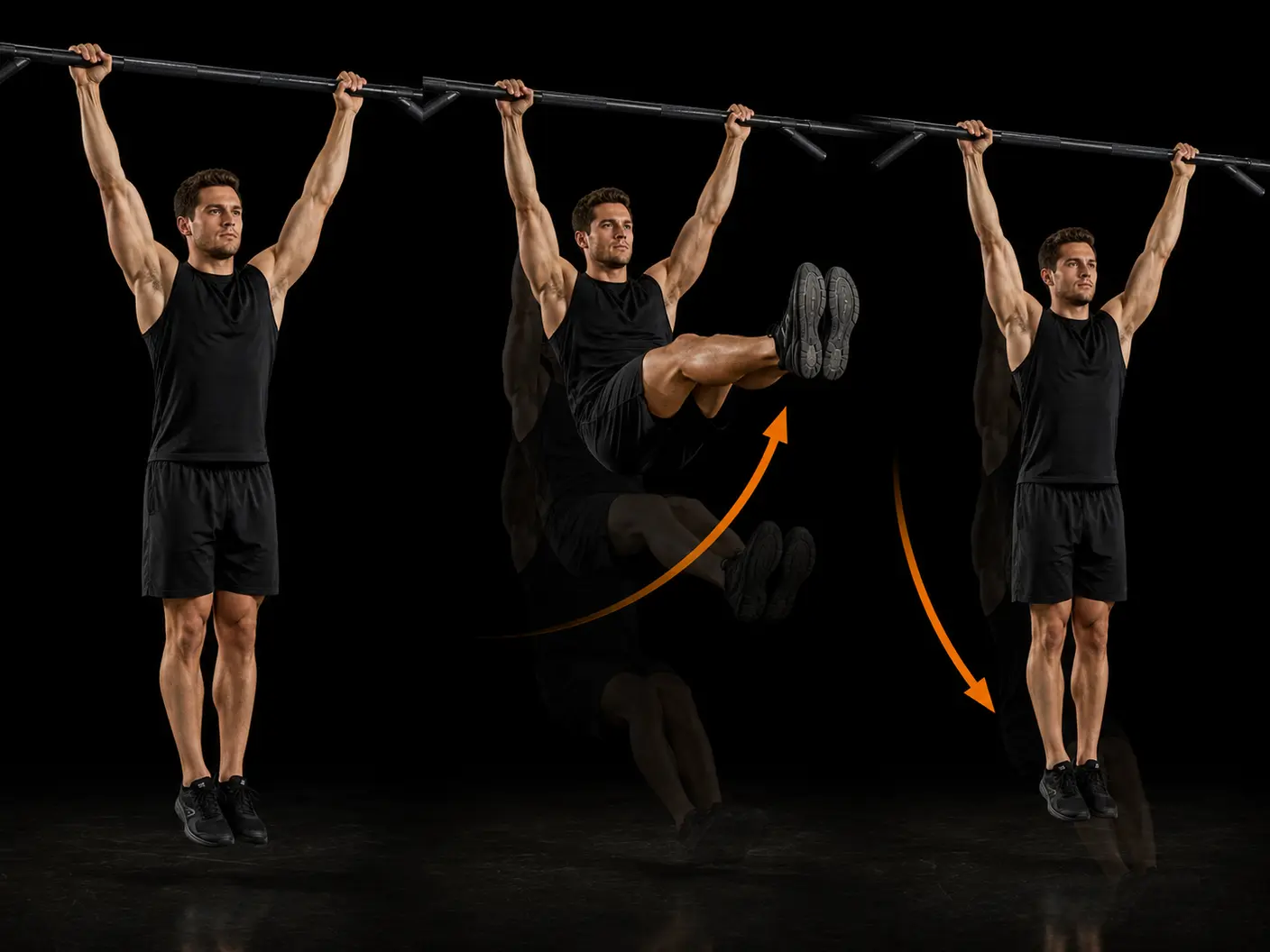
The hanging leg raise is a compound core exercise performed from a pull-up bar in which the lifter raises straight legs to above parallel while maintaining an active shoulder position and a posteriorly tilted pelvis. It trains the anti-extension pattern by demanding that the lumbar spine resist excessive arching throughout the movement, placing significant demand on the lower rectus abdominis and hip flexors. The exercise suits intermediate trainees who have already developed foundational grip strength and basic core control.
How to do it
Hang from a bar with a pronated grip. Active shoulders. Keep legs mostly straight. Posterior-tilt the pelvis and raise the legs until the feet are above parallel. Stop the swing; control both directions. Lower slowly with no kip.
Coaching cues
- Posterior pelvic tilt
- Legs straight
- Above parallel
- No swing
Why train it
- It develops the lower portion of the rectus abdominis through a long range of motion, making it a useful addition to hypertrophy-focused core programmes.
- The requirement to actively tilt the pelvis posteriorly before and during the raise teaches genuine lumbar control rather than the hip-flexor-dominant compensation common in floor-based leg raises.
- Hanging from a bar under load develops grip and forearm endurance as a secondary training stimulus, which carries over to pull-up and deadlift performance.
- The controlled eccentric lowering phase — essential to avoid swinging — builds total-body tension and reinforces the anti-extension pattern that underpins safe loading in compound lifts.
Common mistakes
- Allowing the hips to swing and kipping the legs up — stop any momentum before each repetition, initiating the raise from a dead hang with the pelvis already tilted.
- Failing to posteriorly tilt the pelvis before lifting — cue yourself to think of tucking the tailbone slightly upward first, which transfers effort to the abdominals rather than the hip flexors alone.
- Bending the knees to compensate for limited hamstring flexibility or fatigue — keep the legs as straight as possible throughout, accepting a smaller range of motion if needed rather than compromising the lever.
- Letting the shoulders shrug passively into the ears — actively depress and pack the shoulder blades at the start of every rep to protect the shoulder joint and stabilise the hanging position.
Primary: Rectus Abdominis, Hip Flexors.
Secondary: Obliques, Forearm Flexors.
Equipment
Good for
Easier variation
Hanging knee raise — bent knees reduce the lever.
Similar movements
Frequently asked
- What muscles does the hanging leg raise work?
- The primary muscles are the lower rectus abdominis and the hip flexors, which work together to lift the legs and maintain pelvic position. The obliques assist in controlling rotation and lateral stability, while the forearms and grip musculature work isometrically to maintain the hang throughout the set.
- How many sets and reps should I do for the hanging leg raise?
- For hypertrophy, three to four sets of eight to fifteen controlled repetitions works well, with emphasis on a slow eccentric and a full pause at the top. If you are including it for general fitness or core conditioning, two to three sets of ten to twelve reps at the end of a session is a practical starting point.
- What are good alternatives if I cannot yet do a hanging leg raise?
- A lying leg raise on the floor removes the grip and shoulder-stability demands and allows you to practise the posterior pelvic tilt cue in a more controlled environment. Once that feels solid, a bent-knee hanging raise from a bar is a natural progression toward the full straight-leg version.
- Is the hanging leg raise suitable for building a visible six-pack?
- It is an effective exercise for developing the rectus abdominis, particularly its lower portion, which contributes to the muscular structure underlying the abdomen. Visible definition, however, is largely determined by body composition, so this movement is best understood as a tool for building the muscle rather than a standalone solution for aesthetics.
- Why do my hip flexors fatigue before my abs during hanging leg raises?
- This usually indicates that the posterior pelvic tilt cue is not being applied consistently — when the pelvis stays in a neutral or anteriorly tilted position, the hip flexors take over as the primary mover. Deliberately tucking the tailbone before you begin each rep shifts more of the load onto the abdominals and reduces excessive hip-flexor dominance.
Want this movement in a plan built for you?
Adaptiv programmes the right exercises for your goal, equipment and experience — then adapts them as you train.
Build my programme