Captain's Chair Leg Raise
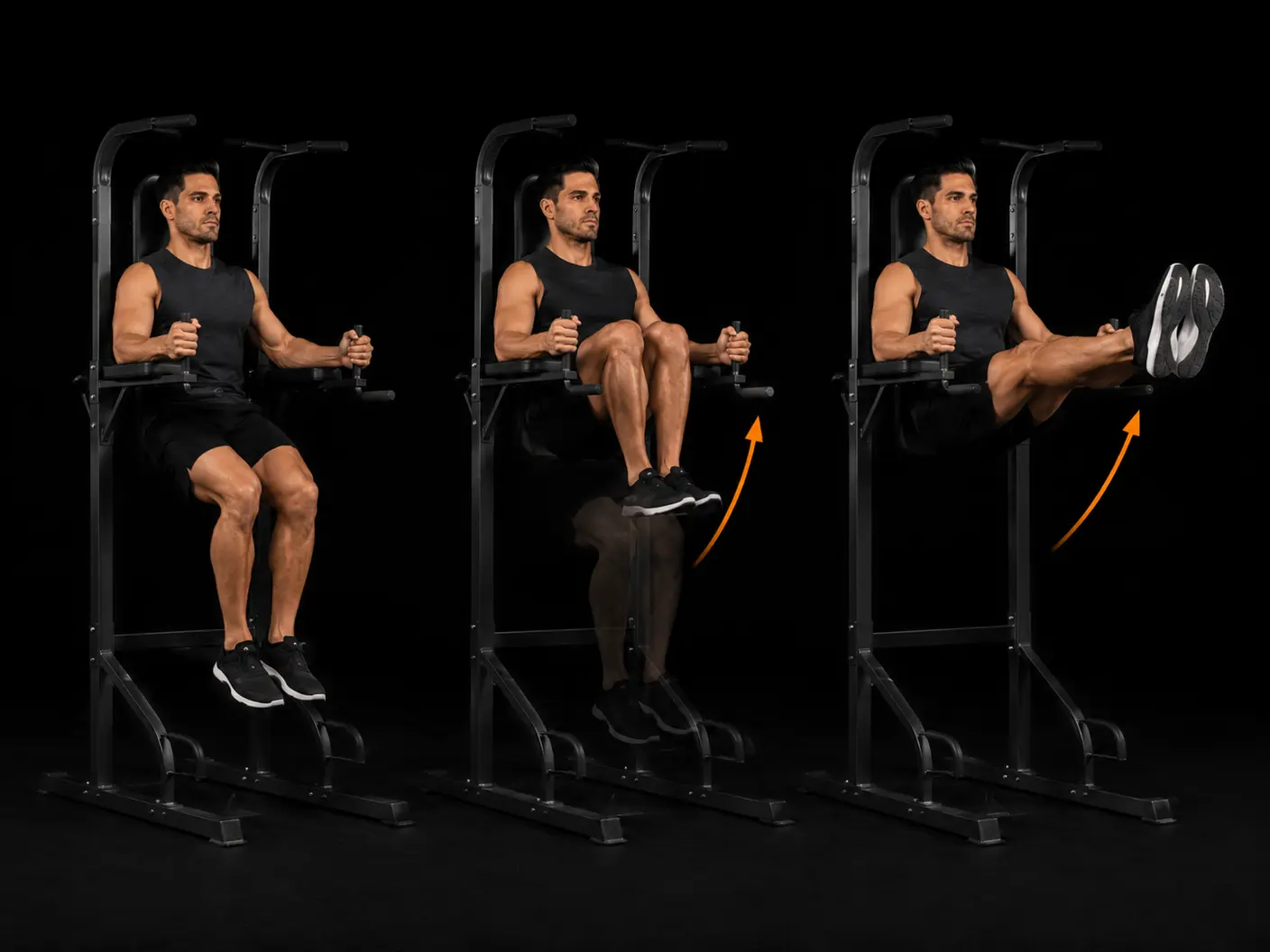
The captain's chair leg raise is a hanging core exercise performed on a vertical knee raise station, where the lifter supports their bodyweight through the forearms while raising the legs against gravity. It trains anti-extension through the lumbar spine and challenges the lower portion of the rectus abdominis alongside the hip flexors through a controlled range of motion. It suits those at a foundational level looking to build anterior core strength and improve pelvic control.
How to do it
Place forearms on the pads of a captain's chair, back against the pad. Hang legs. Raise the knees (or straight legs for more challenge) by tilting the pelvis and flexing the hips. Control both directions.
Coaching cues
- Pelvic tilt first
- Slow and controlled
- No swing
- Full range
Why train it
- The movement places direct demand on the lower rectus abdominis, an area that many traditional floor-based exercises struggle to load effectively.
- Supporting bodyweight through the forearms adds an incidental demand on postural stability, making it a time-efficient option within a general fitness programme.
- The bent-knee variation offers a manageable entry point, while progressing to straight legs meaningfully increases the resistance, giving the exercise longevity across training phases.
- Because the spine is held against a back pad, the lumbar position can be better monitored and controlled compared with unsupported hanging variations.
Common mistakes
- Swinging the legs to generate momentum — initiate every repetition with a deliberate posterior pelvic tilt before the knees rise, keeping the movement slow and controlled throughout.
- Allowing the lower back to hyperextend at the bottom of the rep — tilt the pelvis before lowering and maintain that position through the full descent.
- Cutting the range of motion short — aim to raise the knees to at least hip height or above to achieve meaningful flexion and fully engage the target musculature.
- Letting the shoulders shrug up toward the ears — press down evenly through the forearms to keep the shoulders set and the neck long throughout the set.
Primary: Rectus Abdominis, Hip Flexors.
Secondary: Obliques.
Equipment
Good for
Easier variation
Supported knee raise with legs bent.
Similar movements
Frequently asked
- What muscles does the captain's chair leg raise work?
- The primary muscles are the lower portion of the rectus abdominis and the hip flexors. The obliques act as secondary stabilisers throughout the movement.
- How many sets and reps should I do?
- For general fitness and hypertrophy, three to four sets of ten to fifteen controlled repetitions is a practical starting point. Prioritise quality of each rep over reaching a target number, and add reps or progress to straight legs once the bent-knee version feels consistently controlled.
- What is the difference between the knee raise and straight-leg version?
- Raising straight legs increases the lever arm, which places greater demand on the hip flexors and anterior core compared with the bent-knee variation. The bent-knee version is the appropriate starting point at a foundational level before progressing to straight legs.
- Can I do this exercise if I have lower back discomfort?
- This guide does not cover individual injury management — if you have any existing lower back concerns, check with a qualified professional before including this exercise in your programme.
- Is the captain's chair leg raise a good alternative to hanging leg raises?
- The two movements are closely related, but the captain's chair provides a back pad and forearm support that reduces the grip and shoulder stability demands found in a free hang. This makes it a more accessible option for those who have not yet developed the upper-body endurance required for a full hanging variation.
Want this movement in a plan built for you?
Adaptiv programmes the right exercises for your goal, equipment and experience — then adapts them as you train.
Build my programme