Weighted Crunch
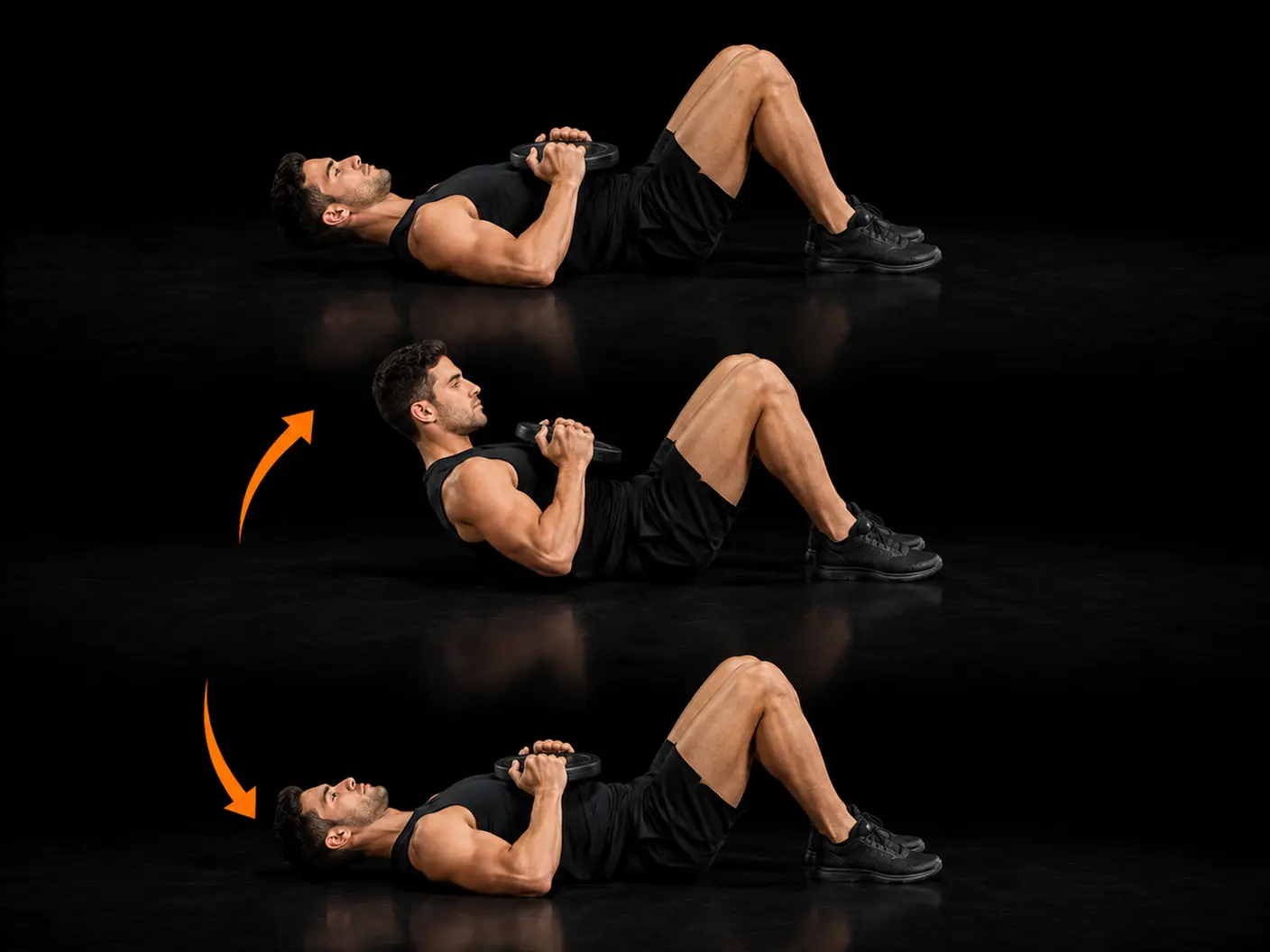
The weighted crunch is a loaded variation of the standard crunch that introduces external resistance to increase demand on the rectus abdominis. It follows an anti-extension pattern, requiring the torso to flex against load while the lower back remains in contact with the floor throughout. It suits beginners building foundational core strength as well as intermediates looking to add progressive overload to abdominal training.
How to do it
Lie on your back with knees bent, feet flat. Hold a weight plate or dumbbell across the chest or behind the head (easier). Crunch the ribs toward the pelvis, lifting the shoulder blades off the floor. The lower back stays down. Pause briefly at peak contraction. Lower under control.
Coaching cues
- Ribs toward pelvis
- Lower back stays down
- Pause at peak
- Controlled descent
Why train it
- Adding a weight plate or dumbbell creates a measurable progressive overload stimulus, making it more effective for hypertrophy of the rectus abdominis than bodyweight crunches alone.
- The movement is performed in a stable, supine position, which allows full attention to be placed on the contraction quality rather than balance or coordination demands.
- The controlled descent phase places the abdominals under load eccentrically, increasing time under tension and contributing to greater muscle development over time.
- It requires minimal equipment — a single weight plate or dumbbell is sufficient — making it accessible for home training and commercial gym settings alike.
Common mistakes
- Pulling on the neck when the weight is held behind the head — keep the hands lightly supporting the skull and initiate the movement by drawing the ribs toward the pelvis, not by yanking the head forward.
- Allowing the lower back to arch off the floor during the descent — maintain contact between the lumbar spine and the floor throughout the entire repetition to keep tension where it belongs.
- Using momentum to complete the repetition — slow the movement down, pause briefly at peak contraction, and lower under control rather than bouncing between positions.
- Holding the weight too far away from the centre of mass — placing a plate or dumbbell across the chest or close to the sternum keeps the load manageable and reduces unnecessary strain on the cervical spine.
Primary: Rectus Abdominis.
Secondary: Obliques, Hip Flexors.
Equipment
Good for
Easier variation
Bodyweight crunch — same pattern without external load.
Similar movements
Frequently asked
- What muscles does the weighted crunch work?
- The primary muscle worked is the rectus abdominis, the vertical muscle running down the front of the abdomen responsible for spinal flexion. The obliques and hip flexors contribute as secondary muscles during the movement.
- How many sets and reps should I do for the weighted crunch?
- For hypertrophy, three to four sets of ten to fifteen repetitions with a load that makes the final two reps genuinely challenging is a reliable starting point. Prioritise a two-second controlled descent and a brief pause at the top over simply accumulating reps with poor form.
- Where should I hold the weight during a weighted crunch?
- Holding the weight across the chest is the most practical and controlled position for most people. Holding it behind the head increases the moment arm and makes the movement harder, but it also places more stress on the neck — this variation is best suited to those with good neck stability and experience with the standard version.
- Is the weighted crunch suitable for building visible abs?
- The weighted crunch is an effective exercise for developing the rectus abdominis, and consistent progressive loading will contribute to muscle thickness over time. That said, visible definition is also influenced by body composition, so it is best viewed as one part of a broader training and nutrition programme.
- What are good alternatives to the weighted crunch?
- Cable crunches are a useful alternative that provide consistent resistance through the full range of motion. Decline crunches increase the range of motion using bodyweight, while ab wheel rollouts challenge the anti-extension pattern in a more demanding standing or kneeling position — though these are considerably more difficult and suit more experienced trainees.
Want this movement in a plan built for you?
Adaptiv programmes the right exercises for your goal, equipment and experience — then adapts them as you train.
Build my programme