Decline Bench Crunch
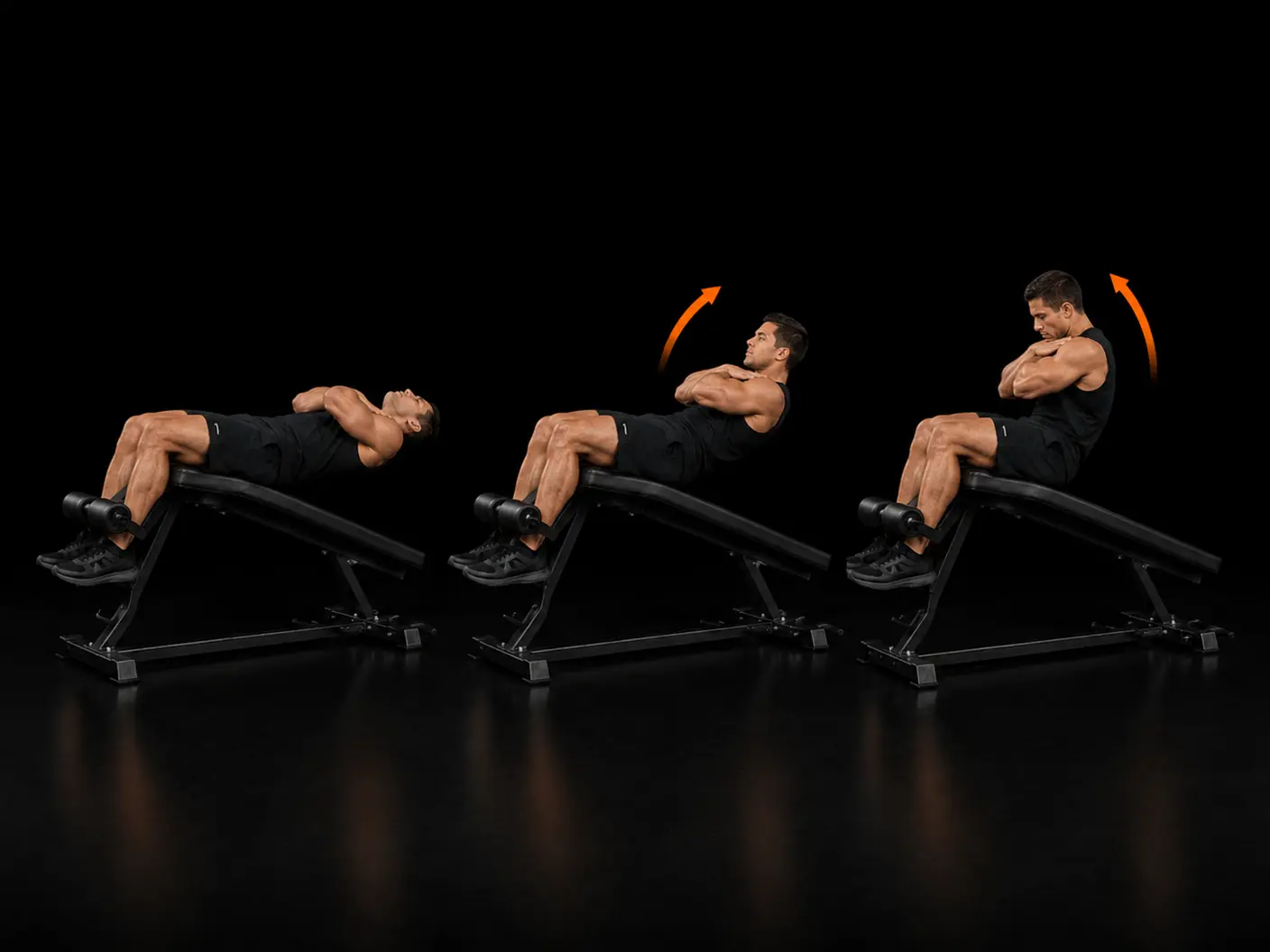
The decline bench crunch is a spine-flexion exercise performed on an angled bench with the feet secured under the pads, which increases the load on the rectus abdominis relative to a flat-floor crunch by adding a gravitational challenge throughout the range of motion. It trains the core anti-extension pattern by requiring the abdominal wall to produce and control spinal flexion in a lengthened start position. The movement suits those building foundational core strength or pursuing abdominal hypertrophy within a structured programme.
How to do it
Set a decline bench. Lock feet under the pads. Cross arms over the chest. Crunch the shoulders off the bench by flexing the spine — ribs toward the pelvis. Pause briefly. Lower under control.
Coaching cues
- Ribs toward pelvis
- Short controlled range
- Tempo not speed
- No neck strain
Why train it
- The decline angle places the rectus abdominis under greater tension at the bottom of the movement compared with a flat crunch, making it a productive option for hypertrophy-focused training.
- Securing the feet and crossing the arms over the chest removes the temptation to use momentum or pull on the neck, encouraging cleaner spinal flexion mechanics.
- The controlled lowering phase builds eccentric strength in the abdominal wall, contributing to greater muscle development and body-wall stability over time.
- As a foundational compound movement, it integrates the rectus abdominis and obliques simultaneously, giving a time-efficient option for general fitness programming.
Common mistakes
- Pulling the chin to the chest — keep the neck neutral throughout and initiate the movement by drawing the ribs toward the pelvis, not the head toward the knees.
- Using speed rather than tempo — slow the repetition down so the abdominal muscles produce the movement rather than momentum carrying you through the range.
- Crunching too high — the shoulders need only clear the bench; a short, controlled range focused on spinal flexion is more effective than attempting a full sit-up on a decline.
- Holding the breath — exhale as you flex the spine upward and inhale on the controlled return, maintaining intra-abdominal pressure and reducing unnecessary neck tension.
Primary: Rectus Abdominis.
Secondary: Obliques.
Equipment
Good for
Easier variation
Flat crunch — easier gravity angle.
Similar movements
Frequently asked
- What muscles does the decline bench crunch work?
- The primary muscle targeted is the rectus abdominis, the vertically oriented muscle that runs along the front of the abdomen. The obliques work as secondary muscles to assist and stabilise during the movement.
- How many sets and reps should I do for the decline bench crunch?
- For hypertrophy, three to four sets of ten to fifteen controlled repetitions with a brief pause at the top works well. For general fitness, two to three sets of twelve to twenty reps at a moderate tempo is a practical starting point.
- What is the difference between a decline bench crunch and a regular floor crunch?
- The decline angle means you begin each repetition with the torso below horizontal, increasing the range over which the rectus abdominis must work and placing greater load on the muscle throughout the movement. A floor crunch starts from a neutral position and therefore offers less gravitational resistance.
- Is the decline bench crunch suitable for beginners?
- It is classified as a foundational movement, so it is appropriate for beginners provided they can control the tempo and avoid pulling on the neck. Those new to core training may benefit from mastering a flat-surface crunch first to establish the basic spinal-flexion pattern.
- Are there alternatives if I do not have access to a decline bench?
- A standard floor crunch, a stability ball crunch, or a cable crunch can all train similar spinal-flexion mechanics without requiring a decline bench. Each variation changes the resistance curve, so the choice should reflect the equipment available and the specific training goal.
Want this movement in a plan built for you?
Adaptiv programmes the right exercises for your goal, equipment and experience — then adapts them as you train.
Build my programme