Reverse Crunch
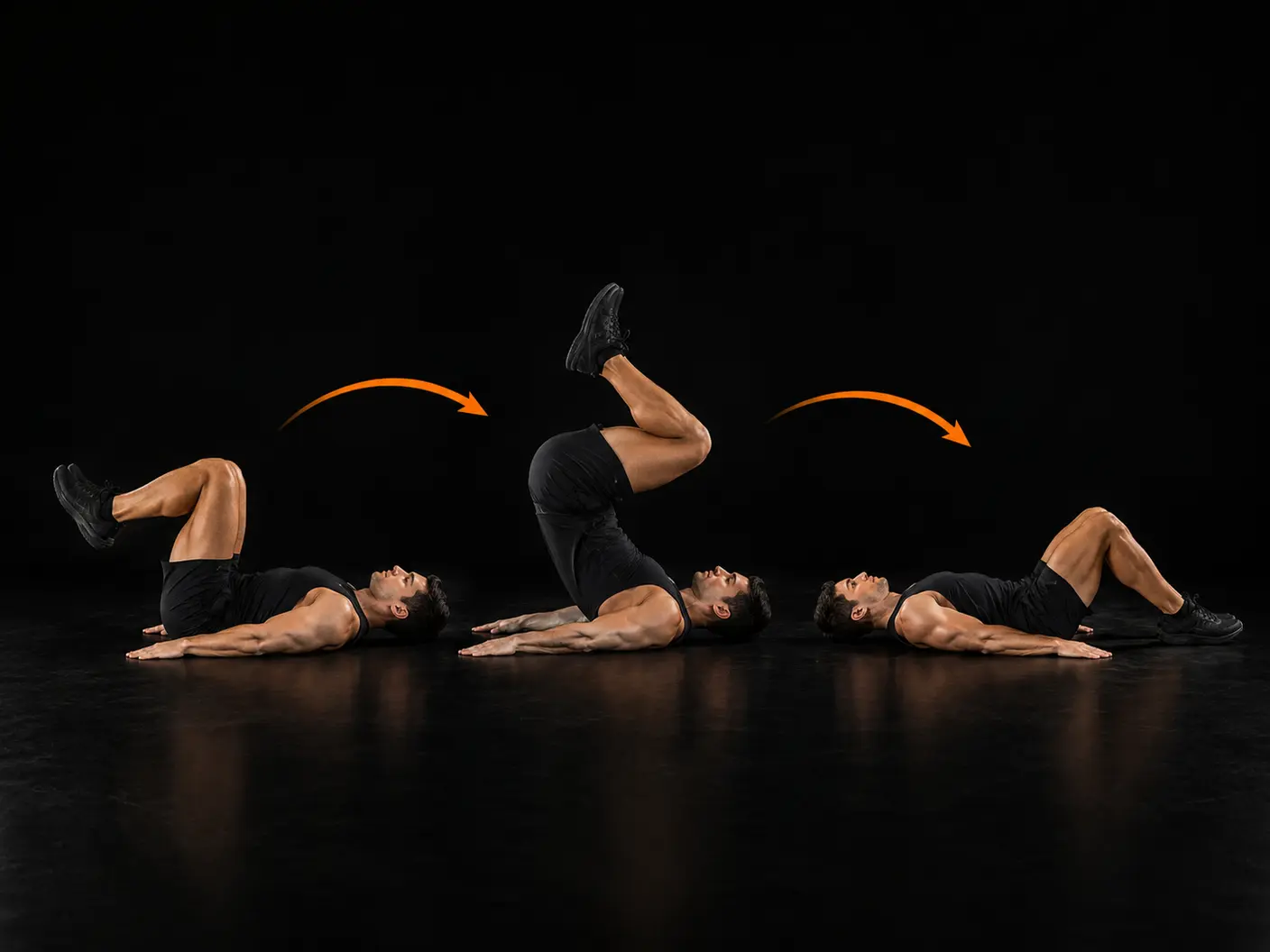
The reverse crunch is a bodyweight core exercise that trains the anti-extension pattern by curling the pelvis toward the ribs rather than the shoulders toward the knees. It places direct demand on the lower portion of the rectus abdominis and the obliques, with the hip flexors working as secondary contributors to control the movement. It suits beginners building foundational core strength as well as more experienced trainees seeking a controlled, low-load option for anterior core development.
How to do it
Lie on your back, knees bent at 90° over the hips, arms flat at the sides. Curl the pelvis off the floor by tilting the pelvis and lifting the hips toward the ribs. Pause briefly. Lower with control.
Coaching cues
- Curl the pelvis
- Hips toward the ribs
- Short focused range
- Control both directions
Why train it
- It targets the lower portion of the rectus abdominis directly, a region that standard crunches tend to underload.
- The short, focused range of motion keeps tension on the abdominals throughout without placing excessive strain on the neck or cervical spine.
- Requiring no equipment, it can be programmed into any setting and slotted into a warm-up, main session, or finisher with equal practicality.
- The controlled lowering phase develops eccentric strength in the core, which carries over to stability demands in compound lifts.
Common mistakes
- Swinging the legs rather than curling the pelvis — initiate by tilting the pelvis and drawing the hips toward the ribs, not by throwing the knees toward the chest.
- Losing the 90-degree bend at the knees — maintain that angle throughout so the hip flexors do not dominate the movement at the expense of abdominal engagement.
- Dropping the hips quickly on the way down — lower with deliberate control to preserve the eccentric demand and avoid momentum taking over.
- Using too large a range of motion — this is a short, focused movement; lifting the hips excessively often shifts load away from the abdominals and into the lower back.
Primary: Rectus Abdominis, Obliques.
Secondary: Hip Flexors.
Equipment
Good for
Easier variation
Knees-over-chest hold — isometric version to groove the tilt.
Similar movements
Frequently asked
- What muscles does the reverse crunch work?
- The primary muscles are the lower portion of the rectus abdominis and the obliques. The hip flexors contribute as secondary muscles to support and control the position of the legs throughout the movement.
- How many sets and reps should I do for the reverse crunch?
- For general fitness, 3 sets of 10 to 15 controlled repetitions works well as a starting point. Prioritise quality of the pelvic curl over volume — a clean set of 10 is more productive than a sloppy set of 20.
- What is the difference between a reverse crunch and a standard crunch?
- A standard crunch moves the shoulders toward the hips, emphasising the upper portion of the rectus abdominis. The reverse crunch moves the hips toward the ribs, shifting the demand toward the lower portion of the same muscle.
- Is the reverse crunch suitable for beginners?
- Yes — it is classified as a foundational movement and requires no equipment or prior strength base. Beginners should focus on the pelvic curl cue and keep the range of motion short until the movement pattern feels consistent.
- Are there alternatives to the reverse crunch that train the same pattern?
- Other anti-extension core exercises can train similar musculature, though specific alternatives depend on your available equipment and programme structure. A qualified coach can help you select movements that match your current ability and goals.
Want this movement in a plan built for you?
Adaptiv programmes the right exercises for your goal, equipment and experience — then adapts them as you train.
Build my programme