Thoracic Rotation (Quadruped)
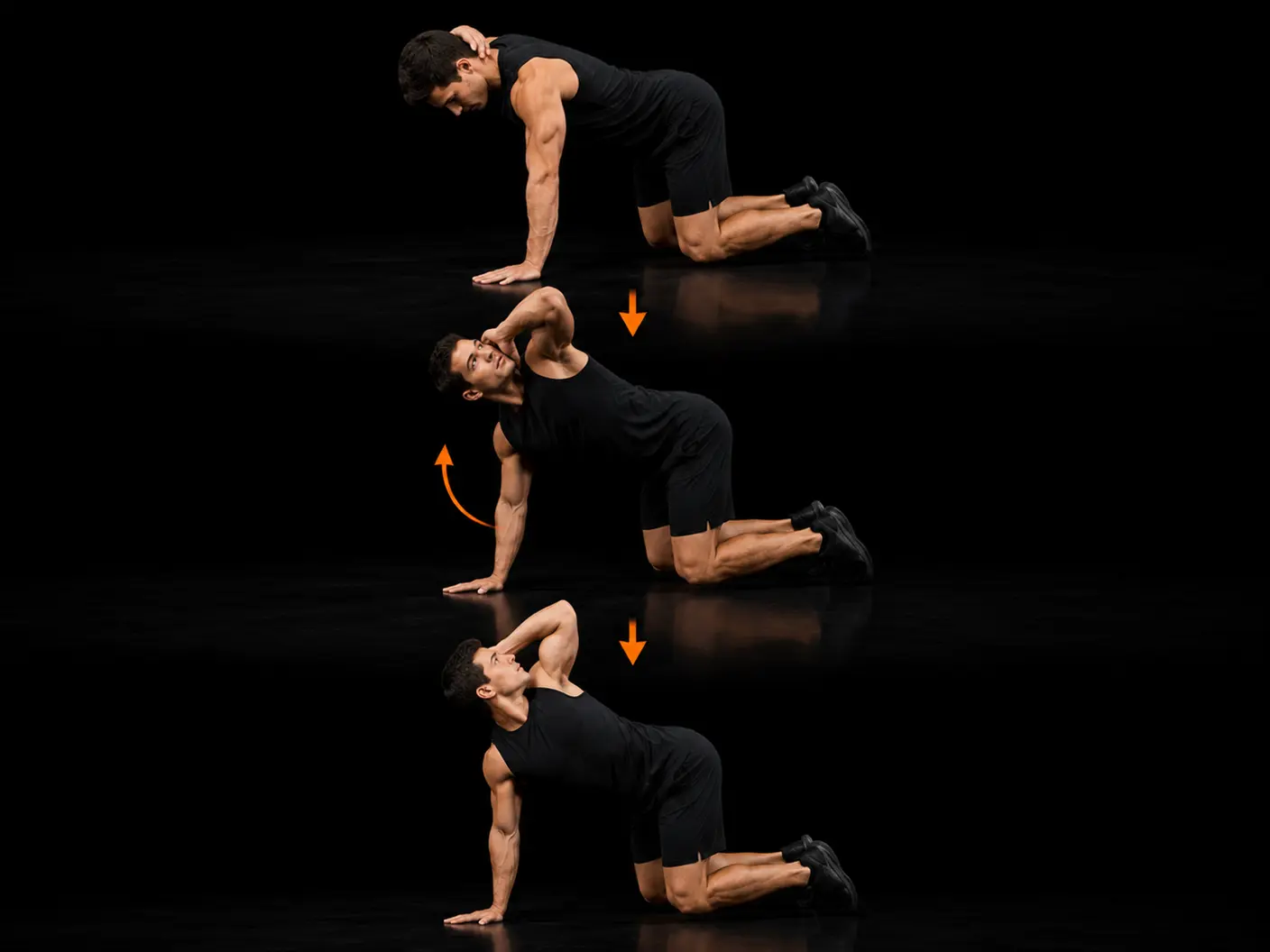
Quadruped thoracic rotation is a bodyweight mobility drill performed on all fours, training the rotational range of motion through the thoracic spine with support from the obliques and surrounding core musculature. By fixing the lower body in a stable position, the movement isolates rotation to the mid and upper back rather than allowing the lumbar spine to compensate. It suits anyone from beginners building foundational movement quality to athletes maintaining thoracic mobility as part of a warm-up or recovery session.
How to do it
Start on all fours. Place one hand behind the head. Rotate that elbow toward the opposite hand (down) then open up to the ceiling (up). Track the elbow with the eyes. Rotate through the thoracic spine, not the lumbar.
Coaching cues
- Rotate through the thoracic
- Track with the eyes
- Control both directions
- Breathe
Why train it
- Develops rotational range of motion through the thoracic spine, a region that commonly becomes stiff with prolonged sitting or repetitive loading patterns.
- The quadruped position stabilises the pelvis and lumbar spine, making it easier to isolate and feel thoracic rotation without excessive lower back involvement.
- Engaging the obliques through a controlled rotational pattern reinforces the connection between spinal mobility and core function.
- As a foundational movement requiring only bodyweight, it integrates readily into warm-ups, mobility circuits, or active recovery sessions without additional equipment.
Common mistakes
- Rotating through the lower back rather than the thoracic spine — focus on moving the elbow and upper back while keeping the hips level and still throughout the rep.
- Rushing through the range of motion — control the elbow both as it drops toward the opposite hand and as it opens toward the ceiling, spending a moment at each end range.
- Losing eye tracking — follow the elbow with the eyes throughout the movement, as this encourages fuller cervical and thoracic rotation together.
- Holding the breath — exhale as you rotate open toward the ceiling and inhale on the return, using the breath to support both mobility and control.
Primary: Obliques.
Secondary: Anterior Deltoid, Rectus Abdominis.
Equipment
Good for
Easier variation
Thread the needle — slower, more passive variant.
Similar movements
Frequently asked
- What muscles does quadruped thoracic rotation work?
- The primary movers are the thoracic spine and obliques, which drive and control the rotational pattern. The shoulders and broader core musculature provide secondary support to stabilise the position throughout the movement.
- How many sets and reps should I do for quadruped thoracic rotation?
- For a warm-up or mobility session, 2–3 sets of 8–12 controlled repetitions per side is a reasonable starting point. Prioritise quality of range over volume — a slow, full rotation with a brief pause at end range is more productive than high repetitions performed quickly.
- What is the difference between thoracic and lumbar rotation, and why does it matter here?
- The thoracic spine is structurally designed for rotation, whereas the lumbar spine has relatively limited rotational capacity. Repeatedly forcing rotation through the lumbar region under load or through faulty movement patterns can place unnecessary stress on those segments, which is why cueing the movement to originate in the mid and upper back is central to performing this drill correctly.
- Is quadruped thoracic rotation suitable as a warm-up before lifting?
- Yes — it is commonly used before upper-body sessions, overhead pressing work, or any programme where thoracic mobility is relevant. Performing it before loaded exercise helps prepare the thoracic spine for the range of motion demands ahead.
- Are there alternatives to this exercise if I find the quadruped position uncomfortable?
- A seated thoracic rotation with a hand behind the head is one option that removes the need to load the wrists and knees. If you are uncertain which variation is appropriate for your situation, a qualified coach or physiotherapist can advise based on your individual needs.
Want this movement in a plan built for you?
Adaptiv programmes the right exercises for your goal, equipment and experience — then adapts them as you train.
Build my programme