World's Greatest Stretch
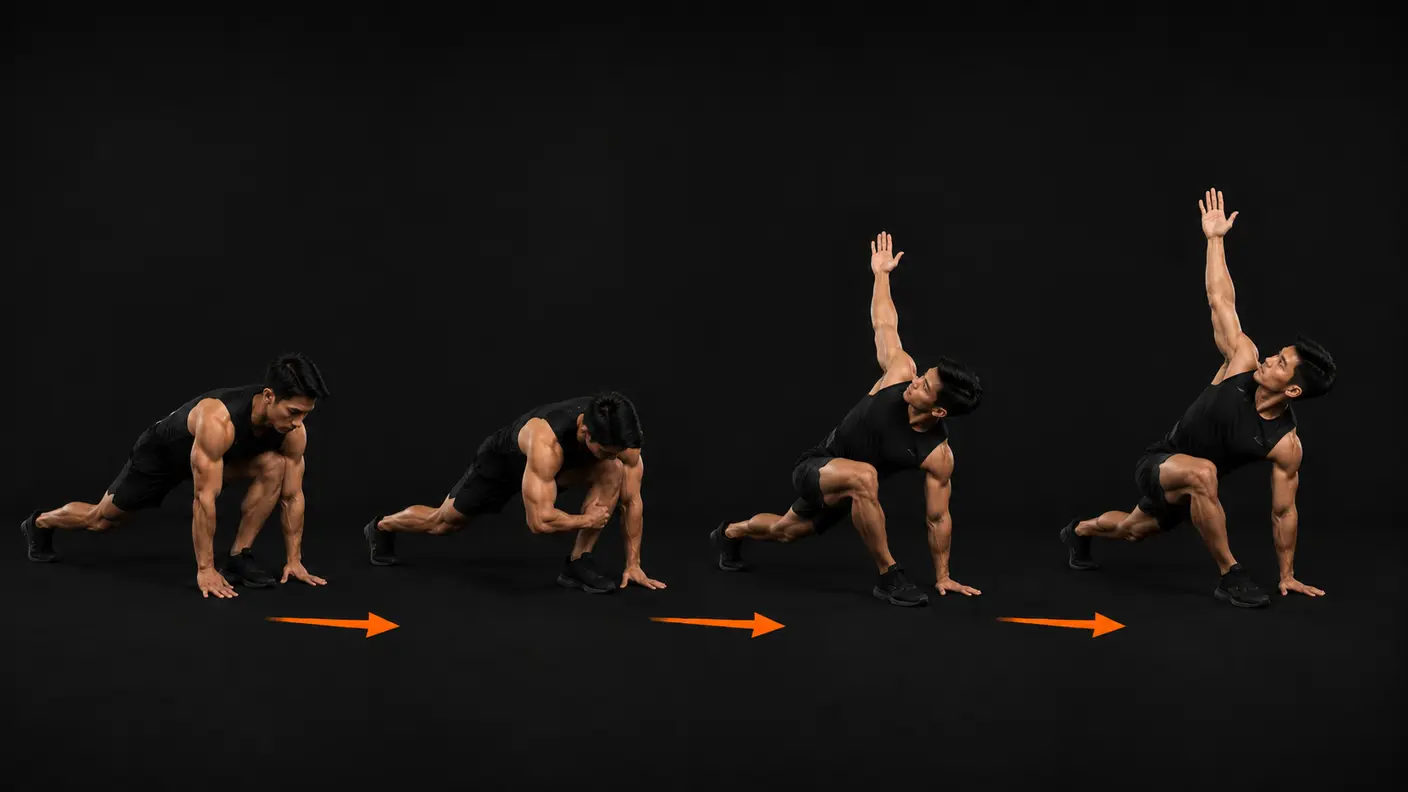
The world's greatest stretch is a multi-joint mobility drill that combines a deep lunge, hip flexor lengthening, and thoracic rotation into a single flowing sequence. It trains the movement pattern of coordinated lower-body opening and upper-spine rotation simultaneously, making it one of the more time-efficient preparations available. It suits athletes, recreational trainees, and desk-based individuals alike — anyone who needs to restore or maintain range of motion across the hips and thorax.
How to do it
Start in a push-up position. Step one foot outside the same-side hand. Reach the same-side arm up and rotate the torso to the ceiling, following the hand with the eyes. Return the hand to the floor; step the foot back. Repeat on the other side.
Coaching cues
- Deep lunge
- Rotate through the thorax
- Reach for the ceiling
- Controlled flow
Why train it
- It addresses hip flexors, hamstrings, adductors, glutes, and thoracic spine in one continuous sequence, reducing the time needed for a comprehensive warm-up.
- The thoracic rotation component encourages mobility through the mid and upper spine, which tends to stiffen with prolonged sitting or repetitive overhead work.
- As a bodyweight drill requiring no equipment, it can be performed anywhere and slotted into a warm-up, cool-down, or active recovery session without additional set-up.
- The controlled, flowing nature of the movement reinforces body awareness and positional control, qualities that transfer directly to compound lifts and sport-specific movement.
Common mistakes
- Letting the front knee collapse inward — actively drive the knee out in line with the toes throughout the lunge to maintain hip alignment.
- Rotating from the lower back rather than the thorax — focus on moving the ribcage and reaching through the upper back, keeping the lumbar spine relatively neutral.
- Rushing the rotation and losing the end-range position — pause briefly at the top of the reach to allow the thoracic spine to settle into its full available range.
- Allowing the hips to rise too high in the lunge — keep the rear leg extended and the front shin close to vertical so the hip flexor receives a meaningful stretch.
Primary: Hip Flexors, Hamstrings.
Secondary: Gluteus Maximus, Adductors.
Equipment
Good for
Easier variation
Skip the rotation — hold the deep lunge only.
Similar movements
Frequently asked
- Which muscles does the world's greatest stretch work?
- The primary muscles targeted are the hip flexors, hamstrings, and thoracic spine. The glutes and adductors also work as secondary contributors throughout the lunge and rotation.
- How many sets and reps should I do?
- For a warm-up context, two to three passes of five to six repetitions per side is typically sufficient. As a standalone mobility session or cool-down, three sets of eight per side allows more time at end-range.
- When in a session should I use this drill?
- It is most commonly used as part of a dynamic warm-up before compound lower-body or full-body work, since it prepares the hips and thoracic spine for the demands of squatting, hinging, and rotating patterns.
- Is the world's greatest stretch suitable for beginners?
- Yes — it is classified as a foundational movement and requires no equipment or prior training background. Those with limited hip or thoracic mobility may find the range of motion challenging initially, but the drill itself is appropriate as a starting point rather than something to work towards.
- What exercises can I use as alternatives or progressions?
- Hip flexor lunges, thoracic rotations, and deep squat holds each address components of this drill in isolation if the full sequence is too demanding. As a progression, slowing the tempo or adding an additional pause at the top of the rotation increases the challenge without changing the fundamental pattern.
Want this movement in a plan built for you?
Adaptiv programmes the right exercises for your goal, equipment and experience — then adapts them as you train.
Build my programme