Spiderman Lunge
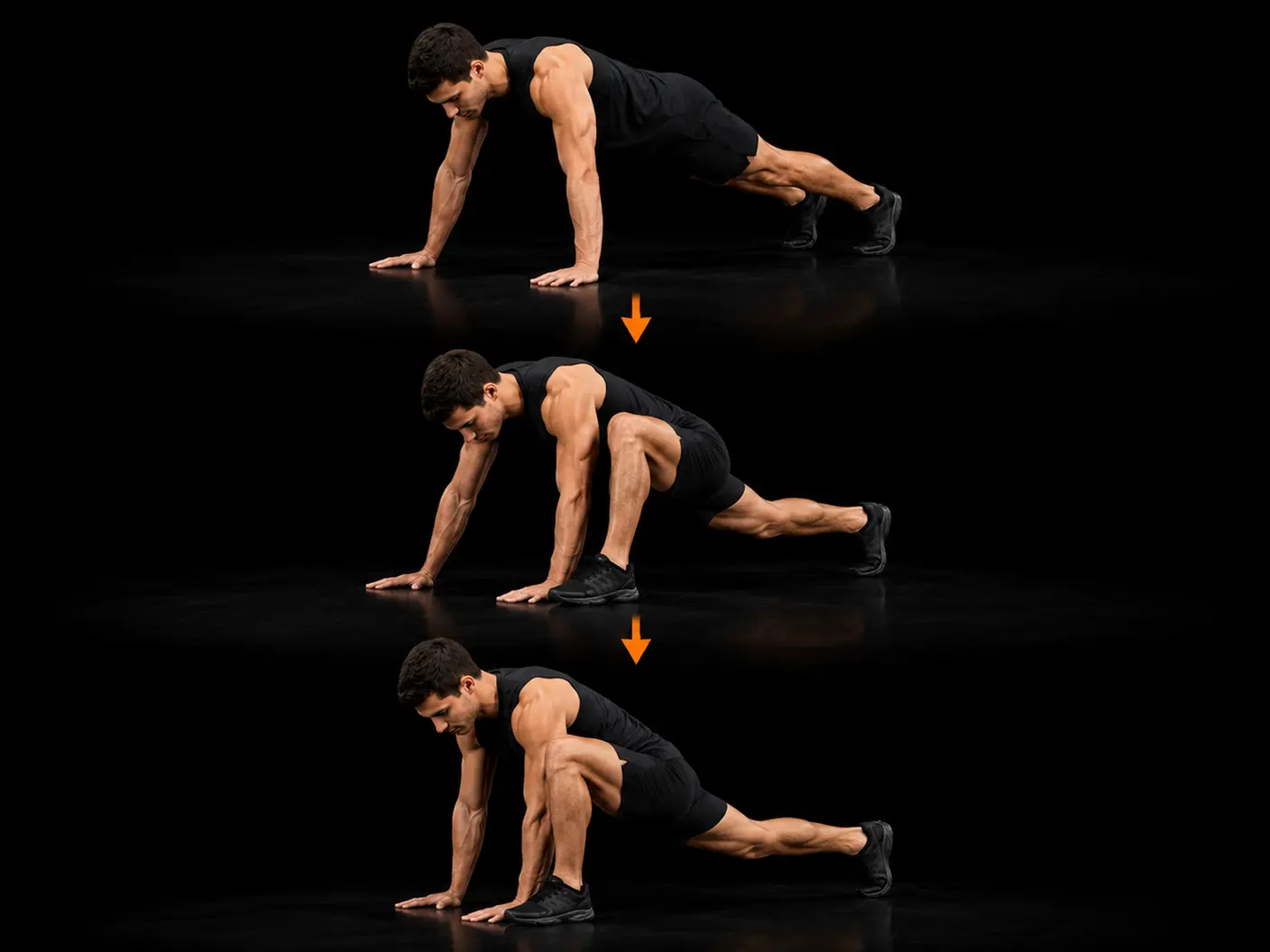
The Spiderman lunge is a bodyweight mobility drill that combines a deep hip flexor stretch with thoracic rotation, training the body to move through multiple planes simultaneously. Starting from a plank position, you step each foot outside the same-side hand and reach toward the sky, cycling through a sequence that challenges hip range of motion and upper-back rotation in a single pattern. It suits a wide range of trainees, from those building foundational movement quality to athletes looking to maintain mobility under a training load.
How to do it
Start in a push-up or plank position. Step one foot forward and place it outside the same-side hand. Drop the back knee toward the floor. With the hand on the same side as the forward foot, reach toward the sky, rotating the thoracic spine. Return the hand to the floor and repeat on the other side, stepping the opposite foot forward.
Coaching cues
- Foot outside the hand
- Hip sinks toward the floor
- Rotate and reach to the sky
- Alternate sides
Why train it
- It stretches the hip flexors and adductors through a deep, weight-bearing position that translates directly to athletic and everyday movement patterns.
- The thoracic rotation component encourages upper-back mobility, which supports posture and reduces compensatory strain elsewhere in the spine.
- As a bodyweight drill requiring no equipment, it integrates easily into warm-ups, cool-downs, or active recovery sessions without disrupting programme structure.
- Training both hips and the thoracic spine within a single flowing sequence makes it time-efficient for athletes who need to address multiple mobility demands simultaneously.
Common mistakes
- Allowing the front knee to drift inward — keep it tracking in line with the foot as you settle into the lunge position.
- Failing to sink the hips toward the floor — consciously drop the pelvis down rather than keeping it elevated, which is where the hip flexor stretch actually occurs.
- Cutting the thoracic rotation short — extend the reach fully toward the sky and let the upper back rotate rather than moving only at the shoulder.
- Rushing through the alternating sequence — control each repetition and hold briefly at the end range before returning the hand to the floor and switching sides.
Primary: Hip Flexors, Adductors, Gluteus Maximus.
Secondary: Hamstrings.
Equipment
Good for
Easier variation
Static hip flexor stretch — hold the lunge position without the rotation.
Similar movements
Frequently asked
- What muscles does the Spiderman lunge work?
- The primary muscles targeted are the hip flexors, adductors, and glutes. The thoracic rotators and hamstrings are also engaged as secondary muscles throughout the rotation and lunge pattern.
- How many sets and reps should I do?
- For a warm-up or mobility circuit, 2–3 sets of 5–8 repetitions per side is a practical starting point. The goal is quality of movement and end-range control rather than accumulating volume.
- When in a session should I programme the Spiderman lunge?
- It works best at the start of a session as part of a dynamic warm-up, particularly before lower-body or full-body training where hip mobility and thoracic rotation are relevant. It can also be used in active recovery or between heavier working sets.
- Is the Spiderman lunge suitable for beginners?
- Yes — it is classified as a foundational movement, so it is appropriate for those new to structured training. If you find the full thoracic rotation difficult initially, focus on the hip position first and add the reach as your range of motion develops.
- What are good alternatives to the Spiderman lunge?
- If you are looking for movements that address similar hip flexor and mobility demands using only bodyweight, a standard kneeling hip flexor stretch or a world's greatest stretch are comparable options. The Spiderman lunge is distinctive in combining the hip and thoracic elements together, so alternatives may need to be paired to replicate both demands.
Want this movement in a plan built for you?
Adaptiv programmes the right exercises for your goal, equipment and experience — then adapts them as you train.
Build my programme