Pigeon Stretch
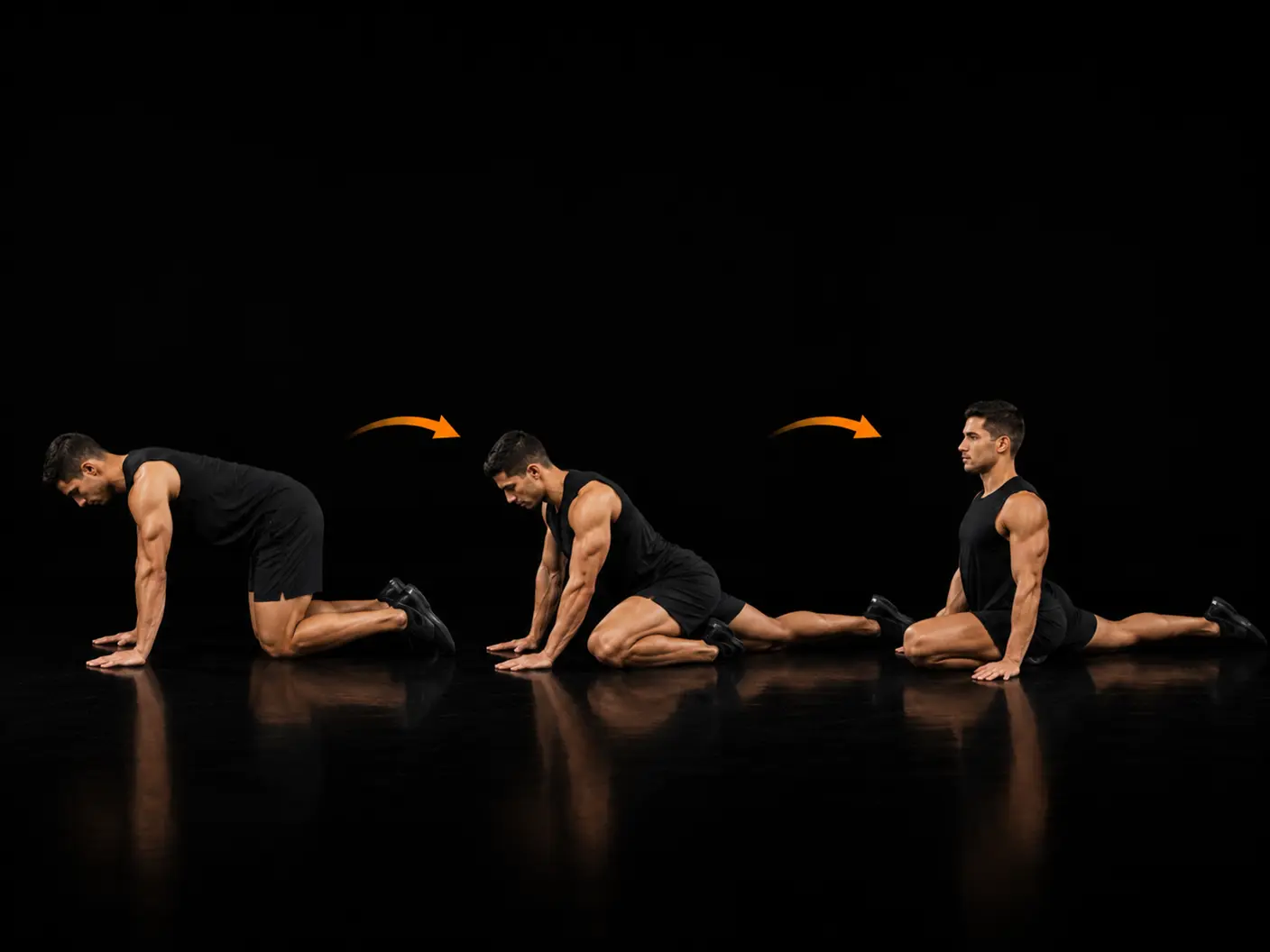
The pigeon stretch is a static hip mobility exercise derived from yoga that targets the deep external rotators of the hip, primarily the piriformis and surrounding glute tissue. It trains the pattern of hip external rotation and flexion simultaneously, making it effective for addressing tightness that accumulates through prolonged sitting or repetitive athletic loading. It suits anyone from general fitness participants to athletes looking to maintain or restore hip range of motion.
How to do it
From a downward dog, bring one shin forward and set it on the mat at an angle in front of the hips. The front shin is roughly parallel to the front of the mat; the back leg extends straight behind. Lower the hips toward the mat. The pelvis should be square and level. Hold for 30–90 seconds. Optionally fold forward to deepen the stretch.
Coaching cues
- Front shin angled
- Hips square
- Breathe into the stretch
- Do not force the hip down
Why train it
- Directly targets the piriformis and hip external rotators, muscles that are commonly restricted and difficult to load through conventional strength work.
- The extended hold of 30–90 seconds allows the nervous system to gradually reduce tension in the target tissue, supporting meaningful improvements in hip mobility over time.
- Squaring the pelvis during the stretch ensures both sides of the hip are addressed evenly, which can help identify and reduce asymmetries between left and right.
- Its low technical demand makes it accessible at any training level, fitting naturally into warm-up, cool-down, or dedicated mobility sessions.
Common mistakes
- Letting the hips rotate and tilt to one side — keep the pelvis square and level throughout the hold so both hip crests remain at the same height.
- Forcing the front shin parallel to the mat before the hip has the range to support it — allow the shin to sit at whatever angle keeps the pelvis square, and let range develop progressively.
- Holding the breath and bracing through the discomfort — breathe steadily and direct your exhales into the area of tension to encourage the tissue to release.
- Collapsing the torso onto the mat before establishing a stable pelvic position — settle the hips first, then fold forward only if the pelvis remains level and the back leg stays straight.
Primary: Hip External Rotators, Gluteus Maximus.
Secondary: Hip Flexors, Adductors.
Equipment
Good for
Easier variation
Supine piriformis stretch (figure-4 stretch) — same target lying on the back.
Similar movements
Frequently asked
- What muscles does the pigeon stretch work?
- The primary muscles targeted are the piriformis, glutes, and hip external rotators of the front leg. The hip flexors of the back (contralateral) leg and the groin are also placed under a secondary stretch as the back leg extends behind the body.
- How long should I hold the pigeon stretch?
- A productive hold falls between 30 and 90 seconds per side. Shorter holds tend to be insufficient for the nervous system to begin releasing tension, so aim for at least 30 seconds before progressing to the next side.
- How often should I include this stretch in my programme?
- For general hip mobility maintenance, two to three sessions per week is a reasonable starting point. Athletes with notable hip tightness or those in heavy training blocks may benefit from including it daily, particularly in cool-down work.
- Is the pigeon stretch suitable for beginners?
- Yes — it is classified as a foundational movement, meaning no prior mobility experience is required. Beginners may find the front shin sits at a sharper angle rather than parallel to the mat, which is entirely appropriate; the position should match current range of motion rather than an ideal end position.
- What are good alternatives if I cannot get into the pigeon stretch comfortably?
- A supine figure-four stretch, also known as a lying glute stretch, targets similar musculature while keeping the pelvis supported on the floor, which removes much of the positional demand. It is a practical starting point if squaring the hips in the pigeon position proves difficult.
Want this movement in a plan built for you?
Adaptiv programmes the right exercises for your goal, equipment and experience — then adapts them as you train.
Build my programme