Hip CAR (Controlled Articular Rotation)
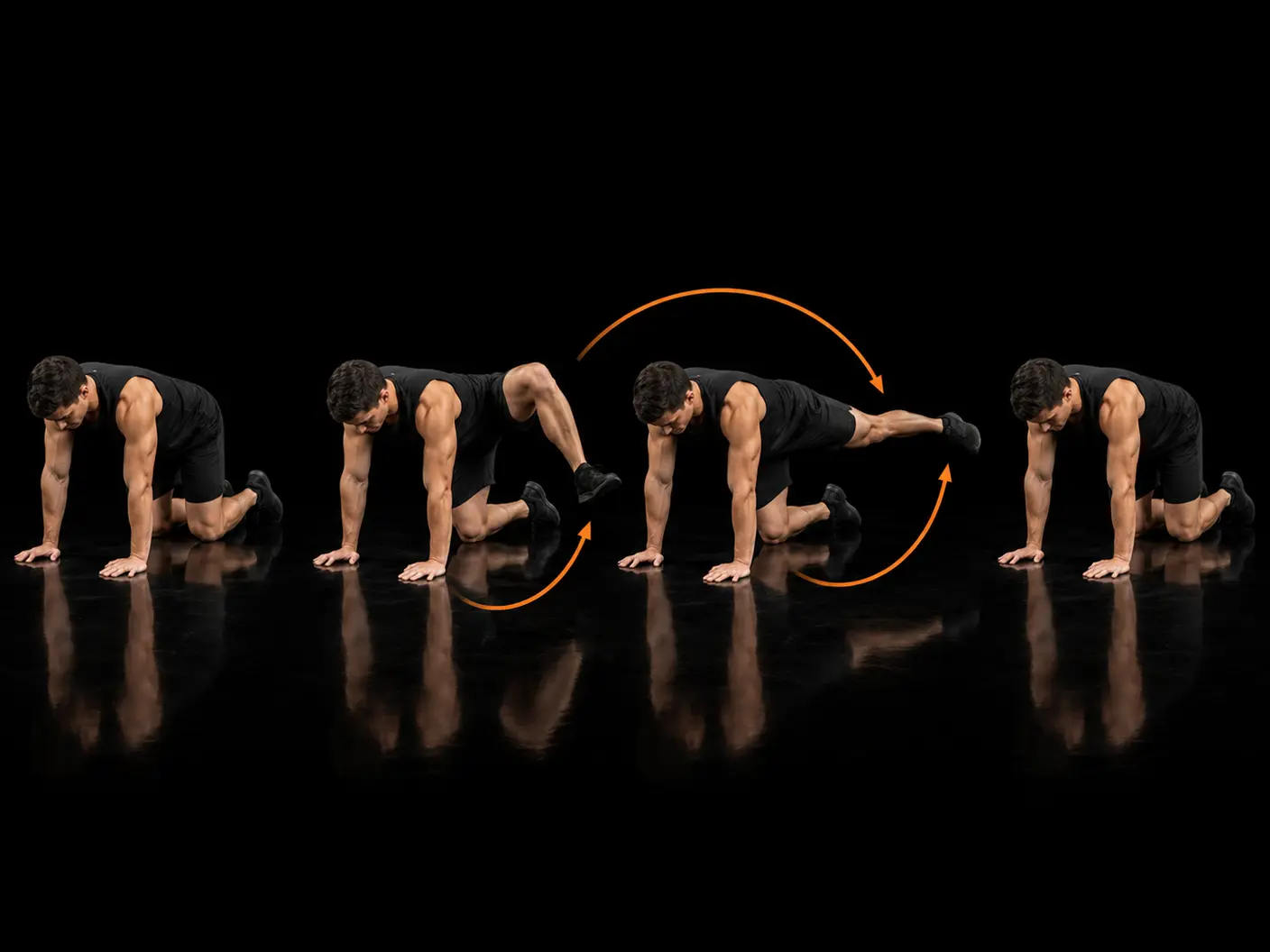
The hip controlled articular rotation (CAR) is a single-leg mobility drill that takes the hip joint through its full available range of motion in a slow, deliberate circle. It trains active control of the hip capsule rather than passive flexibility, meaning the nervous system learns to own the ranges it already has. It suits athletes, general fitness clients, and anyone looking to build or maintain healthy hip function.
How to do it
Stand tall, one hand on a rack for balance. Lift one knee forward to 90°. Circle the knee out to the side; push the knee as high and as wide as possible. Continue the circle back and down. Reverse the direction. Move with maximal effort and control at the outer range.
Coaching cues
- Full range
- Maximum effort
- Slow and controlled
- Fight for the end ranges
Why train it
- Regular practice reinforces active control at the end ranges of hip motion, which passive stretching alone cannot achieve.
- The standing position requires the core and hip stabilisers to work simultaneously, building joint integrity alongside mobility.
- Moving through the full circle in both directions addresses rotational capacity that most gym programmes leave untrained.
- Because it requires no equipment, it integrates easily into a warm-up, cool-down, or daily movement practice.
Common mistakes
- Rushing through the top and back of the circle — slow the movement down deliberately at every point, especially where control feels weakest.
- Letting the standing hip hike or the torso lean to compensate — keep the pelvis level and the trunk upright throughout the entire rotation.
- Using momentum to swing the knee rather than muscular effort — treat each degree of the arc as a controlled, active contraction.
- Stopping short of genuine end range — push the knee as high, as wide, and as far back as the joint will allow with maximum voluntary effort.
Secondary: Gluteus Maximus, Rectus Abdominis.
Equipment
Good for
Easier variation
Reduced range — work what is currently available.
Similar movements
Frequently asked
- What muscles does the hip CAR work?
- The primary target is the hip capsule itself, trained through active loading at end range. The glutes, core, and hip stabilisers all contribute to controlling the movement and keeping the pelvis stable throughout the circle.
- How many sets and reps should I do?
- Two to three sets of three to five slow rotations in each direction per side is a practical starting point. Quality matters far more than volume here — one well-executed repetition at genuine end range is more useful than ten rushed ones.
- When should I programme hip CARs — before or after training?
- Hip CARs work well as part of a warm-up because they prime the joint and the nervous system before loading. They can also be used as a daily maintenance drill on rest days, particularly for those who spend long periods seated.
- Are hip CARs suitable for beginners?
- Yes — they are rated as a foundational movement and require only bodyweight. A rack or wall for balance support makes them accessible regardless of experience level, though beginners may find their active range is initially limited.
- What exercises are similar to the hip CAR?
- Hip 90/90 transitions, fire hydrants, and standing hip circles address overlapping ranges, though none replicate the full-circle, maximal-effort emphasis of the CAR. If you are managing a specific hip condition, speak with a qualified professional before substituting movements.
Want this movement in a plan built for you?
Adaptiv programmes the right exercises for your goal, equipment and experience — then adapts them as you train.
Build my programme