Cossack Squat
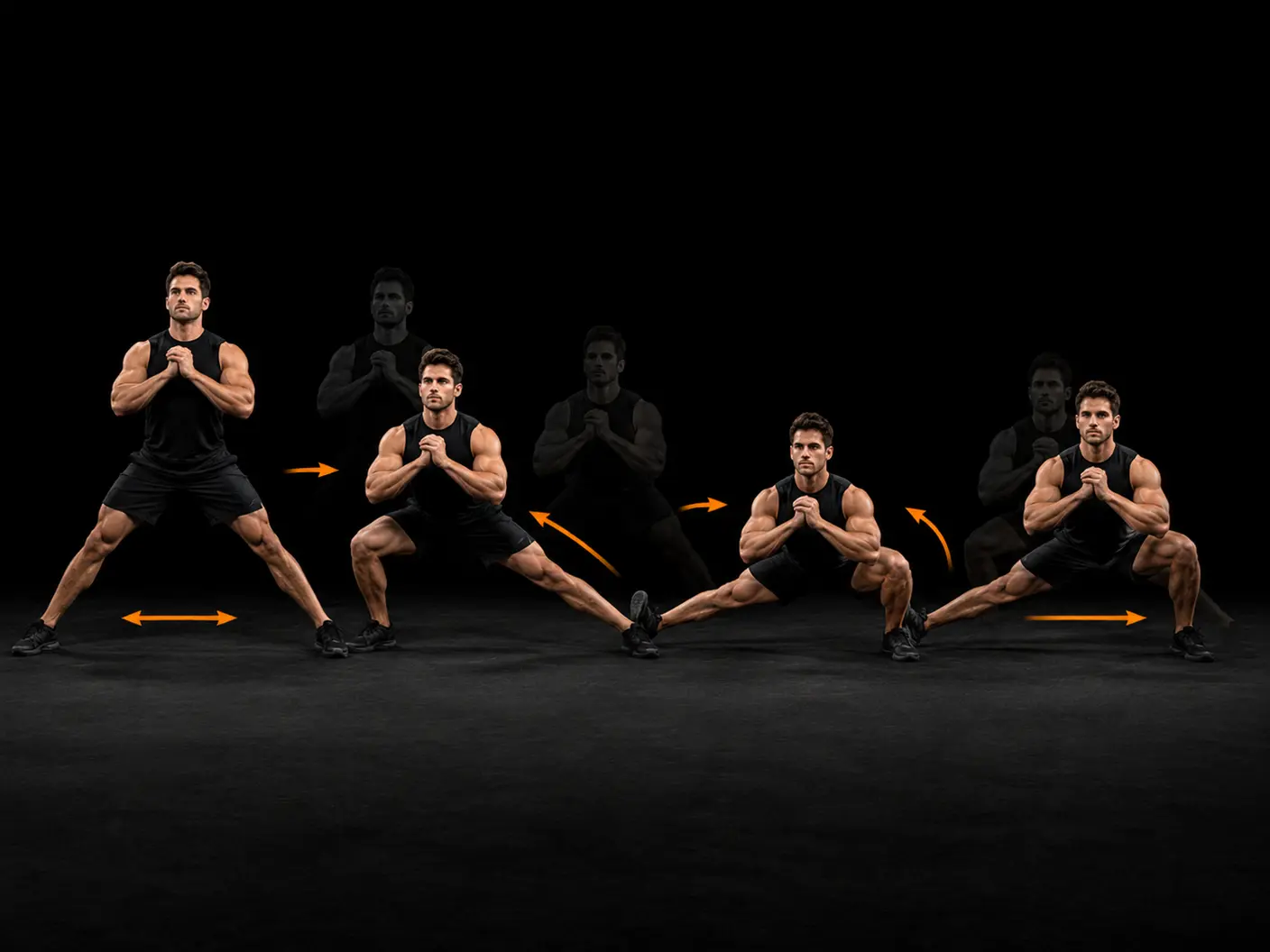
The cossack squat is a lateral loading pattern that trains single-leg strength through a deep, side-to-side squatting motion. It challenges hip mobility, adductor length, and gluteal control simultaneously — qualities that most conventional bilateral squats leave undertrained. It suits intermediate lifters looking to address lateral movement competency, whether for athletic performance or general functional fitness.
How to do it
Stand in a very wide stance, feet turned slightly out. Shift the weight onto one leg and sit deep on that side; the other leg stays extended straight, toe pointed up. The working foot stays flat. Return to centre; switch sides.
Coaching cues
- Wide stance
- Full hip depth
- Extended leg stays straight
- Flat working foot
Why train it
- It develops strength through the adductors and glutes across a large range of motion, making it particularly useful for athletes who need to produce force in lateral or change-of-direction movements.
- The requirement to keep the extended leg straight and the working foot flat places meaningful demand on hip and ankle mobility, improving both over time with consistent practice.
- As a compound movement that loads multiple joints through deep ranges, it builds movement quality that transfers directly to sport and daily activities involving wide, low positions.
- It can be performed with bodyweight alone or loaded with a kettlebell, making it accessible across training environments and easy to scale as competency improves.
Common mistakes
- Lifting the heel of the working foot — consciously press the entire foot into the floor throughout the descent to maintain stability and full muscular engagement.
- Allowing the torso to collapse forward excessively — maintain an upright chest by bracing the core and thinking of sitting down between your legs rather than folding over the working knee.
- Bending the extended leg — keep it straight throughout the movement, with the toe pointing upward, to preserve adductor length and the integrity of the lateral stretch.
- Taking too narrow a stance — set up with a genuinely wide foot position before initiating the shift; insufficient width prevents you from reaching adequate hip depth on the working side.
Primary: Adductors, Gluteus Maximus, Quadriceps.
Secondary: Hip Flexors, Rectus Abdominis, Gastrocnemius.
Equipment
Good for
Easier variation
Lateral lunge — reduces depth demand.
Similar movements
Frequently asked
- What muscles does the cossack squat work?
- The primary muscles trained are the adductors, glutes, and quads of the working leg. The hip flexors, core, and calves contribute as secondary stabilisers throughout the movement.
- How many sets and reps should I do for the cossack squat?
- For general fitness and mobility, two to three sets of six to ten repetitions per side works well. Athletes programming it for performance may prefer lower rep ranges with added load, such as three to five sets of four to six reps with a kettlebell held at the chest.
- Is the cossack squat suitable for beginners?
- It is classified as an intermediate movement due to the hip and ankle mobility demands required to reach full depth safely. Beginners would benefit from building hip mobility and single-leg stability through simpler patterns before progressing to this exercise.
- Can I use a kettlebell for the cossack squat, and how should I hold it?
- Yes — a kettlebell held in the goblet position at chest height is the most common loaded variation. The counterbalance helps maintain an upright torso and can actually make achieving depth slightly easier than with bodyweight alone.
- What are good alternatives to the cossack squat?
- Lateral lunges train a similar side-to-side pattern with less hip depth required, making them a useful stepping stone. Sumo squats and wide-stance Romanian deadlifts also develop adductor and glute strength, though they do not replicate the unilateral lateral loading that makes the cossack squat distinctive.
Want this movement in a plan built for you?
Adaptiv programmes the right exercises for your goal, equipment and experience — then adapts them as you train.
Build my programme