Walking Lunge
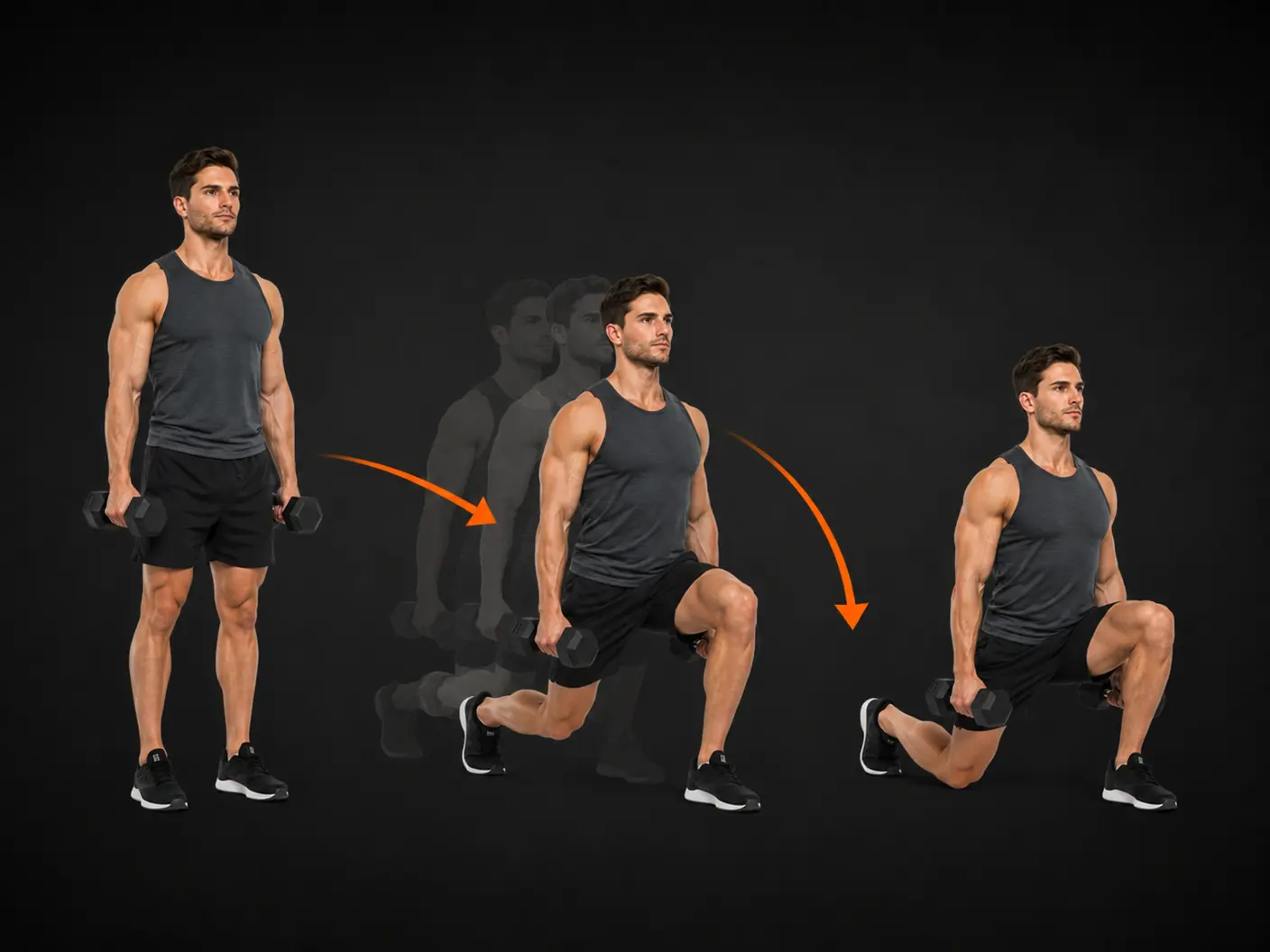
The walking lunge is a compound lower-body movement built on the lunge-split pattern, in which the lifter travels forward by stepping continuously from one long lunge into the next. It trains single-leg strength, stability, and coordination simultaneously, loading the quadriceps and glutes as primary movers with meaningful contribution from the hamstrings, adductors, and core. It suits intermediate trainees across a wide range of goals, from hypertrophy and athletic performance through to fat loss and general fitness.
How to do it
Stand tall holding dumbbells at the sides, or unloaded. Step forward into a long lunge; front shin vertical, back knee toward the floor. Drive through the front foot to bring the back leg through into the next lunge. Keep the torso upright and brace the core. Continue walking in a straight line for reps or distance.
Coaching cues
- Long stride
- Tall torso
- Front shin vertical
- Drive the floor
Why train it
- Training each leg independently exposes and corrects asymmetries in strength and stability that bilateral movements can mask.
- The continuous travelling pattern elevates metabolic demand compared with stationary lunges, making it an efficient choice when conditioning and lower-body development are both priorities.
- The requirement to maintain a tall torso and braced core throughout the movement develops functional trunk stability under dynamic load.
- Dumbbells can be added progressively as bodyweight becomes insufficient, giving the exercise a clear path of overload without specialist equipment.
Common mistakes
- Allowing the front shin to drift forward past vertical — set your stride length long enough so the shin stays perpendicular to the floor at the bottom of each rep.
- Leaning the torso forward as fatigue accumulates — keep the chest tall and the core braced for the duration of the set rather than hinging at the hip.
- Taking too short a stride, which reduces glute involvement and places excess stress on the front knee — commit to a genuinely long step with each rep.
- Letting the back knee crash to the floor — control the descent so the knee travels toward the ground with intent, stopping just short of contact.
Primary: Quadriceps, Gluteus Maximus.
Secondary: Hamstrings, Adductors, Rectus Abdominis.
Equipment
Good for
Easier variation
Reverse lunge — removes the forward momentum demand and reduces knee stress.
Similar movements
Frequently asked
- What muscles does the walking lunge work?
- The primary movers are the quadriceps and glutes, which drive the step and propel the body forward. The hamstrings and adductors contribute to hip control, while the core works continuously to keep the torso upright and stable throughout the travelling pattern.
- How many sets and reps should I do for walking lunges?
- For hypertrophy, three to four sets of ten to sixteen reps per leg — or an equivalent measured distance — at a load that makes the final reps genuinely challenging works well. For athletic performance or general fitness, two to three sets of eight to twelve reps per leg with a focus on controlled mechanics is a sound starting point.
- Can I do walking lunges without equipment?
- Yes — bodyweight is a legitimate starting point, particularly for those new to the movement pattern or returning after a break. Once technique is consistent and bodyweight feels insufficiently demanding, adding dumbbells held at the sides introduces progressive overload in a straightforward way.
- What is the difference between walking lunges and stationary lunges?
- In a stationary lunge the lifter steps forward and returns to the start position, keeping movement contained to a single spot. The walking lunge requires the back leg to drive through into the next step, which increases coordination demands, extends the set under tension, and raises overall metabolic output.
- Are walking lunges suitable for fat loss?
- Walking lunges are listed among the primary goals of this exercise for fat loss because they engage a large volume of muscle across the lower body and core in a single movement, which elevates energy expenditure relative to more isolated exercises. They are best used as part of a structured programme alongside appropriate nutrition rather than treated as a standalone solution.
Want this movement in a plan built for you?
Adaptiv programmes the right exercises for your goal, equipment and experience — then adapts them as you train.
Build my programme