Reverse Lunge
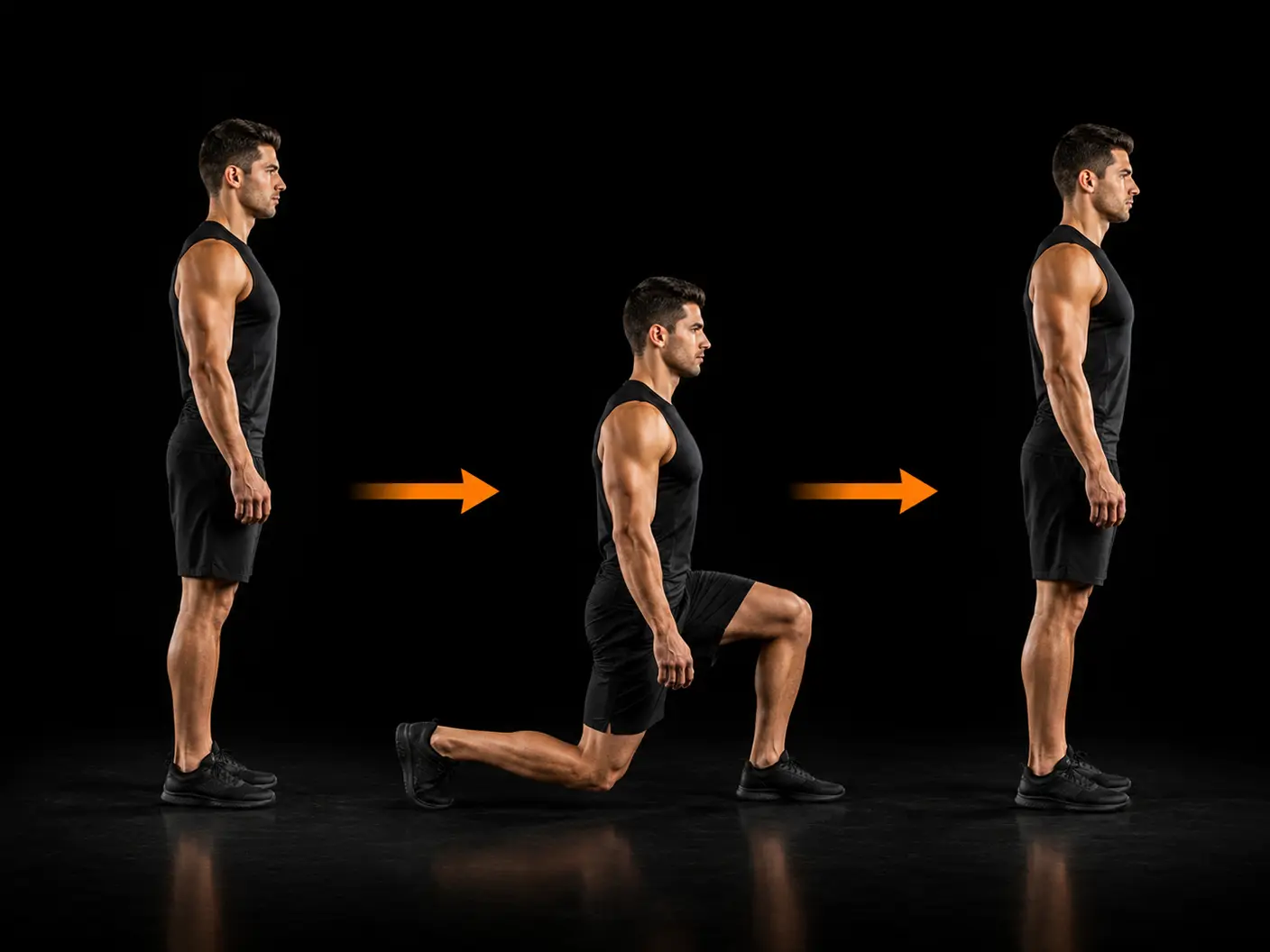
The reverse lunge is a compound lower-body exercise in which you step one foot back and lower the rear knee toward the floor, then drive back to standing through the front leg. It trains the lunge-split pattern with a strong emphasis on the quadriceps and glutes while demanding meaningful contribution from the hamstrings, adductors, and core to stabilise the movement. It suits a wide range of trainees, from those building a general fitness base through to athletes developing single-leg strength and control.
How to do it
Stand tall, feet hip-width. Step one foot directly back into a long stance; drop the back knee toward the floor. Front shin stays near vertical; front knee tracks over toes. Both knees bend to ~90°. Drive through the front mid-foot to return to the start. Alternate legs or complete all reps one side.
Coaching cues
- Long step back
- Front shin vertical
- Back knee to floor
- Drive front heel
Why train it
- The step-back mechanics place the front shin in a more vertical position than a forward lunge, reducing shear force at the knee and making load management more straightforward.
- Driving through a single front heel challenges the quadriceps and glutes through a meaningful range of motion, supporting both muscle development and lower-body strength.
- The split-stance position demands active contribution from the adductors and core to maintain alignment, building stability that transfers well to running, cutting, and other athletic movements.
- It can be loaded progressively with dumbbells once the bodyweight pattern is established, making it a reliable long-term tool for hypertrophy and athletic performance programming.
Common mistakes
- Allowing the front shin to drift forward past vertical — focus on placing the rear foot far enough back so the front shin remains near perpendicular to the floor throughout the descent.
- Letting the front knee collapse inward — actively track the knee over the second and third toes as you drive back to standing.
- Taking too short a step back — a long rear stride is necessary to achieve approximately 90° at both knees and keep the torso upright.
- Rising onto the ball of the front foot during the drive phase — press through the mid-foot and heel to fully engage the glutes and ensure a stable return to the start position.
Primary: Quadriceps, Gluteus Maximus.
Secondary: Hamstrings, Rectus Abdominis, Adductors.
Equipment
Good for
Easier variation
Static split squat — remove the stepping demand and work in a fixed stance.
Similar movements
Frequently asked
- What muscles does the reverse lunge work?
- The primary muscles are the quadriceps and glutes, with secondary involvement from the hamstrings, adductors, and core. The exact distribution shifts slightly depending on step length and torso angle, but all of these muscles are active throughout the movement.
- How many sets and reps should I do for the reverse lunge?
- For general fitness and hypertrophy, three to four sets of eight to twelve reps per leg works well. For athletic performance where power and control are the priority, lower rep ranges of four to six per leg with a deliberate tempo are more appropriate.
- What is the difference between a reverse lunge and a forward lunge?
- In a forward lunge the lead foot steps away from your base, which tends to push the shin into a more forward angle and increases demand on knee stability. The reverse lunge keeps that front shin vertical and places more of the braking demand on the rear leg, which many people find easier to control.
- Can I do reverse lunges if I have knee discomfort?
- The reverse lunge is often better tolerated than a forward lunge because of the more vertical shin angle, but if you are experiencing knee pain you should consult a qualified professional before programming it.
- What are good alternatives to the reverse lunge?
- Split squats are the closest alternative, training the same muscles in a fixed split stance without the step. Bulgarian split squats increase the range of motion and rear-leg stretch, while step-ups offer a similar single-leg pattern with a different loading profile.
Want this movement in a plan built for you?
Adaptiv programmes the right exercises for your goal, equipment and experience — then adapts them as you train.
Build my programme