Bulgarian Split Squat
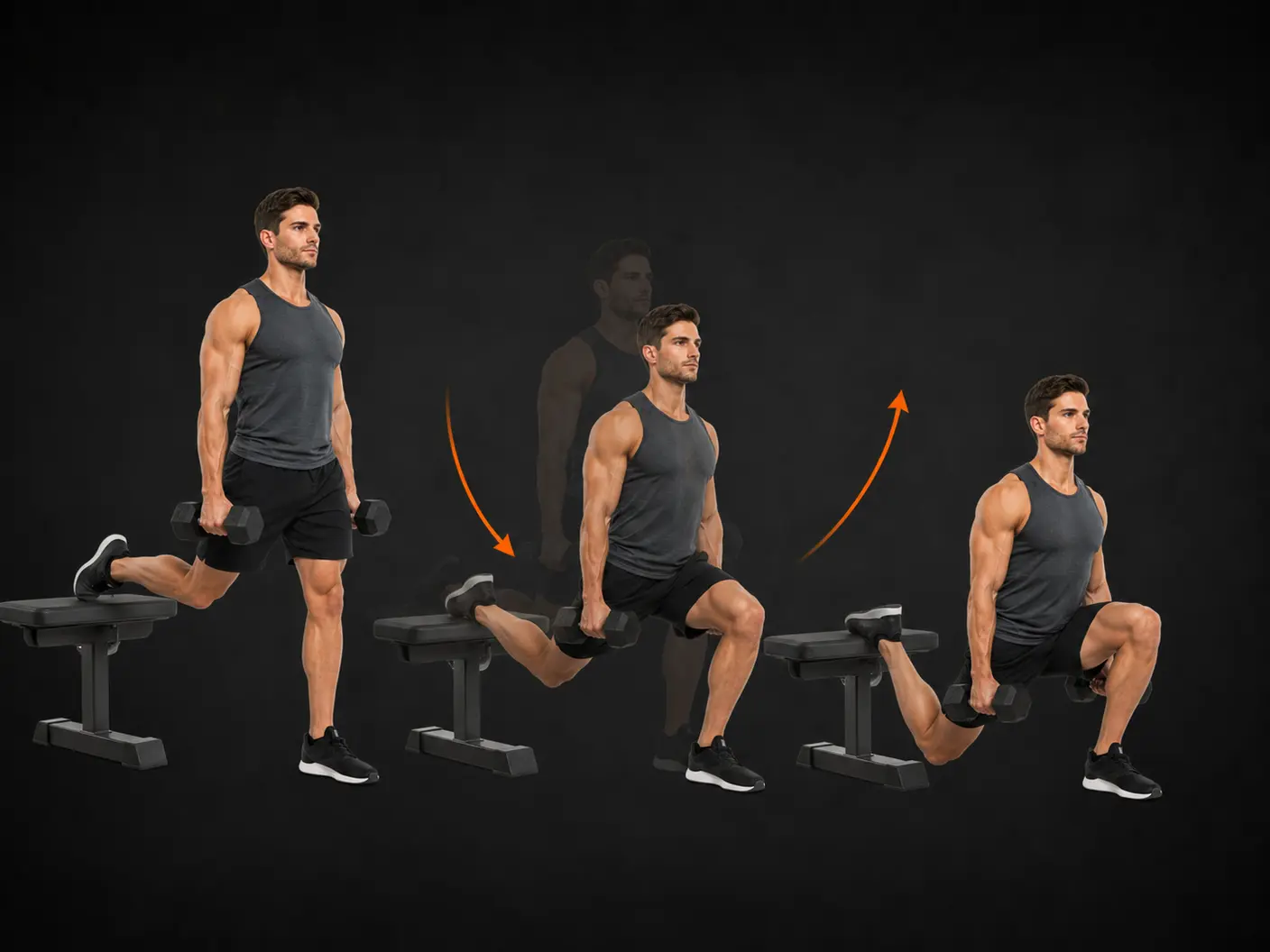
The Bulgarian split squat is a unilateral lower-body exercise in which the rear foot is elevated on a bench, placing the majority of the load through the front leg. It trains the lunge and split pattern with a greater range of motion than a conventional split squat, making it particularly effective for developing single-leg strength and lower-body muscle mass. It suits intermediate trainees who have established basic squat mechanics and are looking to address side-to-side imbalances or increase quad and glute stimulus.
How to do it
Place the rear foot on a bench behind you, laces down. Front foot is 2–3 feet ahead, shoulder-width stance. Hold dumbbells at the sides or a barbell on the back. Descend by dropping the back knee toward the floor until the front thigh is parallel. Front knee tracks over the toes; torso is slightly forward. Drive through the front foot to stand.
Coaching cues
- Weight on the front foot
- Back knee kisses the floor
- Tall chest
- Drive through mid-foot
Why train it
- Trains each leg independently, which helps identify and correct strength asymmetries that bilateral movements can mask.
- The elevated rear foot increases hip flexor stretch and range of motion at the front hip, creating a more demanding stimulus for the quadriceps and glutes.
- Because balance and stability are required throughout the movement, the core and adductors contribute meaningfully as secondary stabilisers, adding training economy to the exercise.
- It translates well to athletic performance contexts — sprinting, jumping, and change-of-direction tasks all demand single-leg force production of the kind this movement develops.
Common mistakes
- Allowing the front heel to rise off the floor — keep the weight distributed through the mid-foot and heel throughout the descent and drive.
- Letting the front knee collapse inward — actively track the knee over the second and third toes to maintain alignment and protect the joint.
- Placing the front foot too close to the bench — a stance of roughly 2–3 feet ahead of the bench allows the back knee to drop toward the floor without pitching the torso excessively forward.
- Rushing the descent — control the lowering phase so the back knee approaches but does not crash into the floor, which keeps tension on the working muscles rather than relying on momentum.
Primary: Quadriceps, Gluteus Maximus.
Secondary: Hamstrings, Adductors, Rectus Abdominis.
Equipment
Good for
Easier variation
Split squat (rear foot on the floor) — removes balance demand while preserving the unilateral pattern.
Similar movements
Frequently asked
- What muscles does the Bulgarian split squat work?
- The primary muscles are the quadriceps and glutes of the front leg. The hamstrings and adductors contribute as secondary movers, and the core stabilises the torso throughout the movement.
- How many sets and reps should I do for muscle growth?
- For hypertrophy, 3–4 sets of 8–12 repetitions per leg is a well-supported range. Choose a load that makes the final 2–3 reps genuinely demanding while allowing you to maintain clean form throughout.
- Do I need dumbbells, or can I do this with just bodyweight?
- The movement can be performed with bodyweight alone, which is a reasonable starting point for learning the balance and mechanics. Dumbbells held at the sides are the most common loading option, though a barbell on the back is also appropriate once you are comfortable with the pattern.
- What is a good alternative if I find the Bulgarian split squat too difficult?
- A conventional split squat — both feet on the floor — removes the balance demand and reduces the range of motion, making it a more accessible starting point. Once you are confident with that movement, transitioning to the elevated rear-foot variation becomes straightforward.
- Is the Bulgarian split squat suitable for fat loss goals?
- Yes — as a compound, multi-joint exercise involving large muscle groups, it has a high metabolic cost relative to isolation work. It fits productively into fat-loss programmes when paired with appropriate nutrition and training volume.
Want this movement in a plan built for you?
Adaptiv programmes the right exercises for your goal, equipment and experience — then adapts them as you train.
Build my programme