Dumbbell Split Squat
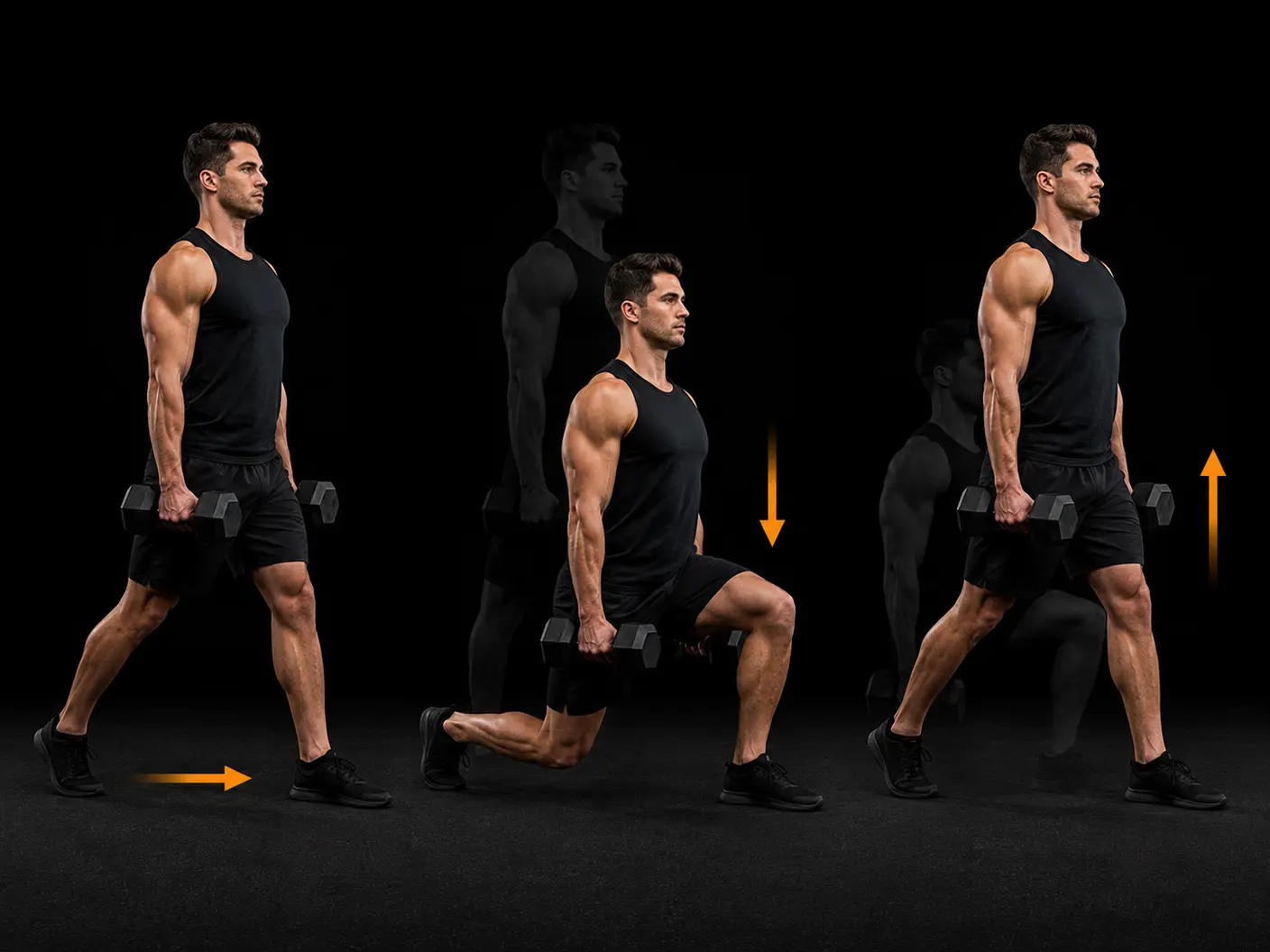
The dumbbell split squat is a unilateral lower-body exercise performed in a fixed staggered stance, training the lunge and split pattern through a controlled descent and drive. It develops strength and hypertrophy in the quadriceps and gluteus maximus while requiring the hamstrings, adductors, and core to work as stabilisers throughout the movement. The fixed stance makes it more accessible than a walking lunge, making it a practical choice for intermediate lifters building single-leg strength or addressing side-to-side imbalances.
How to do it
Stand in a split stance with the front foot 2–3 feet ahead of the back foot, both feet on the floor. Hold dumbbells at the sides. Descend by dropping the back knee toward the floor until the front thigh approaches parallel. The front shin stays near vertical; front knee tracks over the toes. Drive through the front foot to return to the start.
Coaching cues
- Back knee to the floor
- Front shin vertical
- Weight on the front foot
- Chest tall
Why train it
- Training each leg independently highlights and addresses strength asymmetries that bilateral squatting can mask.
- The movement places a significant stretch on the hip flexors of the trailing leg, making it useful for lifters who spend long periods seated and present with limited hip extension range.
- Holding dumbbells at the sides rather than loading the spine allows meaningful progressive overload with a lower technical barrier than barbell variations.
- The core and adductors are recruited continuously to stabilise the split stance, providing a secondary training stimulus without additional exercise selection.
Common mistakes
- Allowing the front shin to drift forward past vertical — position the front foot far enough ahead that the shin remains close to vertical throughout the descent, keeping load over the front foot rather than the knee.
- Dropping the back knee with a forward lean in the torso — keep the chest tall and the hips directly below the shoulders to ensure the glutes and quads bear the load.
- Placing equal weight through both feet — the emphasis should remain on the front foot, with the back foot acting primarily as a balance point rather than a secondary driver.
- Taking too short a stance so the back knee swings wide on descent — set the feet 2–3 feet apart before beginning, and check the position is correct before adding load.
Primary: Quadriceps, Gluteus Maximus.
Secondary: Hamstrings, Adductors, Rectus Abdominis.
Equipment
Good for
Easier variation
Bodyweight split squat — same pattern without load.
Similar movements
Frequently asked
- What muscles does the dumbbell split squat work?
- The primary muscles trained are the quadriceps and gluteus maximus of the front leg. The hamstrings, adductors, and core work as secondary stabilisers throughout each repetition.
- How many sets and reps should I do for the dumbbell split squat?
- For hypertrophy, 3–4 sets of 8–12 repetitions per leg is a well-established range. For strength development, 3–5 sets of 5–8 reps with heavier load is appropriate, provided technique remains consistent.
- What is the difference between a dumbbell split squat and a lunge?
- In a split squat the feet remain fixed in the same position for the entire set, whereas a lunge involves stepping into each repetition. The fixed stance of the split squat reduces coordination demands and allows greater focus on loading the front leg.
- Is the dumbbell split squat suitable for building leg size?
- Yes — the movement directly targets the quadriceps and gluteus maximus, which are the primary drivers of lower-body hypertrophy. Keeping rest periods moderate and working through a full range of motion, with the front thigh approaching parallel, will maximise the stimulus.
- What are good alternatives if I find the dumbbell split squat too difficult?
- A bodyweight split squat removes the load and allows you to focus on stance width, shin angle, and balance before adding dumbbells. If the movement still feels unstable, holding onto a fixed surface with one hand while you build confidence in the pattern is a reasonable regression.
Want this movement in a plan built for you?
Adaptiv programmes the right exercises for your goal, equipment and experience — then adapts them as you train.
Build my programme