Forward Lunge
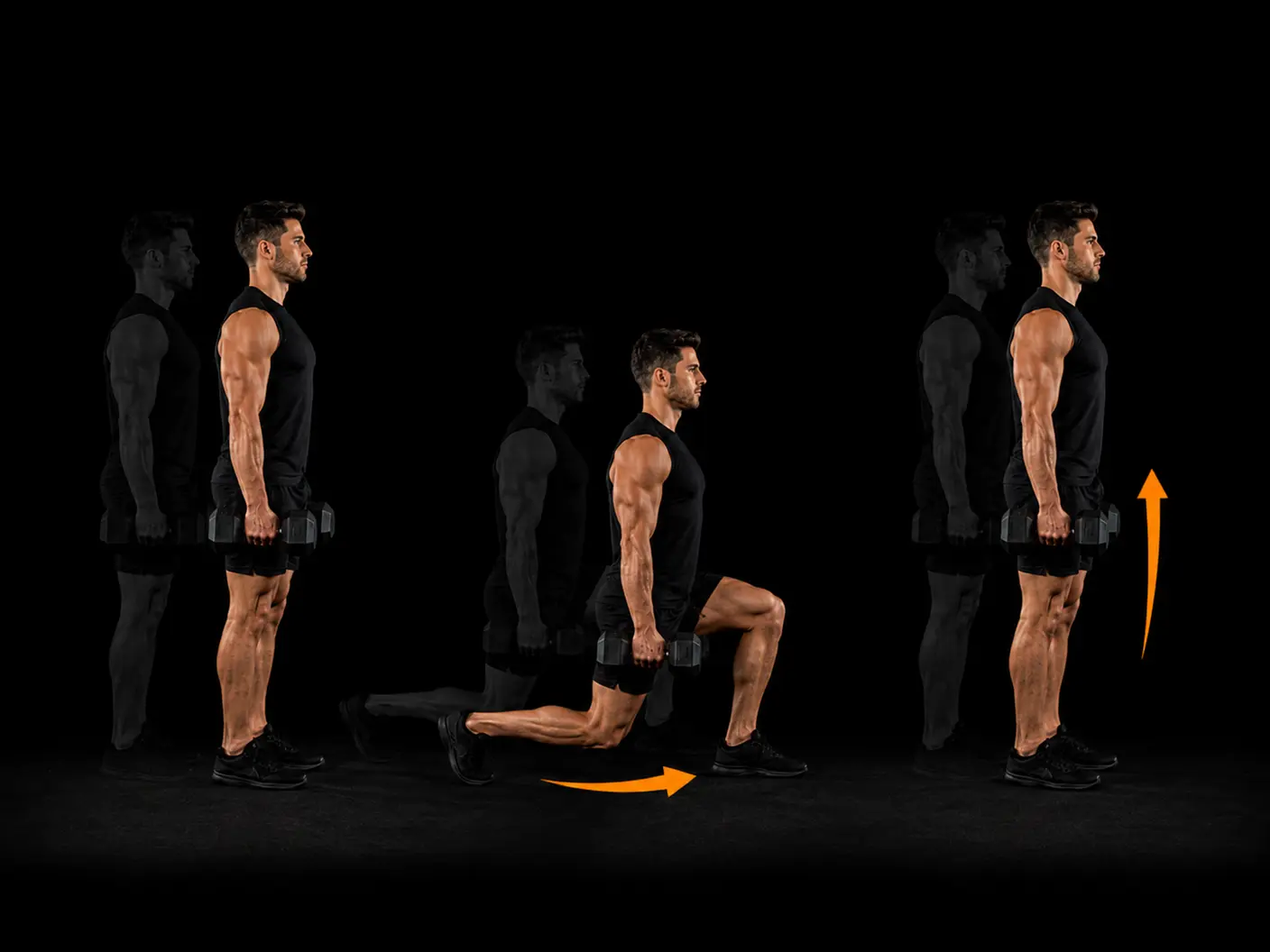
The forward lunge is a foundational compound movement in the lunge and split pattern family, training single-leg strength, balance, and coordination simultaneously. By stepping forward and lowering the rear knee toward the floor, it loads the quadriceps and glutes through a substantial range of motion while demanding stability from the core and adductors. It suits beginners learning lower-body mechanics and experienced trainees alike, and can be performed with bodyweight or dumbbells depending on the training goal.
How to do it
Stand tall, feet hip-width. Step one foot forward into a long lunge stance; front shin stays near vertical, back knee drops toward the floor. Both knees bend to ~90°. Drive through the front foot to return to the starting position. Alternate legs or complete all reps on one side.
Coaching cues
- Long step forward
- Front shin vertical
- Back knee to the floor
- Drive front heel to return
Why train it
- The forward lunge develops unilateral leg strength, addressing side-to-side imbalances that bilateral movements such as the squat can mask.
- Loading the quadriceps and glutes through a long range of motion makes it an effective choice for lower-body hypertrophy programmes.
- The dynamic stepping pattern closely mirrors athletic movements — sprinting, changing direction, deceleration — making it a practical inclusion in performance-focused training blocks.
- Because it requires no specialist equipment beyond bodyweight, it can be programmed consistently across varied training environments without compromising load progression.
Common mistakes
- Taking too short a step — lengthen the stride so the front shin remains near vertical at the bottom of the movement, rather than pitching forward over the toes.
- Allowing the torso to lean excessively forward — keep the chest tall and the spine neutral throughout the descent and the drive back up.
- Letting the front knee track inward — actively steer the knee in line with the second toe as you lower and return to reduce stress on the joint.
- Pushing off the back foot to return — drive through the front heel to stand, keeping the effort in the working leg and avoiding reliance on the trailing limb.
Primary: Quadriceps, Gluteus Maximus.
Secondary: Hamstrings, Adductors, Rectus Abdominis.
Equipment
Good for
Easier variation
Static split squat — work in a fixed lunge stance without stepping.
Similar movements
Frequently asked
- What muscles does the forward lunge work?
- The primary muscles are the quadriceps and glutes, with meaningful secondary contribution from the hamstrings, adductors, and core. The exact distribution of load shifts slightly depending on stride length and torso angle.
- How many sets and reps should I do for the forward lunge?
- For general fitness and hypertrophy, 3–4 sets of 8–12 reps per leg is a practical starting point. Athletic performance work often favours lower rep ranges of 5–8 with added load, or higher-rep unweighted sets for conditioning and movement quality.
- What is the difference between a forward lunge and a reverse lunge?
- In a forward lunge you step the foot ahead of the body, which increases demand on the front leg for deceleration and balance. A reverse lunge steps back instead, generally placing less shear stress on the front knee and making it the preferred starting point for those building confidence in the pattern.
- Can I do the forward lunge with dumbbells?
- Yes — holding a dumbbell in each hand increases the load on the working muscles without altering the mechanics of the movement. Begin with a load that allows you to maintain a vertical front shin and a controlled descent before progressing the weight.
- Is the forward lunge suitable for building athletic performance?
- The forward lunge is listed as suited to athletic performance goals and its stepping, single-leg loading pattern transfers well to sport contexts that involve acceleration and deceleration. Coaches often include it in lower-body sessions alongside bilateral lifts to develop coordination and unilateral strength concurrently.
Want this movement in a plan built for you?
Adaptiv programmes the right exercises for your goal, equipment and experience — then adapts them as you train.
Build my programme