Dumbbell Lateral Lunge
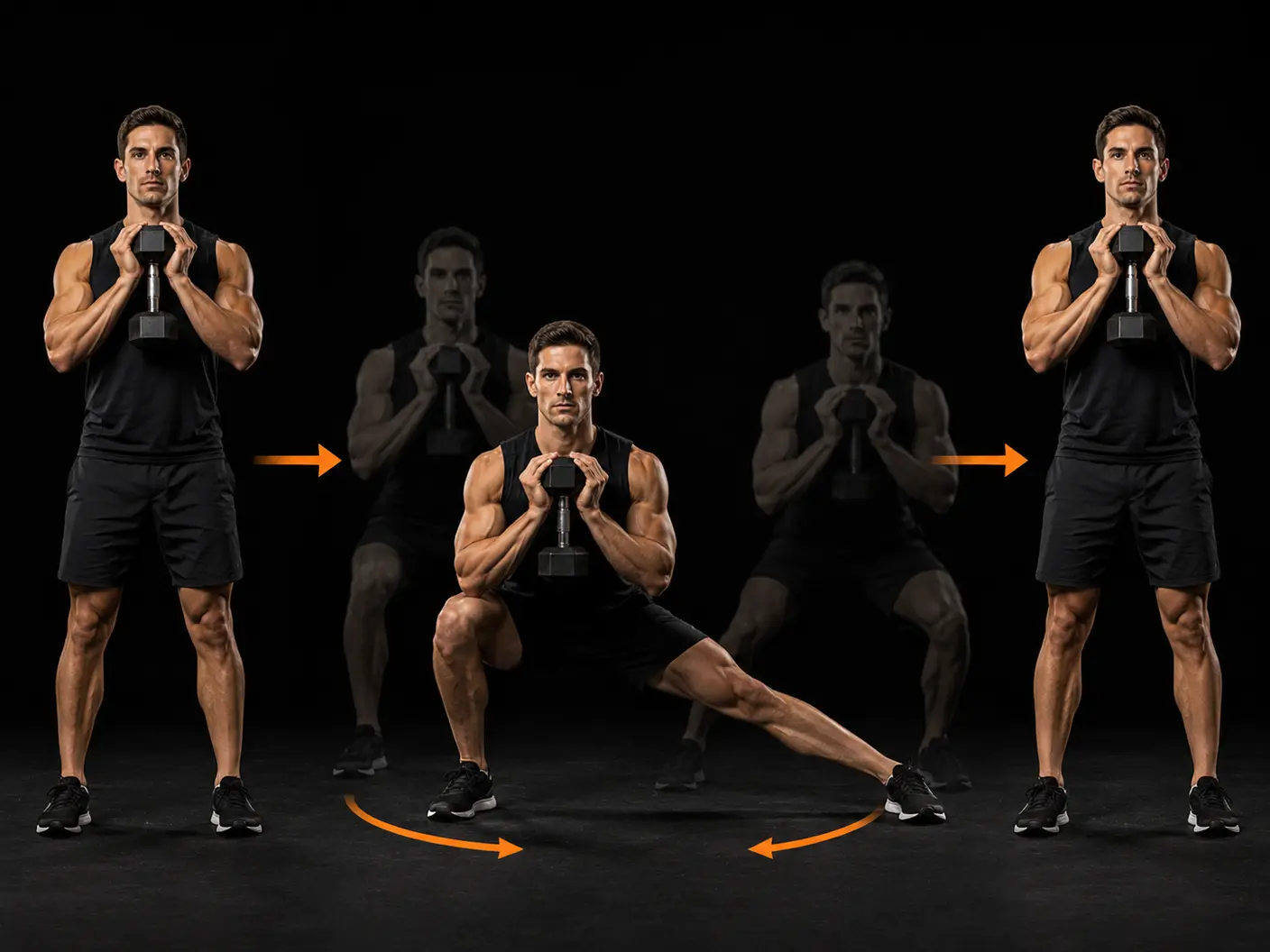
The dumbbell lateral lunge is a compound lower-body exercise that trains the frontal-plane lunge pattern — stepping out to the side rather than forwards or backwards. It develops strength and stability through the gluteus medius, quadriceps, and adductors simultaneously, making it a more complete lower-body stimulus than sagittal-plane lunges alone. It suits intermediate trainees looking to improve athletic performance, build lower-body hypertrophy, or address the lateral movement demands that standard squats and forward lunges leave undertrained.
How to do it
Stand tall holding dumbbells at the sides. Step one foot out to the side in a wide lateral stride. Push the hips back and bend the stepping knee until the thigh approaches parallel — keep the foot flat and the knee tracking over the toes. The stationary leg stays straight. Drive back through the stepping foot to return to the start position. Alternate sides.
Coaching cues
- Push hips back
- Stepping knee tracks toes
- Chest tall
- Drive through the heel
Why train it
- Develops the gluteus medius and adductors in a loaded, functional range that most conventional lower-body exercises do not adequately address.
- The single-leg loading pattern challenges hip and core stability on each repetition, reinforcing balance and coordination relevant to sport and everyday movement.
- Working one side at a time allows the body to identify and gradually reduce left-to-right strength imbalances that bilateral exercises can mask.
- The movement is easily scaled by adjusting dumbbell load or stride width, making it accessible across a broad range of intermediate training goals from hypertrophy to general fitness.
Common mistakes
- Letting the knee collapse inward on the stepping leg — focus on driving the knee out to track directly over the toes throughout the descent.
- Leaning the torso forward excessively — keep the chest tall and the spine long by pushing the hips back rather than dropping the shoulders down.
- Allowing the heel of the stepping foot to lift off the floor — keep the entire foot flat to maintain a stable base and protect the knee joint.
- Taking too short a stride — step out wide enough that the thigh of the stepping leg can approach parallel to the floor while the stationary leg remains comfortably straight.
Primary: Gluteus Medius, Quadriceps, Adductors.
Secondary: Hamstrings, Gluteus Maximus, Rectus Abdominis.
Equipment
Good for
Easier variation
Bodyweight lateral lunge — same pattern without load.
Similar movements
Frequently asked
- What muscles does the dumbbell lateral lunge work?
- The primary muscles are the gluteus medius, quadriceps, and adductors. The hamstrings, gluteus maximus, and core contribute as secondary stabilisers throughout the movement.
- How many sets and reps should I do for the dumbbell lateral lunge?
- For hypertrophy, 3–4 sets of 8–12 reps per side works well. For athletic performance or general fitness, 3 sets of 6–10 reps per side with a focus on control and range of motion is a practical starting point.
- What is the difference between a lateral lunge and a forward lunge?
- A forward lunge moves in the sagittal plane and loads the quadriceps and glutes predominantly through a forward stride. The lateral lunge moves in the frontal plane, which places greater demand on the adductors and gluteus medius — muscle groups that forward lunges largely bypass.
- Can I do this exercise without dumbbells?
- Yes — the bodyweight version is a sensible starting point if you are new to the movement pattern or working on mobility. Once you can perform the bodyweight lateral lunge with full control and a consistent depth, adding dumbbells held at the sides is the natural progression.
- Is the dumbbell lateral lunge suitable for improving sports performance?
- It is well-suited to athletic development because lateral deceleration and change-of-direction mechanics are central to most field and court sports. The exercise trains the hip abductors and adductors under load in a position that closely mirrors the demands of cutting and sidestepping movements.
Want this movement in a plan built for you?
Adaptiv programmes the right exercises for your goal, equipment and experience — then adapts them as you train.
Build my programme